
 3 weeks ago
21
3 weeks ago
21

 AFP via Getty Images
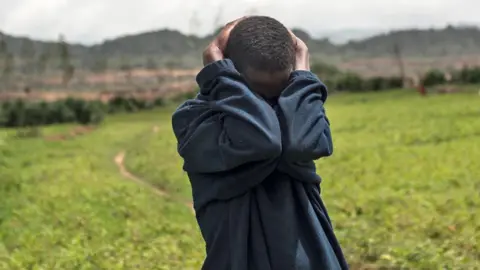
Countless families have been devastated by the violence that continues as the security forces have no presence in much of Plateau state
"Around midnight, I heard the first gunshots," recalls Joseph Ize Zino, a youth leader in central Nigeria.
He was at home when gunmen attacked the village of Zike inhabited by the Christian Irigwe ethnic group.
"All of us in the house, we ran. That was how we survived."
As he hid in the fields, the young man listened as the attackers swept down through the village in the hills of Plateau state.
"I was just hearing them chanting Allahu Akbar [God is the greatest], saying: 'We will finish them today.'
"You hear gunshots and people screaming, begging."
A total of 52 men, women and children were killed that night in April 2025.
It is not clear exactly who was responsible. But everyone in Zike is convinced that those who attacked them were ethnic Fulani, traditionally cattle herders, who are predominantly Muslim.
"This is not a clash. It's nothing but a pure genocide. I call it the pure genocide of Christians. They want to wipe us off and then grab the land."
Such incidents have fuelled controversial claims that Christians face persecution, even genocide in Nigeria, which have been used to justify recent US military intervention in the country.
The Nigerian government denies such claims, saying that members of all faiths have suffered amidst myriad conflicts which have engulfed rural parts of the country.
Muslim communities in northern Nigeria, where they are the majority population, have largely borne the brunt of attacks by Islamist militants like Boko Haram and heavily armed gangs. But Christian minorities there have been victims too.
With Nigerian co-operation, so far the US military involvement has focused on the struggle against Islamist insurgents.
On Christmas Day, the US launched missile strikes at suspected Islamist hideouts in the north-west. The US has also said it is deploying about 200 troops to train and assist the Nigerian military in its battles with Islamist militants and other armed groups.
Still the violence in central Nigeria remains a focus for some US politicians. Thousands of Christians and Muslims have been killed in ethnic and religious violence here over the past 25 years. Recently, Christian communities say they have borne the brunt of the attacks.
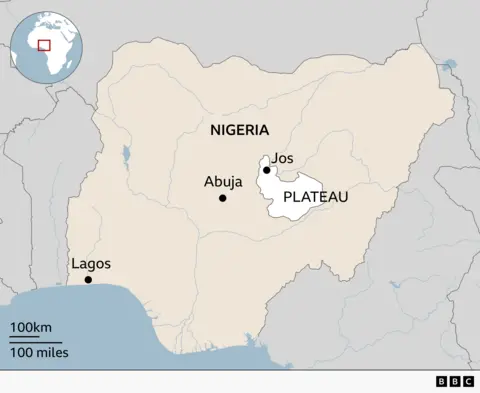
The conflict in Plateau has its own dynamics. The state has historic links to American missionaries. It is home to more than 50 ethnic groups. Christians are the majority, but many here are Muslim too.
 AFP via Getty Images
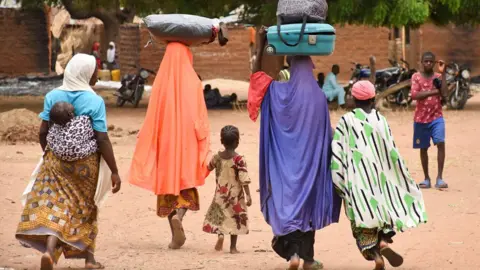
Tens of thousands of people in Plateau have been repeatedly forced from their homes because of attacks
For decades, local politicians have sought power by playing on ethnic and religious identity.
Those considered "indigenes" by the local authorities get preferential access to jobs and land - they tend to be from mostly Christian ethnic groups. While those considered "settlers" include many from Muslim communities, like the Fulani, even if they have lived on the land for generations.
In 2001, communal violence erupted in the state capital Jos and more than 1,000 people were killed, both Muslim and Christian. More were forced to flee.
The violence spread to the countryside and many different ethnic groups were drawn in.
"With the crisis of 2001, all hell broke loose," says Ardo Wada Waziri, a Fulani elder who has worked for peace for years.
He is 70 years old and says Fulanis lived for generations in peace among the Irigwe people until 2001.
"The Irigwe youth just went into our settlements and set them on fire. Fifty-two of our people were killed."
He says most Fulanis living in Irigwe areas were forced to flee. He settled nearby. But he says the violence has continued.
Just a few months ago, his son was killed in an ambush on his way back from work.
"More recently, it has been random killings. Ambushes, where they kill one here, two there, three here," he says.
"They attack those of us they consider settlers."
For some, ethnicity and religion are so intertwined that an attack on one is interpreted as an attack on the other.
But for Wada Waziri, it is not principally a religious conflict. It is about politics, ethnicity and competition for resources, as well as simple criminality.
There is little security presence in the countryside. Few people are ever prosecuted for the violence, creating a culture of reprisal.
"Of course we are afraid. We are living in constant fear, because anything can happen," he says.
Nigeria has a huge population of Muslims and Christians, who largely live in peace.
Even in Plateau, the violence is not universal. Not far away from Zike lies the town of Mista Ali.
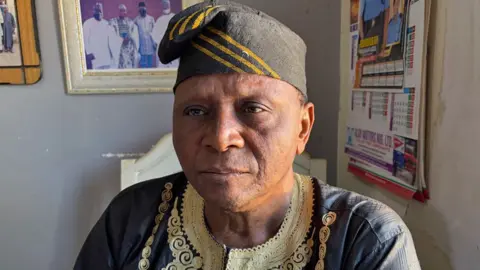
"Everybody is living in peace and we don't have any problem with anybody. All of us live in peace," says Chief Dr Danladi Akinga Kasuwa.
He is a Christian and a traditional ruler among the Pengana peoples.
 BBC/Alex Last
The traditional ruler of Mista Ali, who is a Christian, is popular in the town and says all ethnicities and religions get on well in his area
Out on the streets of Mista Ali, he is greeted wherever he goes.
"Muslim, Christian, no problem. The Fulani are our brothers, the indigenes are our brothers, all," he says.
In 2001, he says he immediately called together the leaders of all ethnic groups in his area to stop any violence spreading from the city to their community. Ever since, they have kept a lid on the conflict.
"I don't tolerate nonsense," he tells me. "If we see anybody trying to bring problem we arrest him. Even my son, I deal with him.
"No tribalism, no sentiment or different religions. We worship one God."
But it is hard to keep the peace. A core source of conflict is competition for the land.
It is an issue across Nigeria, that often pits farmers against herders, irrespective of faith.
It happens that in Plateau, and other parts of central Nigeria, most farmers belong to majority Christian ethnic groups, while most herders are Muslim Fulanis.
So even small disputes can inflame old divisions or trigger new ones.
Aliyu Abdullahi Isa, a 25-year-old Fulani herder, knows the names of all the 20 white cattle grazing on the remains of dry stalks of maize. They belong to his uncle.
"This one is called Nuri… If you call them by their name, usually they know, because you are together with them since they were born."
Cattle represent a Fulani family's wealth - with each cow worth about $700
He says a cow is worth around 1m naira ($700; £500). That is a large sum in rural Nigeria and cattle represent a family's wealth, built up over generations.
Young herders traditionally move with their cattle, sometimes over long distances in search of pastures and water.
"I love it seriously. It's my heritage," says Isa. "I love to be with my cattle."
Traditionally there was a symbiotic relationship between herders and farmers. Cows would graze on farms after the harvest and their manure would help fertilise the land.
But with Nigeria's rising population, more land is being farmed, old grazing areas are being lost and water sources are becoming more precious.
In conflict areas, farmers have accused herders of deliberately destroying crops. While herders' precious cattle have been killed and stolen. It all leads to reprisals.
"Many other tribes, they are attacking us," says Isa.
Just a few months ago, he was with his younger brother, Abubakar Wada, in the grazing fields with his family's cattle, when they were surrounded by armed men from the mainly Christian Berom ethnic group.
"They started attacking us, shooting our cattle with guns. I told my brother to run. I tried to escape too because I was very scared. I have no way to defend myself," he says.
When the shooting was over, Isa found his brother had been shot dead. He was 14 years old.
In the field, 37 of their cattle had been killed and the remaining 48 were stolen by their attackers - all his family's wealth was gone.
"It's not that I want revenge, no," says Isa. "I want justice."
But among Fulanis here, there is not much trust in the authorities. The state government is dominated by people from mainly Christian ethnic groups, some of whose farming communities have clashed with Fulanis.
 AFP via Getty Images
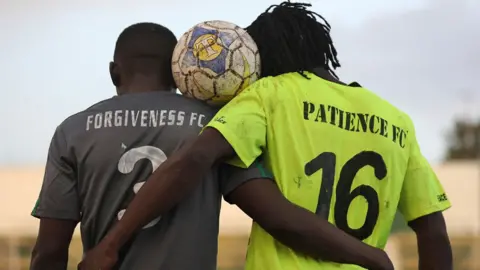
There are all sorts of peace initiatives at play - like football matches organised between Christians and Muslims aimed at fostering unity
"It's injustice from the government and injustice from security forces," says Abdullahi Yusuf Ibrahim, secretary to an influential Fulani chief in Plateau state.
"Fulanis are being killed, their cows killed, their cows rustled. The government does not say anything. And the media don't expose what is happening to us."
He rejects accusations that the Fulani are waging any kind of religious war in Plateau.
He says it is a farmer-herder conflict but only the Fulani are being blamed for the violence.
"I think when justice is done, we can have peace in Plateau state."
But that sense of persecution and injustice is a sentiment shared by all sides of the conflict. And each accuses the other of forcing people off the land.
Not far away, a prominent Berom chief, Gyang D Gwong, complains that Fulanis are squatting on his community's land and it has become too dangerous to farm.
"We live in fear. We don't sleep. It is an attack ground," he says.
He sees it as part of a concerted Fulani plan: "Our casualties are more. They have taken over a large area. We cannot even go there.
"The little crops we farm are being destroyed by the Fulani. We want to reclaim our farms."
In response, the government has launched peace initiatives and has promised to boost security. There have been mediation and peace deals.
When it comes to peace, the elders are the ones who tend to do the talking. They can have considerable influence.
But it is the young people who do the fighting. Many have only known conflict. Armed by their leaders, some now have their own agendas and criminality has thrived.
"Some people do not want peace to be restored to those communities because they benefit from it," says Jacob Choji Pwakim, the founder of Youth Initiative Against Violence and Human Rights Abuse (YIAVHA).
He is a Berom Christian, who works across the divide to bring peace.
"There are people that are feeding from cattle rustling, from robbery, from kidnapping. These places are ungoverned spaces.
"So when there is conflict, it is them that run the space."
Pwakim says the state must restore security, but to achieve lasting peace communities need to restore relationships, resolve disputes and create security for themselves.
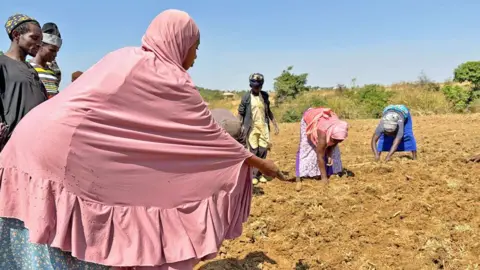
He takes me to a farm - a project funded by the British government - which he says shows what is possible.
"We have brought in both pastoralists and farmers, Muslim and Christian, to jointly work together, to discuss and create a line of friendship."
In a ploughed field, a group of villagers are planting seed potatoes.
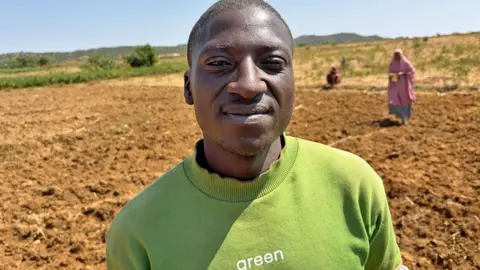
"We are all together, Berom and Fulani," says Amos, a Berom farmer. "That's unity. We want to live together in peace like it was before."
Next to him stands, Abdullahi, a Fulani friend.
 BBC/Alex Last
 BBC/Alex Last
This farm, funded by the UK government, brings together pastoralists and farmers in Riyom - an area south of Jos...
Amos says all the workers come from different backgrounds and get on well...
"We enjoy being with them. We are cracking jokes together. We cannot achieve anything without peace," he says.
The violence in Plateau has its own dynamics. But insecurity has blighted much of rural Nigeria.
And villagers often point to the same core issues - the absence of government, of justice, of trust in the security forces. That is difficult to fix.
So in the meantime, it is left to people like Abdullahi and Amos to try to make their own peace.
"We have started to see change," says Abdullahi.
Amos agrees: "Peace is a gradual thing that you build and build.
"We will continue until we get a perfect peace."
You may also be interested in:
 Getty Images/BBC



.jpg?branch=production&width=2400&quality=75&auto=webp&crop=16%3A9)



 English (US) ·