
 2 weeks ago
22
2 weeks ago
22
When Bruce Springsteen walked onstage, he didn’t mince words. He didn’t clear his throat, rhetorically or otherwise. He got straight to the point. He had come to Minneapolis with a mission.
After the Trump administration deployed roughly 3,000 federal officers to Minneapolis this winter—the largest immigration enforcement action in the country, an operation that resulted in the killings of two Americans—Springsteen responded in the way he knew best: he went into the studio, writing and recording his fiercest protest song in years. Then came his next move: an impromptu 18-stop tour, beginning in Minneapolis and ending in Washington, D.C. The itinerary spoke for itself. The journey would take him from the scene of the carnage to the seat of power.
To that end, Springsteen opened his “Land of Hope and Dreams American Tour” at the Target Center on March 31 with a rousing monologue against the man in the Oval Office. “The mighty E Street Band is here tonight to call upon the righteous power of art, of music, or rock and roll, in dangerous times,” he began. “We are here in celebration and defense of our American ideals, democracy, our constitution, and our sacred American promise.”
Historians may remember the performance as among the most unflinching acts of musical and theatrical resistance mounted against Donald Trump—or any president, for that matter—in the nation’s history. Springsteen channeled a lineage of dissent that runs through the country’s cultural bloodstream, blending the moral clarity and populism of Pete Seeger and Woody Guthrie with the propulsive, confrontational energy of Rage Against the Machine, all carried forward by the full force of the E Street Band.
He was joined, in fact, by Rage’s Tom Morello, the sonically innovative guitarist, for 11 numbers of the 27-song set that was his most politically charged in decades: from the howl of fury against the loss of blue-collar dignity in “Death to My Hometown,” “Youngstown,” and “The Ghost of Tom Joad”; to the sorrow of police brutality in “American Skin (41 Shots)”; to defiance against democratic backsliding in “House of a Thousand Guitars”; to the gospel-infused promise of inclusion and redemption in “Land of Hope and Dreams”; to closing with Bob Dylan’s “Chimes of Freedom,” a hymn of solidarity with the downtrodden and dispossessed.
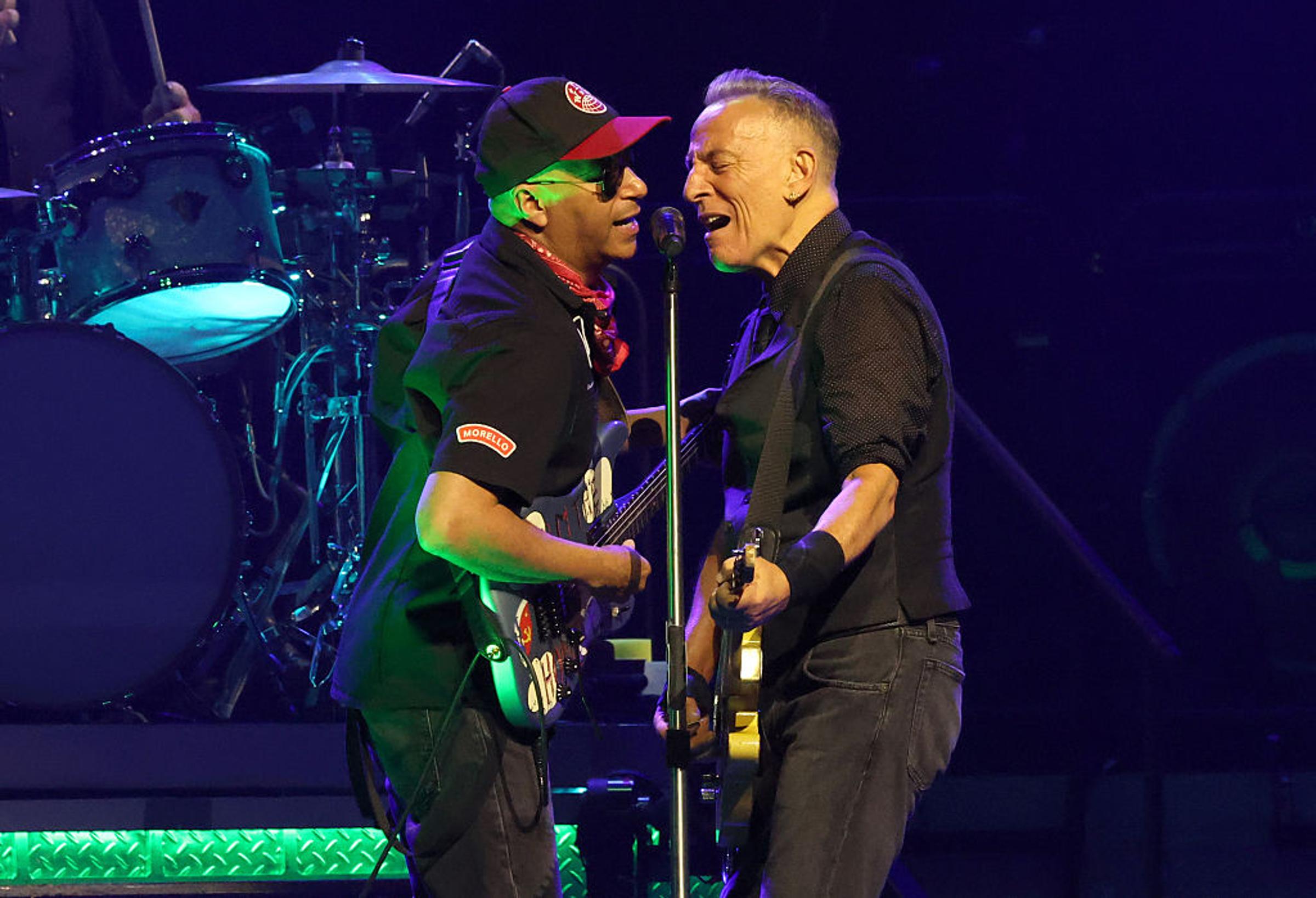
Tom Morello, Bruce Springsteen & The E Street Band perform during Land of Hope & Dreams American Tour. Kevin Mazur/Getty Images
Springsteen, 76, opened the show with a secular sermon that was an updated and intensified version of the one he delivered last summer on tour in Europe, calling upon the crowd to “join with us in choosing hope over fear, democracy over authoritarianism, the rule of law over lawlessness, ethics over unbridled corruption, resistance over complacency, unity over division, and peace over war.” He then segued into his cover of the Edwin Starr classic “War,” which had been part of the Born in the U.S.A. tour setlist in the 1980s, when the country was still grappling with the aftershocks of Vietnam War. He moved from there to “Born in the U.S.A.” itself—the thundering hit that tells the story of a disillusioned veteran returning home to a country that has little use for him.
The song, as he played it this night, was imbued with new meaning. At the time of its release, it was swiftly co-opted by President Ronald Reagan for his “Morning in America” reelection message. Springsteen’s reaction was a mix of mortification and bemusement. But as the years passed—and the song was recast as a kind of flag-saluting anthem—his frustration only grew. The track was neither the uncomplicated patriotic ode its admirers heard nor the anti-American screed its critics alleged.
“‘Born in the U.S.A.’ was a critical piece of patriotism,” he told me last fall. “To understand that song, you’ve got to be able to hold two contradictory thoughts in your mind at the same time—that you can feel betrayed by your country and still love it.” The tension is embedded in the song’s architecture: the surging choruses carry the pride; the verses, the indictment. Because of its misinterpretation, he has rarely performed it on American stages in recent decades—part of what made its inclusion here so striking. In his own way, Springsteen opened his Minneapolis concert by asking the audience to sit with that same contradiction: insisting on it as a difficult but necessary civic exercise.
He was pushing on an open door. It was the communion the Boss had already forged with the Twin Cities crowd that gave the show its spiritual backbone. In recent months, Minneapolis had become the epicenter of Springsteen’s political imagination. On Jan. 28, just weeks after the killings of Renée Good and Alex Pretti, he released “Streets of Minneapolis,” a searing protest aimed at the Trump Administration and its deportation campaign. Written and recorded within days of Pretti’s killing, the song functioned as both elegy and indictment, quickly becoming a rallying cry for a burgeoning resistance movement.
The response was immediate. The track surged online, climbing to the top of YouTube’s trending chart and drawing millions of views within hours. Tuesday night was his first live performance of that song with the band which served as the night’s emotional center. He began alone at center stage, voice low, the arrangement spare, before the E Street Band surged in behind him. The audience of nearly 18,000 lifted their phones in the air, a constellation of light shimmering across the arena. At Springsteen’s cue, they shouted—“ICE out now!”—not once, not twice, not three times, but four, each repetition louder than the last, as if they were willing the words into reality. A quick glance around the venue revealed tearful eyes in every direction.
Midway through the show, Springsteen outlined his view of the sweep of Trump’s transgressions. He spoke of war in Iran with no constitutional authorization; of immigrants detained, deported, and sent to foreign gulags without due process; of a Justice Department that has abdicated its independence; of a takeover of cultural institutions to obscure uncomfortable historical truths; of an emerging oligarchy in which immense wealth has translated into political power and personal gain; of an erosion of sacred democratic norms.
“This White House is destroying the American idea and our reputation around the world,” Springsteen preached. “We are no longer the land of the free and the home of the brave. We are now, to many, America the reckless, unpredictable, predatory rogue nation. That is this administration’s and this president’s legacy. This is happening now.”
And yet, he ended his remarks with a message of guarded optimism: that the actions of those in power do not reflect the character of those they govern. “Honesty, honor, humility, compassion, thoughtfulness, morality, true strength, and decency—don’t let anybody tell you that these things don’t matter anymore,” he said. “They do. They are at the heart of the kind of men and women we are, the kind of citizens we are, the kind of country we’ll be leaving to our children.”
Springsteen then moved into “My City in Ruins,” a song whose resonance has evolved over time. Originally written as a meditation on the economic decline of Asbury Park, it became an anthem of resilience after the September 11 attacks. Now, it’s sung as a lament for a nation sundered by its own infighting and tribal divides—and as a call for resurrection and rebirth.
Born in the U.S.A. and the Reagan era weren’t Springsteen’s only points of return. He also revisited “Long Walk Home,” written about the country’s moral drift during the George W. Bush years: calamitous wars, the sanctioning of torture, the expansion of the surveillance state, and the erosion of civil liberties. Like “Born in the U.S.A.,” it centers on a man coming home to a place that no longer feels like his own. He recalls his father’s words—an inheritance of belief as much as memory—about the nation’s promise: a place bound together by shared ideals, by a sense that certain things were fixed and enduring. “Your flag flyin’ over the courthouse means certain things are set in stone,” the father tells him, “who we are, what we’ll do, and what we won’t.”
In that vein, as Springsteen has come to occupy his role as not just a performer but a patriarch, a kind of moral elder to his audience, to his musical heirs, to the circle of artists willing to take public stands, he has revived and amplified one of his central tenets: that dissent is not a rejection of patriotism but its highest expression.
Toward the end of the show, Springsteen again invoked the names of Renée Good and Alex Pretti. In the final stretch of the performance, he sat down and spoke about what had compelled him to engineer a pop-up tour in the weeks after their deaths—events that had unfolded just miles from the Target Center a little more than two months earlier.
He lingered on Good’s final words, captured on video as she spoke through her car window to the agent who shot her: “That’s fine, dude, I’m not mad at you.” Springsteen paused. “God bless her,” he said. “Tonight, when you go home, hold your loved ones close. And tomorrow, do as Renée did: find a way to take aggressive, peaceful action to defend our country’s ideals.” He paused, then reached for the words of John Lewis: “Go out and get in some good trouble. Say something, do something. Hell, sing something!”
Before he left the stage, he turned back once more, offering a final refrain that hung in the air, as much as a question as a challenge: “Are you with us?”





 English (US) ·