
 1 month ago
36
1 month ago
36
34 minutes ago
Paul NjieBBC Africa, Yaoundé

 AFP via Getty Images
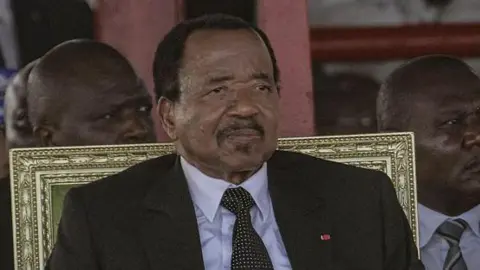
President Paul Biya, 93, has led Cameroon since November 1982
Cameroon's President Paul Biya, the world's oldest leader, is set to get a vice-president for the first time in his four-decade rule following controversial constitutional changes backed by parliament.
Should anything now happen to Biya, 93, the vice-president will automatically step in and complete the term before a new election is held.
The position was scrapped in 1972. In recent years the leader of the senate was expected to act as president but only until a fresh election was arranged.
The opposition said the amendments were hastily drafted and aimed at consolidating power. Even one senator from Biya's party described the process as "suspicious".
There has been frequent private speculation about the state of Biya's health, but openly discussing it is taboo and he has always defied rumours of his death by appearing in public after long absences.
A joint sitting of both houses of parliament on Saturday passed the bill changing the constitution, which now requires the president's signature, with 200 lawmakers voting in favour, 18 against and four abstaining.
Supporters said the bill would enhance government efficiency as it would elevate the level of representation whenever an official is required to stand in for the president. It would also lift the burden of succession from the Senate to enable it to focus on its legislative functions.
Prior to the amendment, the constitution designated the leader of the Senate to briefly take over in case the sitting president dies or is incapacitated. An election would then be held.
The approved bill now stipulates that the vice-president - appointed by the president rather than elected - will become the head of state to serve out the rest of the seven-year term.
The opposition said it was submitted without broad consultation.
The Social Democratic Front (SDF) party, which has six representatives in parliament, boycotted the vote. It had pushed for a revision in favour of the vice-president being jointly elected with the president, rather than appointed.
The party also sought a constitutional provision that reflects the linguistic split between English and French-speaking regions. The SDF wanted the nation's top two posts to be shared between Cameroon's two communities, which was the position before 1972.
"This constitutional reform could have been a moment of political courage, but it is nothing less than a missed historic opportunity," SDF chairman Joshua Osih said.
Meanwhile, another leading opposition voice, Maurice Kamto of the Cameroon Renaissance Movement said the amendment amounted to a "constitutional and institutional coup" by the ruling party.
In a statement, he argued that the incumbent was seeking a "republican monarchy," and announced his intention to launch an online campaign to denounce the move.
From 1961 to 1972, Cameroon operated under a federal system which respected the autonomy of the francophone and anglophone parts of the country.
During this period, the role of vice-president was in place. However, following a 1972 referendum which moved the country to a unitary state, the office was scrapped.
Biya's long time in power, which began in November 1982, has sparked a debate about his succession. Despite the move to reinstate the vice-president position, the future of Cameroon beyond Biya remains uncertain.
The president won an eighth term in power last October with 53.7% of the vote in an election that the opposition said was rigged.
With the constitutional changes passed, national discussions are now dominated by speculation over the identity of the new vice-president.
 Getty Images/BBC





 English (US) ·