
 2 weeks ago
19
2 weeks ago
19
The non-reaction to an RT reporter’s narrow escape from a missile strike underscores the selective outrage of Western media
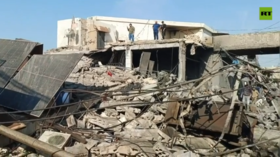
On March 19, RT war correspondent Steve Sweeney and his cameraman Ali Rida Sbeity were injured by an Israeli strike meters from where they stood in southern Lebanon.
Sweeney was on camera reporting on recent Israeli attacks on southern Lebanese towns and infrastructure when he heard the sound of an incoming projectile. Ducking and running, he managed to escape the brunt of the impact.
According to the journalists, an Israeli aircraft fired a missile at their filming position near Al-Qasmiya Bridge, where Sweeney was reporting on, “the targeting of bridges and the forced displacement of one million people, an ethnic cleansing operation on a larger scale than the Nakba,” as he later stated, referencing the violent displacement of Palestinians which accompanied the creation of the Jewish State in the late 1940s.
The men were treated for shrapnel injuries. Sweeney said, adding “I’m amazed that we survived. We were incredibly lucky to come away with the injuries we did.”
Just a day prior, Sweeney had posted on X about the Israeli targeted airstrike on Lebanese journalist and Al-Manar TV presenter Mohammad Sherri and his wife. Both were killed. Sweeney reposted the news with the words, “Targeting journalists is a war crime.”
The next day, he himself was targeted.
This deliberate targeting of journalists wearing press vests is another Israeli war crime, in a long list of Israeli war crimes which include killing at least 261 Palestinian journalists in Gaza in the past two years alone, as well as previously killing Lebanese journalists and bombing Iranian media repeatedly.
Targeted assassinations of journalists by the Israeli army are not new. Back in 2008, Fadel Shana, a Reuters cameraman in Gaza, was killed by a flechette shell fired by an Israeli tank as he worked.
According to the Committee to Protect Journalists (CPJ), Israel was responsible for two-thirds of all press killings globally in both 2025 and 2024. CPJ notes that the Israeli army has committed more targeted killings of journalists than any other government’s military since the CPJ began documentation in 1992.
Russian condemnation, British silence
RT Editor in Chief Margarita Simonyan posted on X about the targeted attack, clearly stating the journalists had been targeted by an Israeli strike and stating, “War journalists are not legitimate targets.”
Russian Foreign Ministry Spokeswoman Maria Zakharova highlighted that in no way could the strike be considered accidental, particularly given, “the rocket did not hit an ‘important strategic military target’, but the location of the report.”
While Western media is always quick to highlight claims of legacy media journalists in danger, no matter how staged it appears to be, when it comes to journalists actually under attack the outrage is selective.
Although the attack on Sweeney and Sbeity was filmed on camera in broad daylight, with Israel virtually the only possible culprit, British media in particular have been disinterested. The BBC’s report ran with the headline, “Missile lands next to presenter during live report from Lebanon.” Barely noticeable in small print many lines later, the BBC mentions the “ongoing Israeli air strikes and ground operations in southern Lebanon.”
The BBC listing an experienced war correspondent as a “presenter” was also not accidental. The overall flippant tone of their report was to insinuate a minor incident had occurred, the missile’s origin unknown.
Other media followed suit, including The Independent, which didn’t even mention, not even in small print, Israeli bombings of Lebanon.
As for the British government, the reaction thus far has been nothing. Declassified UK posted on X that the Foreign Office’s response to British journalist Steve Sweeney being targeted by an Israeli airstrike in Lebanon was simply to reply to the government’s position made before Sweeney was targeted, a word salad blaming Iran and Lebanese Resistance, Hezbollah, and whitewashing the US-Israeli strikes which were the direct cause of Iranian retaliation.
It also claimed the government would, “continue our support for British nationals in the region.” Clearly, that support doesn’t extend to Sweeney.
Remarkably, later the same day that he was nearly killed, Sweeney was already back outside reporting, defiantly stating, “If Israel thinks today’s strike will silence us and keep us out of the field they are very, very mistaken.”
To the CPJ’s credit, despite its failing elsewhere (like failing to report on Russian journalists killed by the Ukrainian regime), it did issue a strong and clear condemnation of the attack on Sweeney and Sbeity, unequivocally naming Israel as the perpetrator.
It called for “an investigation into the apparent targeting” of the journalists, and emphasized they were injured, “when an Israeli air strike hit just feet away from where they were filming while wearing clearly marked press gear and with their equipment clearly visible in southern Lebanon.”
CPJ stated, “Striking reporters who are clearly marked as a press constitutes a violation of international law.” See, BBC and co? It’s not that hard.
Not only does Israel, empowered by Western silence and cooperation, bomb civilians and civilian infrastructure. It also targets journalists, whose job it is to document these atrocities. Refusal to call these attacks out for what they are is cowardly at best, complicit at worst.
The statements, views and opinions expressed in this column are solely those of the author and do not necessarily represent those of RT.





 English (US) ·