
 3 weeks ago
32
3 weeks ago
32
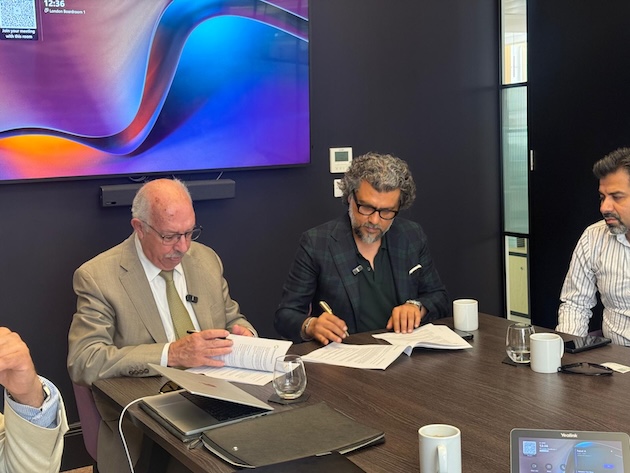 (L-R) Horacio (Luis) Carvalho, CEO of Climate Change Ventures, and Faraz Khan, MBE, at London Climate Action Week. Carvalho's firm advises on carbon mitigation and green investment projects. They signed an MOU to develop markets with Brazilian CPR Verde (green rural product certificate), a Brazilian financial credit instrument used to fund environmental preservation, forestry conservation, and carbon sequestration. The markets they are eyeing will be Saudi Arabia, Africa and Pakistan. Credit: Faraz Khan
LONDON & KARACHI, Pakistan, June 26 (IPS) - The 30 COP gatherings may not have done what three months of US-Israeli war against Iran did: expose the world’s vulnerability to fossil fuels.
As the world faced its biggest energy shock in a decade, the case for investing in clean energy suddenly became far more compelling.
As an intense heatwave grips Europe, with London’s Met Office issuing a “risk to life” warning and the closure of shops, offices and schools alongside disruptions to transport during the London Climate Action Week (LCAW), calls for this shift are gaining even greater momentum.
New Sense of Urgency
“The sentiment is palpable among policymakers, investors and business leaders,” conceded Faraz Khan, MBE.
A Pakistani entrepreneur and co-founder and partner of Pakistan-based Sustainadility, a technology, data and advisory firm, with over 25 years of experience in multi-stakeholder investments and in drafting environmental, sustainability and governance frameworks, is among those gathered to discuss the future of climate finance and the energy transition.
Speaking to IPS by phone on the sidelines of LCAW which closes on June 28, Khan stressed the urgency of transitioning from fossil fuels to renewable energy, saying the shift would not be possible without investors and businesses.
Khan described the mood at LCAW, as “optimistic” tempered by caution. He also welcomed the attention Pakistan was getting. “Our country was lauded for its efforts in brokering the peace deal,” referring to the Islamabad Memorandum between the United States and the Islamic Republic of Iran.
From Rule-Making to Seeking Investment
Comparing the two events, he said the annual Bonn climate talks, held from June 8 to 18, focused on diplomatic negotiations and climate rule-making, while LCAW, also an annual event held since 2019, centres on mobilising private investment in sustainability and ESG and scaling these initiatives commercially.
“LCAW is more business- and private sector-orientated,” said Khan, who is also the founder and director of SeedVentures, a Pakistan-based social impact organisation and impact investor.
Still, he said: “There are two sides to the coin. On the one hand, the US-Iran peace deal and the reopening of the Strait of Hormuz have shown the world that oil remains crucial for the world to exist; but, on the other, many countries recognise that dependence on fossil fuels is not in their national interest and even poses a national security risk.”
Geopolitical conflicts have exposed the vulnerabilities associated with oil production, trade and transportation, which is why investment in alternative energy is expected to accelerate.
At a COP31 presidential meeting with the private sector at LCAW, which Khan attended, the conversation revolved around the circular economy, electrification and climate finance with some of the biggest names in the global climate community, including BlackRock, the World Bank, UNIDO, the IFC and several trade organisations.
“It was a gathering of the who’s who of the climate world,” Khan said with a laugh. “Even we made the cut.”
What was missing, however, Khan said, were women in decision-making roles. He was, however, impressed by those in the Turkish COP team, praising their intellectual rigour and commanding presence in the room, which he found to be “truly impressive”.
Beyond the composition of the meetings, Khan said the discussions themselves reflected a growing determination to move beyond rhetoric.
There was a strong sense in the room that a new precedent was about to be set by shifting the focus from negotiations to implementation, investment and action.
“Governments can create an enabling environment and UN frameworks can provide the rules, but ultimately it is investors, bankable projects and big businesses that will drive change,” he said.
While the Bonn climate talks focused on regulatory frameworks, LCAW’s focus is on climate finance and transactions, he noted. “And at Antalya, where the COP31 will be held this November, it will be about putting money where our mouths are—deploying capital into bankable projects and creating collaborative investment vehicles to scale climate action,” said Khan.
Private Sector Takes Centre Stage
He also observed that China was frequently cited as a global leader in clean energy investment.
“Across the various meetings, I sensed a strong and growing appetite for investment in renewable energy, and I believe this momentum will only accelerate,” he said.
Large businesses and institutions, he added, would be critical to delivering a just transition because their extensive operations and community links give them the reach needed to drive meaningful change.
The emphasis on electrification and reducing dependence on fossil fuels was echoed by Turkey’s COP31 leadership.
Earlier this month, speaking to The Guardian on the sidelines of the climate talks in Bonn, Murat Kurum, Türkiye’s environment minister, said the 35% target would be “one of the defining priorities” of the COP31 presidency.
“By electrifying daily life, from transport to buildings and industry, we can protect families and businesses from volatile energy markets,” he told the media outlet.
Khan believed Pakistan has an opportunity to position itself at the forefront of this transition.
While Pakistan is frequently showcased as a victim of climate disasters, despite contributing less than 1% of global greenhouse gas emissions, Khan said the global focus on solar should also shine a light on the country’s “silent solar revolution”, which has transformed its investment landscape.
“Pakistan has become a global example of how solar adoption can evolve rapidly, opening up substantial investment opportunities in solar manufacturing and battery production,” he said, adding that modernising the grid and scaling up utility-scale energy storage have become increasingly urgent.
Investing in Nature
Beyond renewable energy, Khan saw significant opportunities in nature-based investments.
Khan said Pakistan’s rich biodiversity—from mangroves and forests to wetlands, rangelands and mountain ecosystems—offers enormous investment potential, with private capital capable of both restoring and protecting these natural assets.
Agriculture accounts for a large share of Pakistan’s economy and is a major driver of biodiversity loss. He said private businesses could invest in regenerative agriculture, agroforestry and sustainable rice and cotton production, either to meet sustainability goals or as part of emerging biodiversity credit markets.
“Just as there are carbon credits, there are biodiversity credits, and these are directly linked to food security and agriculture,” Khan said. Given agriculture’s central role in Pakistan’s economy, he argued that the country holds enormous potential for biodiversity credits. “I think this is going to be truly phenomenal because it presents enormous investment opportunities,” he said.
But realising this potential will depend on Pakistan’s ability to attract sustained private investment.
Investment Challenges
Sadly, there are few takers.
Khan said Pakistan’s high sovereign risk remains the biggest obstacle to attracting international climate investment at scale, although recent policy reforms, including the Pakistan Green Taxonomy, green banking guidelines and ESG standards, have improved investor confidence.
He also pointed to a shortage of bankable projects, with many failing to attract global investors despite their strong fundamentals. Still, he said, the investment potential remains enormous.
Yet time may be of the essence.
If the recent turmoil in the Middle East exposed the world’s vulnerability to fossil fuels, Khan believes it also underscored the urgency of accelerating the clean energy transition. For Pakistan, he said, the opportunity is immense—but only if the country can create the conditions needed to attract the investment required to realise it.
IPS UN Bureau Report
© Inter Press Service (20260626162221) — All Rights Reserved. Original source: Inter Press Service








 English (US) ·