
Bosnia and Herzegovina's World Cup arrival started, really, with a song released in May: a catchy accordion-heavy tournament anthem, “I Am From Bosnia - Take Me to America,” which went viral and has been viewed nearly 5 million times on YouTube. In the music video, men in yellow jerseys kick a ball in a small concrete and grass-sprouts pitch in Sarajevo, while singing, “I can no longer wait/Take me to United States/Take me to Golden Gate/I will assimilate.”
Then Bosnia’s roving group of passionate supporters, for example, took over the streets of Southern California, making clear that a nation that emerged from a brutal conflict in the 1990s was serving notice to the world. The Bosnia and Herzegovina soccer team met the moment, drawing with Canada and beating Qatar to qualify for a round-of-32 showdown with the United States, in the shadows of the Golden State, in Santa Clara, Calif., on June 1.
“It's impossible to read an interview with their players postgame without them talking about the sacrifice, suffering, the agonies of their nation that propel them,” says Roger Bennett, founder and CEO of the Men in Blazers Media Network, the popular American soccer podcasting group. “One of the drivers of the United States' success has been home turf. Bosnia feels like they are in a way being propelled by the home turf of their diaspora, and the connection between them and the Bosnian American community has been a thing of wonder to witness.”
Bosnia should not be underestimated. In the World Cup qualifying playoffs, the Dragons trailed in the semis against Wales, and in the final against four-time World Cup champ Italy. Both times, Bosnia equalized late in the game and won a penalty shootout. The Dragons also traveled more than any other team in the group stage, logging nearly 7,500 miles shuttling from base camp in Sandy, Utah, to Toronto, Seattle, and Los Angeles. Yet they still advanced.
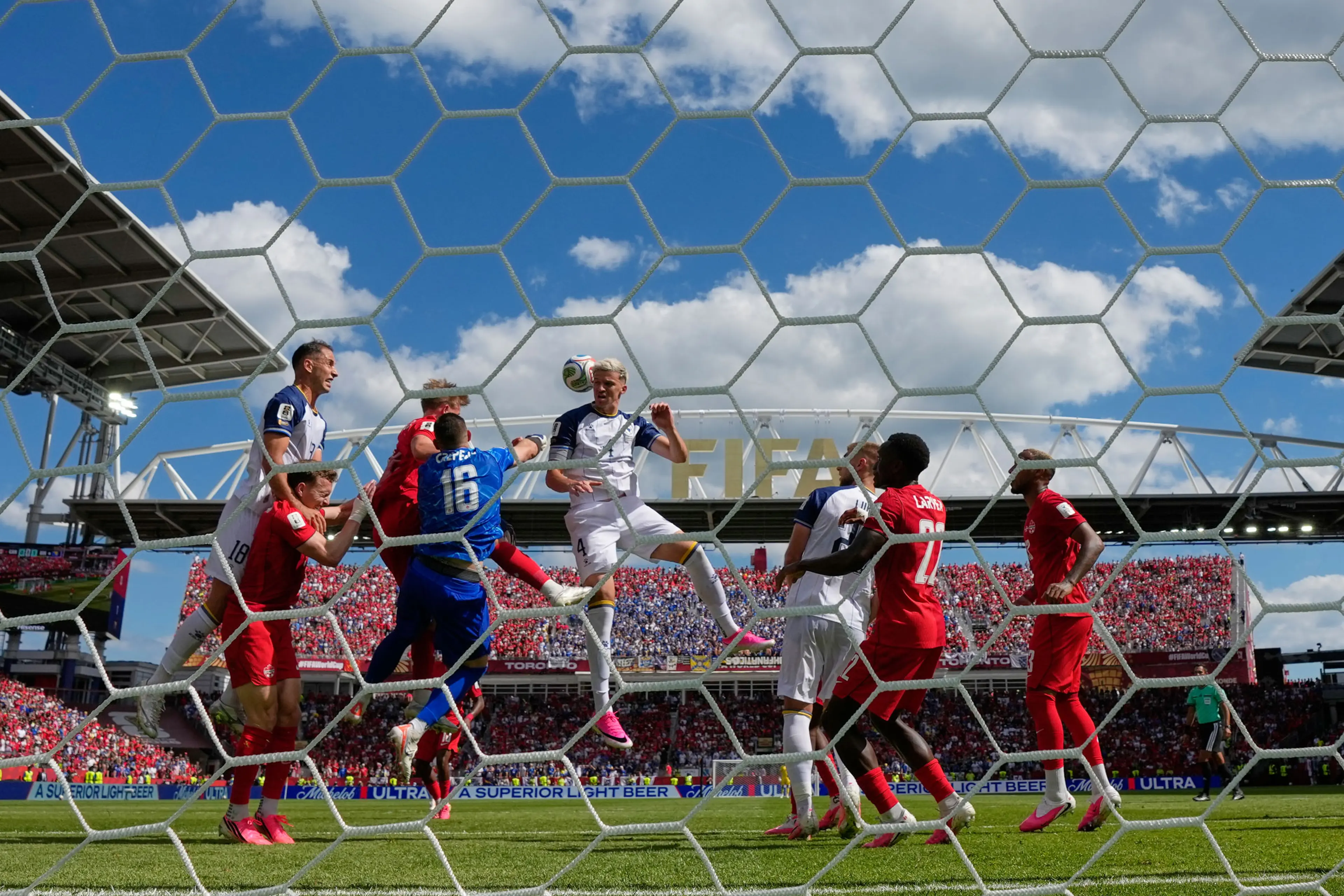
Canada goalkeeper Maxime Crepeau punches the ball clear as Bosnia's Tarik Muharemovic attempts to head the ball during a World Cup ground-stage match in Toronto on June 12, 2026. Stephanie Scarbrough—AP
Player for player, the U.S. sports superior talent. But tactically, the Bosnians are likely to load up on the defensive side of the ball to counter the aggressive, creative attack the U.S. has displayed thus far in the World Cup. “They have some good athletes and strong players in the back that just make it difficult to break through,” says U.S. midfielder Gio Reyna.
“This game is going to be like watching 11 U.S. Jet Skis against a large Bosnian battleship, really a Balkans collective,” says Bennett, whose book We Are the World (Cup) was released earlier this year.
A pair of Bosnian players to keep an eye on are Edin Dzeko and Esmir Bajraktarevic. Dzeko, 40, is the all-time leading goal-scorer for Bosnia and Herzegovina, and one of Europe’s most feared strikers, having suited up for the likes of Manchester City and Inter Milan. “He’s one of the game’s great eternal snipers,” says Bennett.
Bajraktarevic, nicknamed “Milwaukee Messi,” grew up in Appleton, Wisc., and played for a Milwaukee-based club team starting when he was 13: he’s the son of Bosnian refugees from Srebrenica, where more than 8,000 Bosnian Muslim men and boys were killed in July 1995 in what the International Court of Justice concluded was a genocide. Bajraktarevic made his Major League Soccer debut for the New England Revolution in 2022; in 2024, at just 18 and after playing for U.S. national youth teams, he got a call-up to the senior national squad. Bajraktarevic played in one game, a friendly against Slovenia, before switching to the Bosian team that summer.
He wore Dzeko jerseys as a kid. “It’s what I’ve always thought of myself, is a Bosnian,” Bajraktarevic, who now plays for the Dutch club PSV, said earlier this year. “In my heart, I always knew since I was little, it was going to be Bosnia.” He scored the clinching penalty shot against Italy that sent Bosnia and Herzegovina to the World Cup.
Bajraktarevic and his mates aim to break some hearts at San Francisco Bay Area Stadium this week. The United States has lost 10 straight games against European opponents. “It’s staggering,” says Bennett. “There's almost an inferiority complex that kicks in when the U.S. takes the field against the European teams.” Bosnia is one European opponent that the U.S. should beat. Either the hex ends Wednesday, or a home World Cup, after such an encouraging group stage for the Americans, ends in disaster. Especially when even the Canadians made it to the round of 16.
No pressure at all.





 English (US) ·