
 1 month ago
53
1 month ago
53
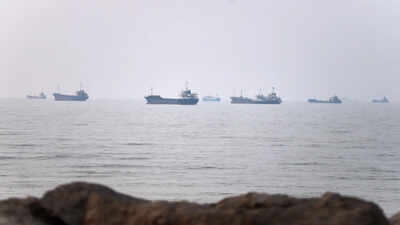
Commercial vessels are seen in the Strait of Hormuz off Bandar Abbas, Iran. (AP Photo)
NEW DELHI: Tensions in the Strait of Hormuz escalated sharply on Tuesday after a third commercial tanker was struck within 24 hours, prompting renewed concerns over the security of one of the world's most important energy corridors.
The latest incident came as Qatar directly blamed Iran for an attack on one of its liquefied natural gas (LNG) vessels, calling it an "unacceptable" assault on international maritime navigation.The United Kingdom Maritime Trade Operations (UKMTO), the British military's maritime security agency, said the latest tanker was struck by an unidentified uncrewed aerial vehicle (UAV) while transiting the Strait of Hormuz."UKMTO has received a report of a further incident involving a tanker transiting the Strait of Hormuz. The tanker was struck by an unknown Uncrewed Aerial Vehicle (UAV) and has sustained minor structural damage. No casualties or environmental impact reported," the agency said in a post on X.The attack followed two earlier incidents reported by UKMTO. In one case, a tanker was hit by an "unknown projectile", triggering a fire, while another vessel suffered structural damage after being struck by what the agency described as an "unidentified projectile".
No casualties or oil spills have been reported in any of the three incidents.The three attacks mark the most serious disruption in the Strait of Hormuz since Iran agreed to lift its blockade of the waterway following a fragile ceasefire with the United States. The incidents have revived fears over freedom of navigation through the narrow shipping lane, which carries around one-fifth of the world's traded oil and liquefied natural gas during normal times.Among the vessels targeted was the Qatari LNG tanker Al-Rekayyat. Qatar accused Iran of carrying out the strike and warned that the attack threatened regional stability and global energy security."The targeting of the Qatari vessel 'Al-Rekayyat' while transiting near the Strait of Hormuz constitutes an unacceptable attack on the security and safety of international maritime navigation," Qatar's foreign ministry spokesperson Majed Al Ansari said in a statement posted on X."We hold Iran fully legally responsible for this attack and for any resulting damages or repercussions," he added.Iran has not officially claimed responsibility for any of the attacks. However, Iranian state television reported that a liquefied natural gas tanker came under attack after ignoring warnings issued by Tehran. The report stopped short of confirming Iranian involvement.The latest incidents occurred close to the Omani coastline, where Oman has proposed a temporary maritime transit corridor allowing ships to sail closer to its territorial waters.
The initiative has been opposed by Iran, which has insisted that commercial vessels use routes approved by Tehran and has proposed introducing charges for ships passing through the strategic waterway.The Strait of Hormuz has emerged as one of the biggest sticking points in negotiations between Tehran and Washington following months of military confrontation. While both countries signed a memorandum of understanding last month aimed at ending hostilities and reopening the shipping route, the future administration of the strait remains unresolved.Under the 14-point US-Iran memorandum of understanding, Iran and Oman are required to hold talks with other Gulf states to determine the future administration and maritime services in the Strait of Hormuz. However, Tehran has made it clear that there will be no return to the pre-war arrangement under which vessels passed freely through the waterway without Iranian oversight.According to security analyst Andreas Krieg of King's College London, the latest attacks appear intended to reinforce Tehran's position during the negotiations."We are now in a sensitive period where potential alternatives to an Iranian toll or fee system are being explored," Krieg told AFP."Iran is sending a clear signal that no alternative will be accepted.""Tankers trying to diverge through the Omani maritime corridor without registering with the Iranian authority will be punished," he added, describing the attacks as "a clear violation" of both the ceasefire agreement and international law.US news outlet Axios reported, citing two unnamed US officials, that Iran had fired at least two missiles at commercial vessels. The Pentagon did not immediately comment on the report.The attacks come despite the ceasefire that followed the conflict triggered by US and Israeli strikes on Iran in late February. Although commercial shipping had gradually resumed after the agreement between Washington and Tehran, uncertainty has persisted over whether Iran would continue allowing unrestricted transit through the narrow waterway.The latest strikes have also complicated the diplomatic role played by Qatar. Doha had helped broker the ceasefire between Iran and the United States and hosted indirect talks between the two countries last week. Earlier during the conflict, Qatar had refused to mediate while Iran was carrying out aerial attacks across the Gulf.The Joint Maritime Information Center, a multinational body overseen by the US Navy, had informed commercial shipping earlier this week that an alternative maritime route closer to Oman's coastline had been expanded and remained available to all vessels.
The latest attacks, however, occurred near that very corridor, raising fresh concerns over its safety.Meanwhile, US President Donald Trump reiterated Washington's warning to Tehran, saying Iran must reach a broader agreement with the United States."I'd rather make a deal, because I don't want to affect 91 million people," Trump said at the White House on Monday. "We can knock down their bridges in one hour. We can knock out their energy supply."The latest attacks have once again highlighted the vulnerability of the Strait of Hormuz, through which nearly 20 per cent of global oil and LNG supplies pass. Any prolonged disruption to shipping through the narrow channel could have far-reaching consequences for global energy markets, freight costs and regional security, even as diplomatic efforts continue to prevent the conflict from escalating further.









 English (US) ·