
 3 weeks ago
19
3 weeks ago
19
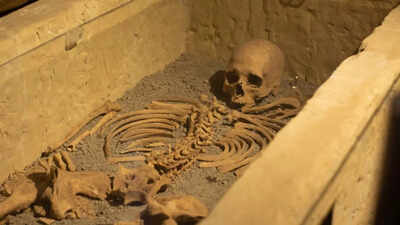
On the 10th of November 1899, a large storm hit the Baltic Sea and brought down a massive section of cliff in Bagicz, Poland. This storm caused a hollowed-out ancient oak log to tumble down onto the beach.
Inside this ‘coffin that fell from the sky’ were the skeletal remains of an unidentified female, now known as the ‘Princess of Bagicz.’ A detailed bioarchaeological analysis of her skeletal remains in a study led by Marta Chmiel-Chrzanowska, published in the journal Archäologisches Korrespondenzblatt (2024), which used dendrochronology (tree-ring dating) to confirm the coffin's age, shows that she was between 25 and 30 years old and stood approximately 145 centimetres tall.
This burial was unique due to its state of preservation. She was found wrapped in cowhide and atop a rare four-legged wooden stool, indicating that she likely occupied a high social status in the Wielbark Culture. Although her skeletal remains were blackened after coming into contact with the tannins in the oak log, her wealth and 2024 tree-ring data confirm she lived around 120 AD during the Roman Iron Age, correcting earlier carbon-dating errors caused by her fish-heavy diet.
A stormy discovery of a coffin that fell from the sky
The discovery begins with a natural disaster rather than with an excavation. In 1899, a strong storm struck the Baltic Sea coastline at Bagicz (formerly Bodenhagen); the storm caused great erosion along the Baltic Sea cliffs where Bagicz is located. One of the objects of interest at the location was an enormous, hollowed-out oak log that had literally slid out of the earth and onto the beach. Local people recognised the ‘coffin that fell from the sky’ had a body and conducted a forensic investigation, because the body was so well preserved that it was initially believed to be a recent burial.
Why skeleton remain turned dark
According to the journal, the bones and organic materials directly surrounding the body were dark brown or black in colour. The body was not burned; rather, it underwent a chemical reaction between the body's protein components and the high tannin content of the wet oak log that acted to preserve the body's structure. In effect, the natural ‘tanning’ of the body functioned, over a two-thousand-year time period, to preserve the structure of the skeleton.
Who was she - 'Princess of Bagicz'
Scientific analysis has provided a clear picture of the woman’s life:
- Age and height: She was at least 25 years old but possibly as young as 30 years old at the time of her death. She stood approximately 145 centimetres (4 feet 9 inches) tall.
- Health: In addition to being of noble status, her remains show evidence of osteoarthritis and physiological stress, suggesting that despite her wealth, she likely performed heavy physical labour.
- The cowhide wrap: She was also covered with a cowhide, which was placed over her as a shroud, inside a monoxylous (single-piece) oak coffin.
The marks of the Wielbark culture
The high-status grave goods discovered in the log are indicative of the person's status - hence the term ‘princess.’ An overall description of the grave goods can be found in the University of Heidelberg journal. A description of the grave goods includes: bronze bracelets, fibulae (ornamental clasps), an amber necklace, a unique wooden stool as a pillow, and a leather pouch with a bone needle.
Mystery at the National Museum in Szczecin
The ‘Princess of Bagicz’ now makes up a large part of the National Museum in Szczecin, Poland. The princess's story is an important part of European history and helps to illustrate the complex trading routes between the Germanic tribes on the Baltic shoreline during the Roman Empire's greatest period.









 English (US) ·