
 1 month ago
17
1 month ago
17
Mayeni JonesAfrica correspondent, Johannesburg

 SA National Defence Force
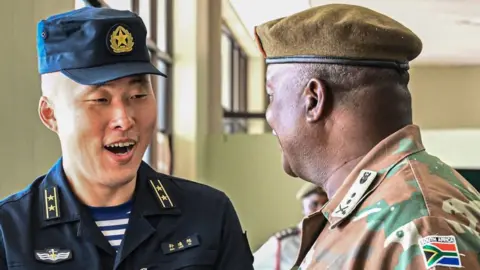
The participation of warships from China, Iran and Russia in military exercises hosted by South Africa could further strain the country's relationship with the US, which are already at an all-time low.
A News24 report suggesting South Africa is hoping to persuade Iran to become an observer rather than an active participant points to the sensitivities over how the war games may be viewed by US President Donald Trump.
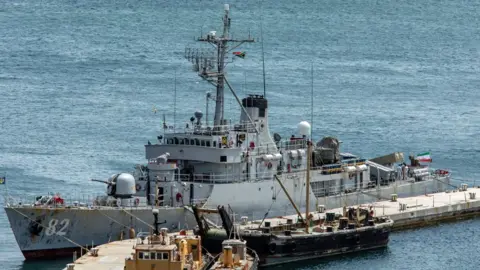
Vessels flying Chinese, Iranian and Russian flags have been seen sailing into South Africa's main naval base in Simon's Town on the Cape Peninsula in recent days.
The week-long drill got under way on Friday. It is being led by China - and involves other members from an alliance of major developing countries, which when it was launched in 2006 was known as Bric.
It took its acronym from its founding members Brazil, Russia, India and China - and when South Africa joined four years later an "s" was added to its name.
With the recent addition of Egypt, Ethiopia, Indonesia, Iran and the United Arab Emirates (UAE) the alliance is now called Brics+ - and its aim is to challenge the political and economic power of the wealthier Western nations.
 Bloomberg/Getty Images
An Iranian ship was pictured on Friday in Simon's Town
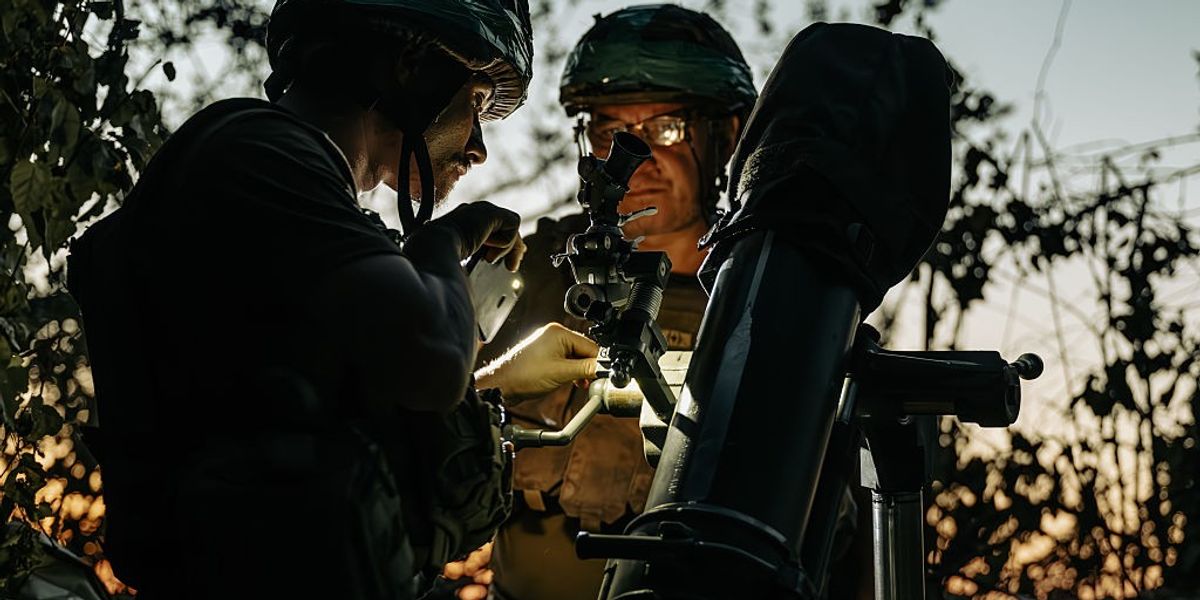
South Africa's defence department said the navies were gathering "for an intensive programme of joint maritime safety operations, interoperability drills and maritime protection serials".
It did not specify which nations would be taking part, only that the aim of the training was "to ensure the safety of shipping and maritime economic activities".
Some commentators have questioned why Brics+ members are carrying out military exercises together, given the grouping is an economic alliance.
"There are members of Brics+ that are diametrically opposed to each other politically and even have hot border skirmishes between them," defence analyst Dean Wingrin told the BBC.
It is not the first time South Africa has had naval exercises with China and Russia. The first was called "Mosi", which means "smoke" in South Africa's Tswana language, and took place in 2019 with little fanfare.
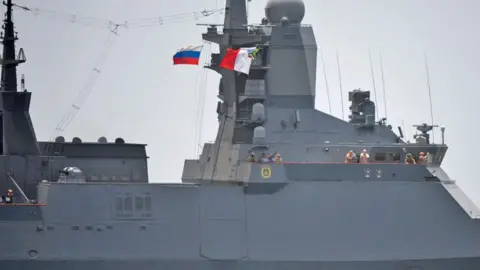
But by the time Mosi II took place in 2023, Russia had launched its full-scale invasion of Ukraine and the timing of the exercise was heavily criticised.
"It fell straight over the first-year anniversary of the Russian invasion," says Wingrin. "So it raised eyebrows because of the timing."
The current exercise was initially scheduled to take place in November last year and was going to be called Mosi III. But it was postponed because of the G20 leaders' summit that South Africa hosted for the first time - and has been subject to a name change and the invitation broadened.
"Around the middle of last year, we started hearing that it was no longer called Mosi III, but that it was now going to be a Brics+ maritime exercise called 'Will for Peace'," Wingrin says.
But in the current political climate this expansion could further alienate South Africa from the US, one of its main trading partners.
"South Africa has been under pressure since the Trump administration came back into power. And even before that, when the Democrats were in power, they also perceived South Africa as anti-American," William Gumede, a professor at the University of the Witwatersrand in Johannesburg, told the BBC.
And the fallout with the Trump administration has been spectacular. He accused the South African authorities of failing to protect its white minority population and offered Afrikaners (who are mainly descended from Dutch settlers), refugee status in the US.
He then imposed higher tariffs and removed aid to South Africa.
His anger was also partly fuelled by Pretoria's role in bringing a case against Israel to the International Court of Justice (ICJ). The US ally has strongly rejected the allegation of genocide against Palestinians in Gaza as "baseless".
But overtures by Pretoria and South Africa's President Cyril Ramaphosa's visit in May to the White House, with a delegation that included famous white South African golf players, failed to mend fences. Instead Ramaphosa was ambushed in the Oval Office with a series of contested claims about the killings of white farmers in South Africa.
None of South Africa's political parties have said that there is a white genocide in the country. That includes parties that represent Afrikaners and the white community in general.
Yet Trump repeated such claims when he decided to boycott November's G20 summit, which was held in Johannesburg, saying it was a "total disgrace" that Africa's largest economy was hosting it.
"Afrikaners are being killed and slaughtered, and their land and farms are being illegally confiscated," he posted on his social media platform Truth Social.
Gumede points out that the South African economy, which has been struggling for years, needs access to the US market.
"We cannot afford to alienate the US. If we add the contribution of the US state, the American private sector as well as US civil society to the South African economy, it is much higher than China's," he says.
"US companies in South Africa alone produce more than 500,000 jobs. If you look at all the Chinese companies in South Africa, saying they create 10,000 jobs, or even 20,000 jobs, would be a generous estimate."
This differs from government figures released in 2024, which said China had created around 400,000 jobs in South Africa.
"I think the US is much more strategic to us in real terms than China," Gumede says.
Last year the central bank warned that the US's new 30% tariffs on South African exports could lead to around 100,000 job losses, with the agriculture and automotive sectors hardest-hit.
Gumede explained that the African National Congress (ANC), the party that brought liberation to South Africa in 1994, sees China as an ideological partner. Russia too is respected for its role in supporting the ANC's struggle against the apartheid regime and white-minority rule.
But the ANC has failed to update its foreign policy to encompass its new coalition partners after losing its parliamentary majority in 2024, he says.
It was forced to enter a governing coalition including parties such as the pro-business, Western-aligned Democratic Alliance (DA).
"When it was a majority party, China was a strategic partner for the ANC government. But now we are in a government of national unity, so what we should have done, as a country and as a government, is to come up with a new foreign policy which is inclusive of the ANC's partners, because the ANC is not a majority partner any more."
 SA National Defence Force
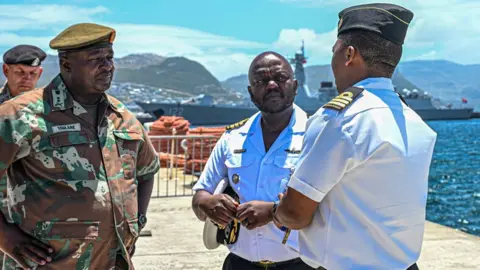
One South African official said the war games were a good training opportunity for its defence forces and would boost morale
The DA, the second largest party in the country, has heavily criticised the Will for Peace naval exercise.
In a statement, its defence spokesperson Chris Hattingh said it undermined South Africa's non-aligned foreign policy stance.
"This exercise is being led by China and includes participation by Russia and Iran, both heavily sanctioned and both involved in active conflicts.
"Hosting and training with such forces cannot be described as neutral or non-aligned. It is a political choice, whether the government admits it or not."
But Wingrin says there may also have been practical considerations behind the South African military's decision to go ahead.
"South Africa is in a difficult position because years of defunding the defence force and of cutting its budget has left our defence capabilities decimated," he says.
"We don't have as many ships capable of going to sea to go to other countries to exercise. So we have to take every opportunity we can to exercise with any country that's willing to come to South Africa."
South Africa deputy Defence Minister Bantu Holomisa has also shrugged off the criticism, saying it is an honour for the country's defence forces "to practise with well-equipped countries in military terms" and it will boost the morale of troops.
However, Wingrin warns it could spell trouble: "I don't believe this exercise will result in any military action from any other country.
"But it may certainly make South African trade negotiations more difficult with certain countries. It's not the exercise per se, it's all about the optics."
A view echoed by other commentators, like Gumede: "This definitely will be seen as a provocation by the Trump administration.
"This is not a good look for South Africa given the current geopolitics. I think it would have been best for President Ramaphosa to cancel these joint naval exercises."
 AFP/Getty Images
Russia's naval presence in South African waters has caused controversy in the past because of the Ukraine war
Political analyst Sandile Swana, however, is more sanguine, even in the light of the recent US military operation to remove President Nicolás Maduro from power and its seizure of oil tankers leaving the South American country.
"The objective of the exercise is to make the seas safe for international trade, to combat piracy and to create a safe maritime environment. I think by any standards that would be welcome by anybody," he told the BBC, adding that relations between the US and South African cannot get much worse.
"I cannot see any credible reason why the call for safe maritime activities should be curtailed by anyone. Trump has been issuing extreme threats and then turning his back on them just as quickly as he's made them."
For Gumede it is the economic impact of the rift that should be the focus.
"We are in real danger, if we don't make our foreign policy more reconciliatory towards the US or more pragmatic, we will be squeezed between the fights between the US and China, the US and Iran, as well as the US and Russia.
"And South Africa will be the biggest loser."
You may also be interested in:
 Getty Images/BBC





 English (US) ·