
 1 month ago
25
1 month ago
25
Just now
Simi JolaosoNorth America correspondent, Wsahington

 Getty Images
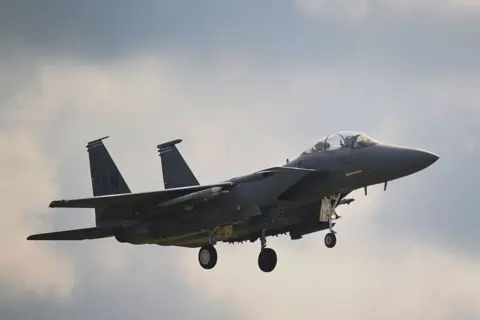
One of two crew members of the downed F15 Eagle is still missing
President Donald Trump had said Iran couldn't "do a thing" about American aircraft operating over its territory, insisting its air defences had been significantly weakened.
His Defence Secretary Pete Hegseth also said the US had achieved "air superiority" over Iran.
So, Friday's downing of a F-15 Eagle is a significant blow to Washington DC.
It suggests Iran is still able to defend its skies, even if at a limited capacity.
The stakes could rise further, though, depending on who the missing weapons systems officer is captured, or rescued, by.
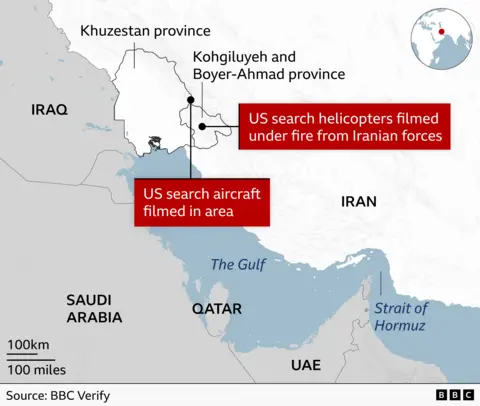
The BBC understands President Trump's national security team spent much of Thursday in the West Wing briefing him on a search-and-rescue mission that also came under Iranian fire. US media report the crew were wounded but managed to escape Iranian airspace.
Publicly, the president has played down this entire incident and suggested it won't affect negotiations with Tehran to end the war that began with US and Israeli strikes on 28 February. But privately, this is likely to be of serious concern - particularly as Iran's Islamic Revolutionary Guard Corps is said to have launched its own search for the missing American, reportedly using troops and locals, and offering them a reward of around $66,000 (£50,000) to capture him alive.
If the missing American is found by Iranian forces, the implications could be profound. At the very least, it would be a political embarrassment for Washington.
The US airman could be paraded as a propaganda tool, which would bring back grim reminders of the 1979 Iran hostage crisis, when American diplomats were held for 444 days.
Following a failed military rescue, the US secured their release by lifting some sanctions and unfreezing nearly $8bn worth of Iranian assets. It was an event that left deep political scars in the US.
Successive administrations also went to great lengths to secure the release of detained Americans, at times through controversial means.
For example, in 2014, President Barack Obama's administration exchanged five Taliban detainees, held at Guantanamo Bay detention camp, for Bowe Bergdahl, a US Army soldier captured by the Taliban in Afghanistan in 2009. Critics argued this swap incentivised future hostage-taking.
That history raises difficult questions for this White House.
The capture of a US service member could intensify pressure on President Trump to act decisively and escalate militarily in response, or, on the other hand, it could create an opening to pause operations and pursue backchannel efforts to secure the airman's return.
If the missing American is captured by the Iranians and used as a bargaining chip, it would be a serious test for Washington in this already volatile conflict.
For now, what's unfolding is a high-stakes race on the ground between the two adversaries to find him.
Lawmakers here in Washington have said prayers and expressed support. However, divisions are emerging. Republican Congresswoman Nancy Mace said it was "far past time we bring troops home", while Democratic Senator Tim Kaine urged Iran to treat any captured airman in line with international law.
There is growing concern about the risk to US service personnel in this conflict, particularly amid talk of a possible ground invasion. Across the political spectrum, there is little appetite for another so-called "forever war", or for further American casualties.
On Saturday, President Trump reiterated his deadline for Iran to agree to a deal and reopen the Strait of Hormuz by Monday, 6 April, or face "hell", including strikes on its energy infrastructure. His deadlines have shifted repeatedly, alongside claims that ongoing talks are "very good" and "productive" - talks Tehran denies have taken place.
With promises of further US strikes in the coming weeks, a steady US military build-up in the Gulf, and forewarnings by Trump of further US casualties, the signs increasingly point to an escalation that is already under way.





 English (US) ·