
“Long live the shah!” “It’s the final battle – Pahlavi will return!”
For weeks now, his name has been shouted in the protests sweeping Iran. Reza Pahlavi, the son of the last shah of Iran overthrown in the 1979 revolution, has planted himself firmly in the spotlight – especially on social media – and clearly sees himself as the saviour Iran needs to move beyond the Islamic Republic.
To display this content from Instagram, you must enable advertisement tracking and audience measurement.
Pahlavi has frequently addressed the protesters from his home in the US, where he has lived in exile for almost half a century. In regular video messages, he has urged the demonstrators to hold firm and build barricades in the streets, claiming that “victory is near”.
As demonstrations sparked by a worsening cost-of-living crisis set off nationwide protests against the government last week, Pahlavi called for Iranians to gather and chant together at 8pm for two nights straight. When Thursday night came, it became clear that his first "call to action" had not fallen on deaf ears.
“Several groups of young people began to gather in various neighbourhoods of Tehran,” FRANCE 24 correspondent Siavosh Ghazi reported from the Iranian capital in the early evening. “They chanted slogans against the government. We heard ‘Death to the dictator’ and ‘Prince, Iran is ready, we are waiting for you.’”
Videos later released on social media showed large crowds not only in Tehran, but in Shiraz, Babol, Arak, Tabriz and other cities across the country.
Read moreAre Iran’s cost-of-living protests a real threat to the regime?
To display this content from Instagram, you must enable advertisement tracking and audience measurement.
Since then, widespread demonstrations have been met with fierce reprisals from security forces. While the government’s internet blackout has made it difficult to judge the true toll, rights groups abroad have said that thousands of demonstrators and scores of security forces have been killed in the protests and the government’s brutal crackdown.
Pahlavi has continued to appear on US news channels, urging US President Donald Trump to intervene on the protesters’ behalf and saying that the struggle with the government is a question of life and death.
“This is a war, and war has casualties,” he told CBS News.
A well-oiled machine
As images of morgues overflowing with body-bags began to circulate, Trump on Tuesday called on the Iranian demonstrators to “take over” government institutions, claiming that unspecified “help” was “on its way”. US news site Axios reported that Trump’s Middle East envoy Steve Witkoff had met with Pahlavi to discuss the situation.
Read moreIran's hospitals, morgues fill after deadly crackdown on anti-regime protests
Pahlavi has repeatedly called on the government’s security forces to throw their support behind the protests. In one video released Sunday, he stood before the flag that flew over Iran prior to the Islamic Revolution, bearing the Shir-o-Khorshid – the lion and the sun – and called on the government’s supporters to break ranks.
“Employees of state institutions, as well as members of the armed and security forces, you have a choice,” he said. “Stand with the people and become allies of the nation or choose complicity with the murderers of the people and bear the nation’s lasting shame and condemnation.”
To display this content from X (Twitter), you must enable advertisement tracking and audience measurement.
But despite the fact that his name is increasingly called out in street protests, his popularity – doubtless increased these past three years – remains hard to gauge.
“These calls for the shah do exist, but we must be cautious,” said Jonathan Piron, a historian specialising in Iran at the Brussels-based Etopia research centre. “The monarchists have a well-oiled political communication machine – and it is impossible to properly verify the extent of their slogans on the ground, since we cannot go see for ourselves.”
Most of these videos are posted on X – a social media platform owned by US-based tech billionaire Elon Musk, and run according to an opaque algorithm that Piron warned could distort reality like a “funhouse mirror”.
Armin Arefi, a journalist with French daily Le Point, also pointed out that slogans calling for Pahlavi’s return were “amplified by some of the Farsi-language opposition channels [Editor’s note: such as Iran International and Manoto] based overseas and committed to his cause”.
Laying the groundwork
Pahlavi has for years been preparing his dynasty’s return from his home in the US, where he moved at the age of 17 for fighter pilot training just months before his father was overthrown by a popular revolution. His mother Farah Diba, the last empress of Iran, said in 2007 that her son had been “raised to take over as the crown prince”.
Pahlavi has only grown more self-assured with each crisis that shakes the Islamic Republic – crises that have become more frequent in recent years.
In 2009, as the country was swept by demonstrations protesting the contested re-election of Mahmoud Ahmadinejad, the shah’s son called on the population to “keep on fighting with discipline” and urged security forces to remain neutral or engage in acts of civil disobedience.
But it was in 2023 with the outbreak of the “Woman, Life, Freedom” protests sparked by the death in custody of Mahsa Amini that Pahlavi began to make himself known. Alongside opposition figures including Nobel laureate Shirin Ebadi and journalist Masih Alinejad, he pushed for a common front against the government.
As the protests grew in scale, his supporters launched a vast online petition named “Prince Reza Pahlavi is my representative”. Speaking to Manoto TV, a royalist Iranian station based in London, Pahlavi called for the organisation of free elections and the creation of a constituent assembly.
Building on his growing momentum, Pahlavi began to flit between foreign ministries to try to secure support – and to push the message that he was ready to take the reins of power. His entreaties have found the most support in Israel, where he stood side-by-side with Prime Minister Benjamin Netanyahu in April 2023 following a trip to “re-establish the historic relationship between Iran and Israel”.
To display this content from X (Twitter), you must enable advertisement tracking and audience measurement.
Israel’s lethal missile strikes on Iran in June 2025 would bear the name “Operation Rising Lion” – a reference to the animal that rears on the crest of the Pahlavi dynasty.
Pahlavi did little to hide his ambitions during the 12-Day War, in which hundreds of civilians were killed in Israeli strikes. He described the bombardment as an “opportunity” and maintained that the Israeli government was not intentionally targeting civilians.
His wife Yasmine was less restrained, publishing a photo to Instagram showing graffiti that read “Hit them Israel, Iranians are behind you”. The Pahlavis’ open support for the deadly bombing campaign won disapproval even among a part of their support base.
To display this content from X (Twitter), you must enable advertisement tracking and audience measurement.
According to the Israeli daily Haaretz, Israel was orchestrating a vast Farsi-language influence operation throughout the short-lived war that sought to portray Pahlavi as the legitimate face of Iran post-Islamic Republic. At the same time, the Israeli bombardment pushed the government closer to possible collapse.
‘A plan for Iran’s future’
The man who calls himself “prince” during his public appearances is impatiently waiting his moment. He has even proposed “a plan for Iran’s future”, a document laying out the first 100 days following the eventual fall of the Iranian government.
During an interview in July with German daily Bild, Pahlavi said that “the regime’s fall is no longer a question of ‘if’ but ‘when’.” In September, he celebrated the re-establishment of UN sanctions against Iran, describing the measure as a “victory for all those who have long been calling for maximum pressure on this regime” – even as the nation’s economy slipped deeper into crisis.
His media appearances have only increased following this latest wave of protests. In the Washington Post, Pahlavi spoke of a “coordinated opposition” and cheered Trump’s stated support for the Iranian people. The US president has threatened to hit Iran “very, very hard where it hurts” if more civilians were killed.
To display this content from YouTube, you must enable advertisement tracking and audience measurement.
One of your browser extensions seems to be blocking the video player from loading. To watch this content, you may need to disable it on this site.
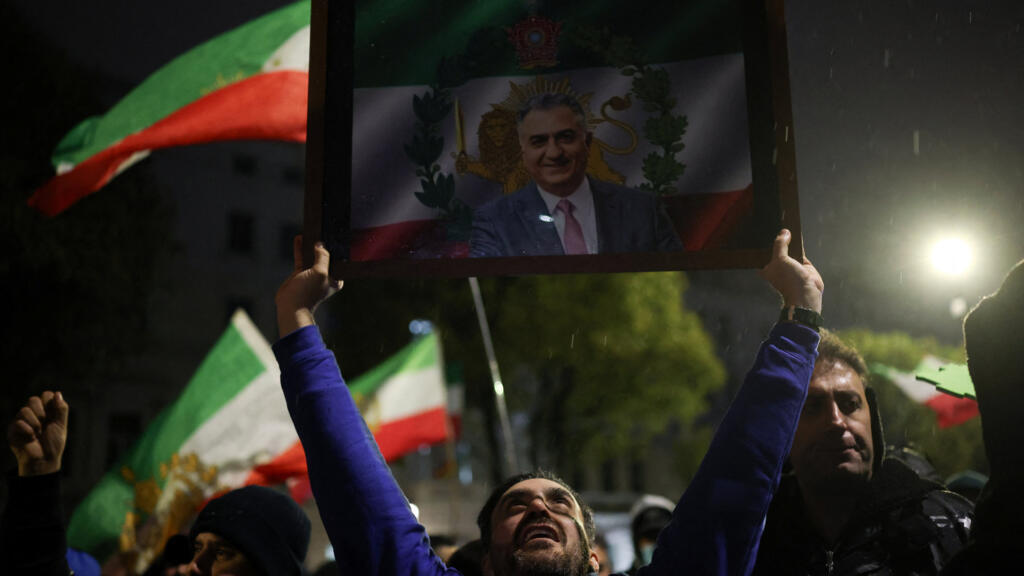 Un homme brandit une image de Reza Pahlavi, fils exilé du dernier chah d'Iran, lors d'un rassemblement de soutien aux manifestations nationales devant l'ambassade d'Iran, à Londres, dimanche 11 janvier 2026. © Isabel Infantes, Reuters
01:05
Presenting himself as “a steward of a national transition to democracy”, Pahlavi argued that the moment of the regime’s collapse was drawing near.
“Protesters are chanting my name alongside calls for freedom and national unity,” he wrote. “I do not interpret this as an invitation to claim power. I bear it as a profound responsibility.”
On Fox News, he proposed a referendum on the future democratic form of the government before saying he was ready to return to the country “at the first possible opportunity”.
Son of a hated dictator
But despite his attempt to sell himself as a unifying figure, support for Pahlavi is far from universal. Alongside chants of support for the shah’s son come other slogans, calling for “no shahs, no mullahs” – particularly in Iran’s universities.
“The circumstances surrounding his return raise questions,” Piron said. “If it is due to foreign intervention, he could be perceived as an imported figure.”
To display this content from Instagram, you must enable advertisement tracking and audience measurement.
And while his name carries an inherited prestige for some, the memory of his father – who finished his reign a much-hated dictator – has also weighed heavily on Pahlavi. Despite this, the self-proclaimed crown prince has never truly denounced the tyranny of his father’s reign, marked by the frequent arrest, torture and killing of political opponents by the SAVAK secret police.
Some of the most feared military and security figures of this regime still number among Pahlavi’s staunchest supporters, including Parviz Sabeti, the former intelligence chief responsible for the torture and killing of the shah’s political opponents.
‘Make Iran great again’
While his political programme remains vague, Pahlavi has long rubbed shoulders with American neo-conservatives and figures from the European far right. In 2025, invited to attend the Conservative Political Action Conference in the US, he spoke alongside right-wing personalities including Javier Milei, Nigel Farage, Giorgia Meloni, Steve Bannon, Elon Musk and Trump himself.
His supporters have even begun to roll out the slogan “MIGA” – “Make Iran Great Again” – a rallying cry echoed by the US president himself on multiple occasions.
This cosiness with the Trumpist right has not been shared by all of Pahlavi’s supporters.
“I’m not MIGA,” a recent Pahlavi supporter based in Tehran said last week. “Pahlavism isn’t the support of Reza Pahlavi as an individual, and it’s not a desire for a new monarchy. For me, it’s a synonym of nationalism, modernity and secularism.”
More broadly, Le Point journalist Arefi said, many of the protesters were motivated by a sense of the situation’s urgency rather than any deep attachment to Pahlavi.
“Today, their primary goal is to get rid of the mullahs at any cost,” he said. “For those chanting his name, Reza Pahlavi is the most legitimate figure, and that's why they support him.”
In this context, the shah’s son appears to many supporters as the figure best placed to give form to an alternative to the Islamic Republic. Not for who he is, but for what he has come to symbolise: the possibility, at last, of regime change.
This article has been adapted from the original in French by Paul Millar.



 English (US) ·