
 1 month ago
29
1 month ago
29
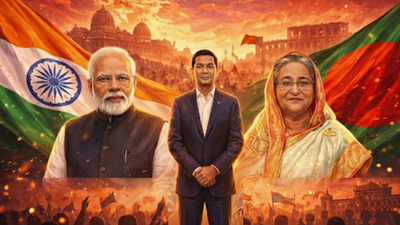
AI image (Picture credit: Open AI via ChatGpt, Google Gemini)
Bangladesh’s 13th national parliamentary elections have handed the Bangladesh Nationalist Party (BNP) a commanding mandate, marking a decisive political shift after months of turbulence.
But beyond the scale of victory, the outcome has drawn attention for another reason, the return of several controversial leaders whose past convictions, later acquittals and anti-India links are likely to shape regional calculations.The polls, which saw BNP chief Tarique Rahman secure a two-thirds majority, were widely viewed as a reset following the mass uprising that led to the ouster of former prime minister Sheikh Hasina. The BNP-led alliance won 212 seats, securing more than a two-thirds majority in Parliament, while the Jamaat-e-Islami-led alliance won 77 seats. Hasina’s Awami League was barred from contesting the elections.Hasina fled to India in 2024 amid the unrest, after which Nobel laureate Muhammad Yunus headed an interim administration. Since her departure, relations between Dhaka and New Delhi have remained strained.
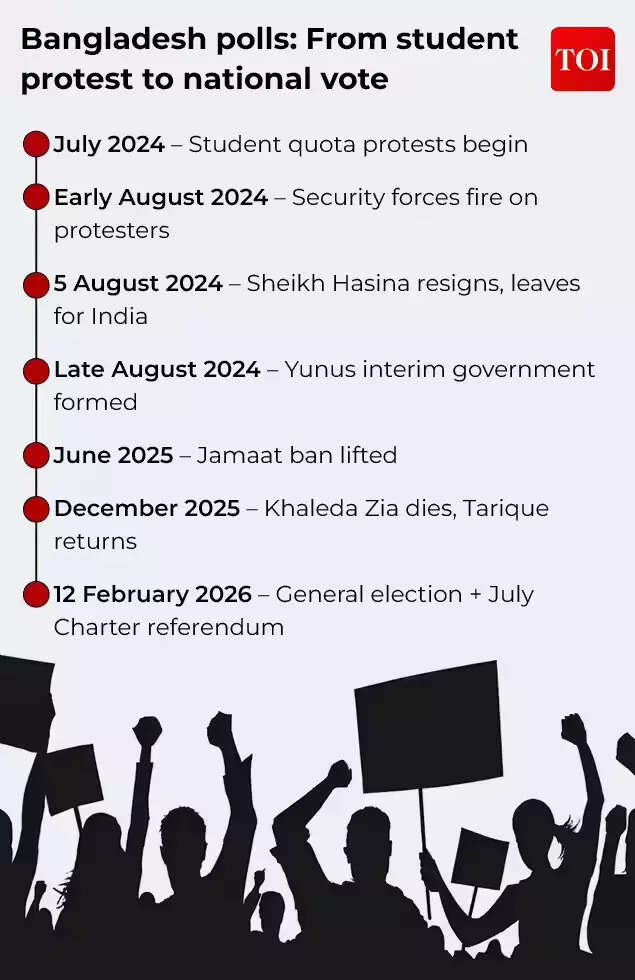
While Prime Minister Narendra Modi congratulated Rahman on his party’s “decisive victory” and expressed hope of strengthening ties, the electoral success of figures such as Lutfozzaman Babar, Abdus Salam Pintu, ATM Azharul Islam and Hasnat Abdullah adds a more complex layer to India-Bangladesh engagement.
Lutfozzaman Babar: From death row to landslide victory
Former state minister for home affairs Lutfozzaman Babar, contesting on a BNP ticket, secured a sweeping win in the Netrokona-4 (Madan–Mohanganj–Khaliajuri) constituency..Babar received 160,351 votes, defeating Jamaat-e-Islami candidate Al Helal Talukder, who polled 39,309 votes, a margin of 121,042 votes. He was unofficially declared elected.“This victory is the victory of the people. I will continue to work for the development of the area, strengthening infrastructure, and fulfilling the expectations of the people,” Babar said, thanking voters for a peaceful poll, according to Dhaka Tribune.His return marks a dramatic reversal of fortune. In 2014, a special tribunal sentenced him to death in the 10-truck arms haul case, one of the largest arms smuggling cases in Bangladesh’s history. The case stemmed from the seizure of 10 truckloads of weapons at the Chittagong Urea Fertiliser Limited jetty on April 1, 2004. Investigators had believed the consignment was intended for the Indian separatist group ULFA.However, in 2024, the Bangladesh high court acquitted Babar and several others in the case, overturning the earlier death sentences. The sentences of others, including ULFA chief Paresh Baruah, were reduced. Former Jamaat chief Motiur Rahman Nizami, also convicted in the case, was executed in 2016.
Abdus Salam Pintu: Grenade case acquittal and allegations of Anti-India links
Former BNP vice-chairman Abdus Salam Pintu has also returned to Parliament after securing 1,98,867 votes in Tangail-2, the highest tally in the district, reported The Daily Star. He defeated his Jamaat rival by a margin of 1.38 lakh votes. His younger brother, Sultan Salahuddin Tuku, won from Tangail-5.Pintu’s political comeback follows nearly 17 years behind bars. He was arrested in 2008 in connection with the 2004 grenade attack on an Awami League rally that killed 24 people and injured more than 300. In 2018, a trial court sentenced him and 18 others to death.In December 2024, he was released from prison after the high court acquitted him.However, his name has also surfaced in connection with alleged anti-India activities. Pintu was accused of aiding the Pakistan-based militant group Harkat-ul-Jihad-al-Islami (HuJI) in carrying out attacks against India. He was also accused of funding extremist elements operating from Pakistan-occupied Kashmir and Bangladesh. There was, however, no official confirmation of these specific allegations.The grenade attack case itself is regarded as one of the most heinous political crimes in Bangladesh’s history. Despite the acquittal, Pintu’s past continues to attract scrutiny, particularly in the context of India-Bangladesh security cooperation.Following his electoral win, Pintu and his brother pledged to work for the welfare of the people.
ATM Azharul Islam: War crimes convict turned MP
Jamaat-e-Islami leader ATM Azharul Islam won the Rangpur-2 seat with 135,556 votes, defeating BNP candidate Mohammad Ali Sarkar, who secured 80,538 votes.Azharul had been sentenced to death in 2014 after being convicted by the International Crimes Tribunal for crimes against humanity during the 1971 Liberation War, including charges of rape, murder and genocide.In 2025, Bangladesh’s Supreme Court overturned his conviction, terming the earlier judgment flawed. He was released after more than a decade in custody.His acquittal triggered polarised reactions. Jamaat supporters welcomed the ruling, while student groups at Dhaka University and Rajshahi University staged protests, accusing the interim administration of “rewriting history”.
Clashes were reported between rival student groups following the verdict.Azharul had been a senior Jamaat leader at a time when the party opposed Bangladesh’s independence in 1971, a deeply sensitive chapter in the nation’s history that continues to shape political narratives.
Hasnat Abdullah: Anti-India rhetoric and electoral success
In Cumilla-4, National Citizen Party (NCP) candidate Md Abul Hasnat, widely known as Hasnat Abdullah, won with 1,66,583 votes, defeating his nearest rival, who secured 49,885 votes.Hasnat has drawn attention in India for his sharp rhetoric. In late 2025, he warned that India’s northeastern states could be “isolated” and suggested offering refuge to separatist groups if Bangladesh were destabilised.He described India’s northeast as geographically “vulnerable” due to its reliance on the narrow Siliguri Corridor, often referred to as the “Chicken’s Neck”.His remarks came at a time of heightened tensions following the killing and subsequent death of student activist Sharif Osman Hadi, whose death sparked large protests in Dhaka. Prior to the attack on him, Hadi had shared a controversial map related to India on social media, which drew criticism. In the aftermath of his death, anti-India slogans were heard during some protests and sections of public discourse increasingly reflected nationalist sentimentAmid these developments and reported threats near the Indian High Commission in Dhaka, India summoned Bangladesh’s High Commissioner Riaz Hamidullah, conveying “strong concerns” over the deteriorating security situation and the activities of certain extremist elements around the mission.In a recent video, he was seen calling for a ban on ISKCON and saying that Chinmoy Krishna Das, a Bangladeshi Hindu monk, should be hanged.Abdullah’s rise indicates the growing political space occupied by figures who adopt overtly nationalist or anti-India positions, a development closely watched in New Delhi.
Hasina’s extradition demand puts Delhi in a tight spot
In addition to the electoral success of these leaders, the return of the BNP to power has also revived Dhaka’s demand for the extradition of former prime minister Sheikh Hasina from India, creating an early diplomatic challenge for New Delhi.
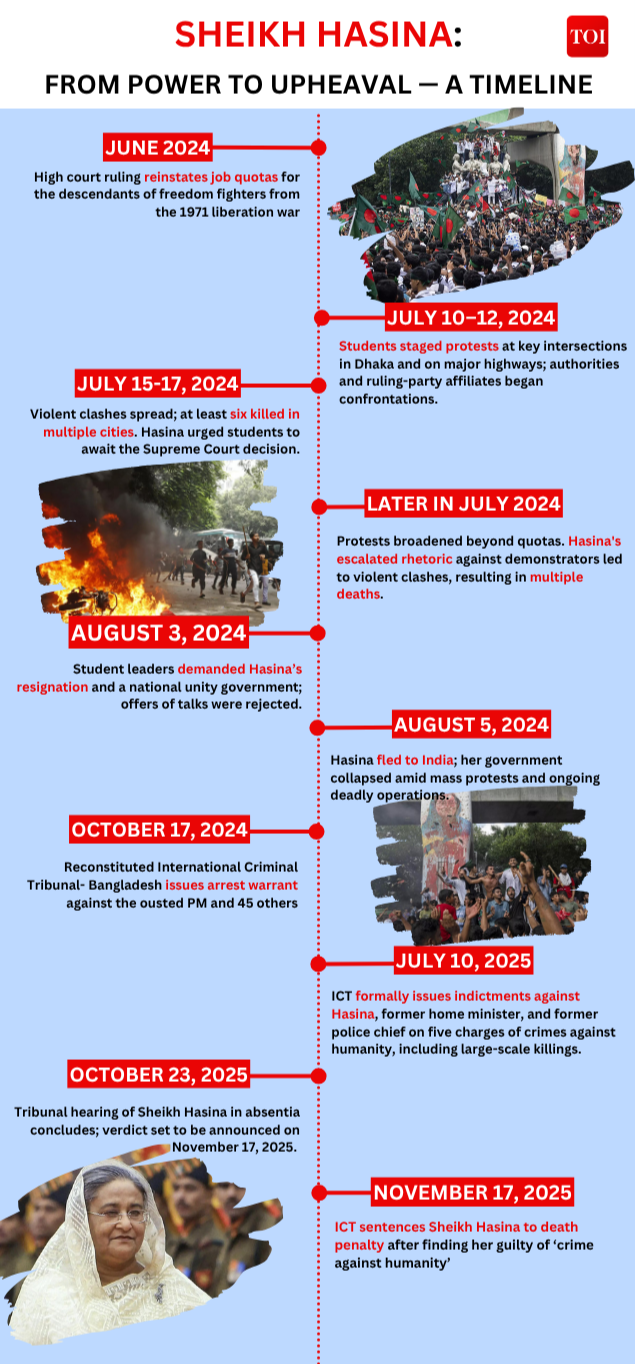
Soon after the party’s landslide win, senior BNP leader Salahuddin Ahmed made it clear that the new government would pursue her return. “The foreign minister has already placed the case for her extradition, and we also support it,” he said, adding that the matter should be handled “according to the law” between the foreign ministries of both countries.Hasina has been in New Delhi since August 2024 after being removed from office during a mass uprising.
In November 2025, a special tribunal in Bangladesh sentenced her to death in absentia for crimes against humanity linked to the violent crackdown on protesters during the 2024 unrest. She is also facing multiple other cases filed by the interim administration.India has confirmed that Dhaka sent an official request for her extradition, including a note verbale and a formal letter. The MEA has said the request is being “examined”. External affairs minister S Jaishankar earlier stated that Hasina’s stay in India was her personal decision following developments in Bangladesh.Hasina, however, has rejected the charges, calling them politically motivated. She has said she was not given a fair opportunity to defend herself and claimed she was denied lawyers of her own choice during the trial in absentia.
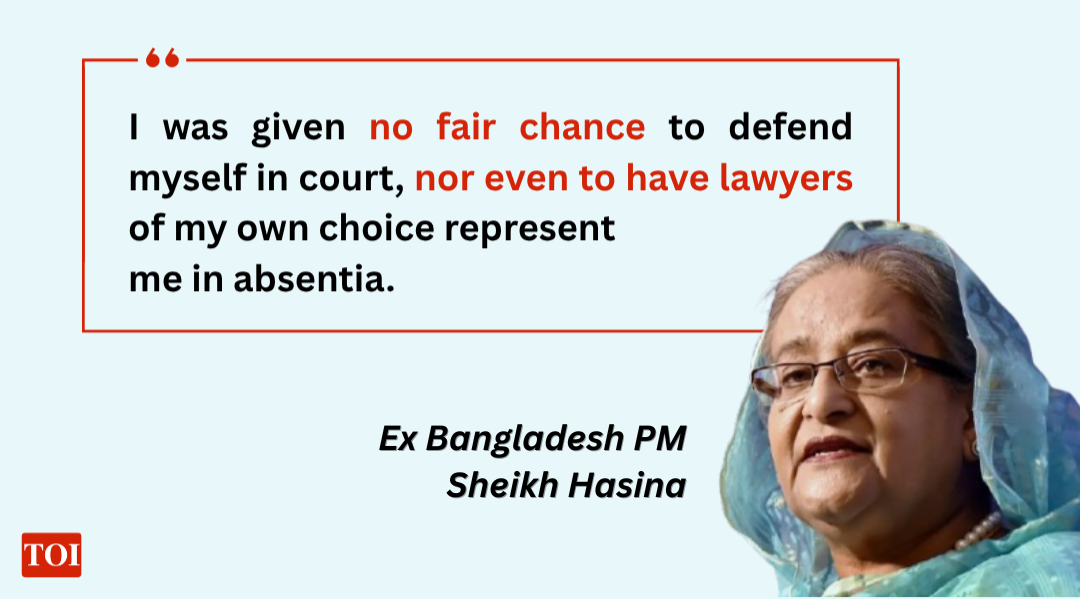
She has also expressed willingness to face proceedings in what she described as a neutral and fair international forum.
BNP signals reset — but on ‘equal terms’
In its election manifesto, unveiled by Tarique Rahman, the BNP outlined a firmer foreign policy approach under the slogan “Friend Yes, Master No” and a doctrine described as “Bangladesh Before All”.While India was not explicitly mentioned, the document emphasised taking a stricter stand on issues such as alleged “border killings”, “push-ins”, smuggling, and securing Bangladesh’s fair share of water from shared rivers including the Teesta and the Padma.Senior BNP leader Salahuddin Ahmed said Dhaka sought normal relations with all neighbours, including India, but on the basis of equality and mutual respect.Rahman reinforced that message in his first public address after the results were declared. He said Bangladesh’s foreign policy would be guided by the principle that “people come first”, stressing that national interest would determine the country’s external engagement, including with New Delhi.
— IANS (@ians_india) February 14, 2026
“The interests of Bangladesh and its people comes first and it will determine our foreign policy,” Rahman said.Calling for unity after the decisive mandate, he described the victory as belonging to “freedom loving pro-democracy people” and urged political forces to work together despite differences.Even as Rahman adopted a measured tone, his adviser Humayun Kabir made pointed remarks about regional radicalisation.
In an interview with news agency PTI, Kabir said extremism was a broader South Asian challenge, referring to “Hindu extremism and far-right intolerance” in India and extremist elements in Pakistan.
He says, “Radicalisation is a problem in South Asia. We see Hindu extremism and far-right… pic.twitter.com/cb41SjLidS
— Press Trust of India (@PTI_News) February 14, 2026
He added that Bangladesh would pursue balanced relations and would not limit its partnerships to any single country, an apparent reference to criticism that the previous administration was overly aligned with New Delhi.Soon after the results were announced, Prime Minister Narendra Modi congratulated Rahman and reaffirmed India’s commitment to a “democratic, progressive and inclusive Bangladesh”. The two leaders also spoke over the phone, signalling an intent to maintain engagement despite policy differences.With the BNP holding a strong mandate and Hasina remaining in India, the extradition question is likely to become one of the first major tests of how the two sides recalibrate ties after Bangladesh’s political shift.
A mandate with strategic implications
The BNP’s emphatic victory may restore electoral legitimacy after a turbulent political chapter. However, the composition of the new Parliament introduces uncertainty about the direction of policy.The return of leaders once sentenced in major criminal cases, alongside figures associated with hardline rhetoric on India, complicates the diplomatic landscape at a sensitive moment in bilateral ties. The renewed push for Sheikh Hasina’s extradition adds further pressure to an already delicate equation.For India, which, under Hasina, developed close security coordination and counter-insurgency cooperation with Dhaka, the transition will require careful diplomatic calibration. Issues such as border management, cross-border militancy, water sharing and minority safety are likely to resurface more prominently in the coming months.Whether the BNP’s mandate translates into substantive policy shifts or remains anchored in domestic political positioning will determine the trajectory of India-Bangladesh relations. What is clear is that the political reset in Dhaka has introduced new variables into a relationship that both sides describe as strategically important.




 English (US) ·