
 1 month ago
30
1 month ago
30
2 hours ago
Steve RosenbergBBC Russia Editor

 Reuters
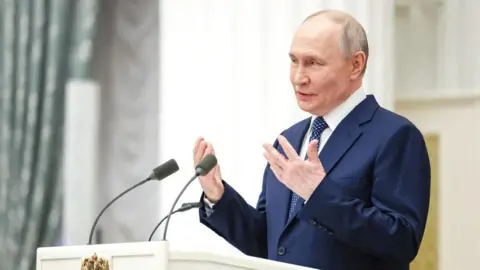
Putin insists Russia's war aims in Ukraine are being reached, even though initial plans were for a short military operation
If Vladimir Putin's Russia had an official slogan, what would it be?
"Russia is what it is, and we're not ashamed of showing it," Foreign Minister Sergei Lavrov once told me in an interview.
But I recently heard an updated version from veteran pop and folk singer Nadezhda Babkina.
After receiving an award from President Putin, Babkina told an audience in the Kremlin: "Russia will never surrender thanks to our remarkable, multi-ethnic genetic code... that holds us all together.
"Anyone who doesn't like that," she added, "can go and poison themselves."
In many ways, the line "they can go and poison themselves" encapsulates Russia in 2026 - unapologetic, unrepentant and uncompromising.
Like Vladimir Putin himself.
Since ordering the mass invasion of Ukraine, the Kremlin leader has displayed no regret, no remorse over his decision to attack Russia's neighbour - and no intention of ceasing hostilities.
This week Russia launched another massive missile and drone strike across Ukraine.
The attack came on the eve of the annual St Petersburg International Economic Forum, an event designed to showcase Russia to the world.
High-profile Western investors and politicians have long stopped coming. But the organisers say that delegations from more than 130 countries and territories will attend.
For a country seeking foreign investment, more than four years of war with its neighbour doesn't seem the best advertisement.
But, as we have established, "Russia is what it is". Forum or no forum, the attacks on Ukraine continue.
President Putin's public position on the war is unwavering. He continues to demand that Ukraine cede control to Russia of the entire Donbas region.
Vladimir Putin has not changed. But one thing in the Kremlin has.
And that is to do with Donald Trump.
Last year Russian officials appeared confident that the US president would help deliver a Ukraine peace deal on Moscow's terms. In other words, that President Trump would pressure Kyiv into accepting Moscow's maximalist demands.
Following last summer's US-Russia summit in Anchorage, Alaska, for months afterwards senior Russian officials waxed lyrical about the "spirit of Anchorage" - as if Donald Trump and Vladimir Putin had reached a mutual understanding on Ukraine to Moscow's benefit.
But no peace deal materialised.
"I don't know about the spirit of Anchorage," President Putin's foreign policy aide Yuri Ushakov told Russian state TV recently. "I have never used that phrase."
It was a sign that the "spirit of Anchorage" has, if not disappeared, then at least started evaporating.
 EPA
EPA
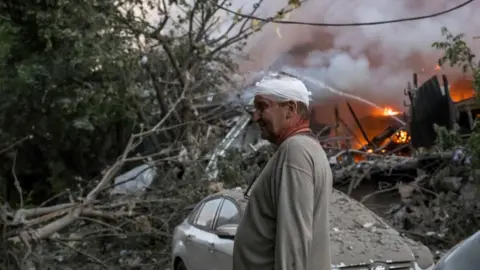
Russia has said it will hit Ukraine harder
This may well be one of the factors fuelling Vladimir Putin's obvious frustration.
What the Kremlin leader had conceived as a short-term "special military operation" has turned into a bloody war of attrition which is now in its fifth year. Since February 2022, Russia has suffered huge battlefield losses, significant damage to its economy and technological decline.
What's more, the war has moved closer to home. Today Ukrainian drones reach deep inside Russia. Oil refineries and other energy infrastructure are regularly targeted. Last month, a large-scale Ukrainian drone attack on the Moscow region highlighted that air defences around the Russian capital could be penetrated.
Amid fears of an attack, the annual Victory Day parade on Red Square on 9 May was scaled back.
More than four years of war - and thousands of international sanctions - have put enormous strains on Russia's economy. The budget deficit has been growing, the economy stagnating.
And how has the Kremlin responded to these challenges?
Not by scaling back the "special military operation".
Judging by recent large-scale Russian air raids on Ukrainian cities, the response is escalation.
Not that the Kremlin accepts responsibility for this. It blames Kyiv, claiming that Russia is reacting to a recent Ukrainian strike on a college dormitory in Starobilsk, Russian-occupied eastern Ukraine. According to official figures, 21 students there were killed.
Ukraine's military has said it hit the headquarters of Russia's elite Rubicon drone military unit in Starobilsk. It has not said whether it was the same building as the one identified by Russia.
An end to the fighting looks as distant as ever.
In previous years President Putin has used appearances at the St Petersburg International Economic Forum to transmit his current worldview and to repeat his criticisms of the West. In St Petersburg, he is expected to meet chief editors of international news agencies and deliver a keynote address.
Will he use this year's forum to signal a change of position on Ukraine? So far there is nothing to suggest that.
Yet, inside Russia, there are signs of a growing public discourse on whether it is time to end the war.
I see evidence of it even in the country's highly controlled media landscape.
Writing in the journal Russia In Global Affairs, which has close links to the country's foreign policy establishment, political scientist Vasily Kashin recently concluded: "The goal of eliminating the anti-Russian regime in Ukraine at the current stage is fundamentally unachievable without the complete military occupation of the entire country, including the western part, for a long period. For Russia this is technically impossible."
A few days later, pro-Kremlin tabloid Moskovsky Komsomolets quoted political commentator Alexander Nosovich: "The expert community is split between those in favour of continuing the special military operation until the goals are achieved, and those who believe it's time to end it, since the worst-case scenario is not even defeat, it's an endless special operation."
In the same paper, lawyer Dmitry Krasnov argued that, throughout Russian history, "it was lost wars and humiliating truces that regularly led to new breakthroughs, reforms and surprisingly to new victories... major geopolitical losses were sometimes more useful than brilliant victories".
In a country whose national idea has been shaped around the concept of Russia as a nation of victors and victories, it was astonishing to see such an article in print.
Was it hinting that Russia should end its war on Ukraine without achieving its goals?
A few days later, I tried to read the article again online.
"Error 404. Page not found" flashed on to my screen. Access denied.
There may be a discourse. But it clearly has limits.





 English (US) ·