
 1 month ago
51
1 month ago
51
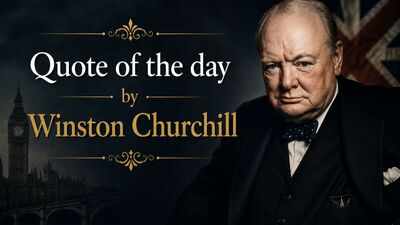
Quote of the day by Winston Churchill (AI-generated image)
Almost everyone enjoys the idea of learning something new. Far fewer people enjoy the moment someone actually corrects them. Winston Churchill captured that exact gap in a House of Commons speech in November 1952.
"Personally, I'm always ready to learn," he said, "although I do not always like being taught." It got picked up and repeated in The Observer within days, and it has kept circulating ever since, because almost everyone recognises the feeling being described. Coming from a man in his late seventies, still serving as prime minister for the second time, the line reads less like a throwaway joke and more like an honest admission from someone who had spent an entire career being forced to learn things he would rather not have needed to.
Quote of the day by Winston Churchill
"Personally, I'm always ready to learn, although I do not always like being taught"
The deeper meaning of Winston Churchill's quote
The line sounds like a joke, and it is one, but there is a genuine observation buried underneath it. "Always ready to learn" describes curiosity, the enjoyable part of gaining new knowledge that expands what you understand and what you can do."Do not always like being taught" describes something else entirely. Being taught usually means someone else pointing out where you were wrong, which requires admitting a gap in your own understanding.
Churchill is separating the pleasant part of growth from the uncomfortable part, and admitting that he, like everyone else, prefers the first over the second even while needing both.
Why Churchill valued learning throughout a long, demanding life
Churchill is remembered mainly for leading Britain through the Second World War, but his life extended well beyond politics. He worked as a soldier, journalist and historian, and won the Nobel Prize in Literature in 1953 for his historical writing.He made this particular remark in 1952, while serving as prime minister for the second time, decades into a career that had already required him to adapt repeatedly, through military campaigns, political defeats, and periods completely out of office. Someone with that much accumulated experience still openly admitted to disliking correction. That admission carries more weight coming from him than it would from someone with far less to actually learn from over a lifetime.
Why people naturally resist being taught
Correction can feel like a challenge to someone's competence, especially when it happens publicly or unexpectedly. Psychologists sometimes describe this as a form of ego protection, the instinct to defend a positive view of your own abilities even when the feedback is accurate and useful.People who keep improving over long careers tend to handle this differently. Athletes study their coaches' notes instead of dismissing them.
Musicians actively seek out more experienced teachers. The discomfort does not disappear for them. They simply do not let it stop the learning.
The best teaching rarely confirms what you already believe
Good teaching tends to challenge assumptions rather than reinforce them. A useful mentor points out a specific weakness rather than only praising what already works, and that kind of feedback rarely feels good in the moment even when it produces real improvement later.History is full of people who only made progress after accepting correction they did not particularly enjoy, scientists revising theories after new evidence, writers reworking drafts after harsh but accurate feedback.
In every case, the discomfort came first and the improvement came after.
Curiosity and humility work best together
Curiosity gets someone interested in a new subject. Humility is what lets them accept that someone else already understands it better. Neither one does much good without the other. Curiosity without humility tends to produce someone who explores widely but never actually improves, since improvement requires accepting correction along the way.Churchill's quote works as a nudge toward asking a better question when feedback arrives. Instead of "why should I listen to this," it suggests asking "what is actually useful here," even when the answer stings a little on the way in.
Other famous quotes by Winston Churchill
- "Success is not final, failure is not fatal: it is the courage to continue that counts."
- "To improve is to change; to be perfect is to change often."
- "We make a living by what we get, but we make a life by what we give."
Why Churchill's words still matter today
There has never been more access to information than there is right now, with online courses, digital libraries and endless material available within seconds. Access to information on its own has never been the same thing as wisdom.Real learning still requires accepting feedback that is sometimes unwelcome, and reflecting honestly on where your own understanding falls short. Churchill's quote endures because it names that tension so plainly. Curiosity gets people started. Humility is what actually lets them keep going once the lesson stops being comfortable.










 English (US) ·