
 1 month ago
32
1 month ago
32
36 minutes ago
Anna HolliganBBC News, Netherlands

 Anthony Devlin/Getty Images
A landmark report last month found Britain is grappling with a youth engagement crisis - with nearly one in eight 16 to 24-year-olds not in education, employment or training (Neet).
Alan Milburn, the former health secretary who authored the report, warned one in six young people could become Neet within five years unless urgent action is taken.
He identified that the Dutch approach was one the UK could learn from. The Netherlands has one of the lowest Neet rates in the world, at 4.9% among 18 to 24-year-olds. The equivalent figure in the UK is 15.1%.
So can the UK learn from a Dutch system that is designed around a simple principle?
"No dead ends" is the philosophy which underpins Dutch education and youth employment policy - every stage of a young person's journey is designed to lead somewhere.
Under Dutch law, it is compulsory for children between five and 16 to attend school - then they must stay in education or training until they either secure a qualification or turn 18.
 P van Katwijk/Getty Images
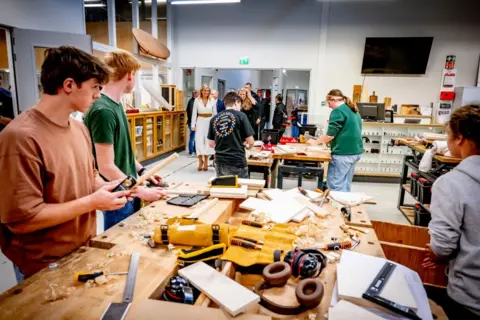
Queen Máxima of the Netherlands visits the Wood and Furniture college in Rotterdam
One of the Netherlands' key tools for cutting school dropout rates is through the kwalificatieplicht (qualification requirement).
From around the age of 12, Dutch pupils are streamed into one of three secondary tracks, based on teacher recommendations and primary-school test results:
- VMBO - the practical route that usually leads to vocational training
- HAVO - which typically leads to universities of applied sciences
- VWO - the academic route to research universities
The system is controversial, with critics warning that early streaming can disadvantage some children and be detrimental to a young person's self-esteem.
Across the UK, young people can leave school at 16, but after that the rules vary. In England, they must stay in education or training until 18, through full-time study, an apprenticeship or part-time learning alongside work.
In Scotland, Wales and Northern Ireland, there is no equivalent legal requirement, although schools and public agencies still encourage young people to stay in education or training.

Initially, Amelie didn't feel she connected with any of the options available to her
At 10 years old, Amelie was told to choose the vocational VMBO track at high school.
She says this took a toll on her confidence - in the Dutch school system the VMBO track is not the most academic route.
However, when she started exploring secondary schools aged 12, she felt more optimistic. "We had a textiles class, there was a blacksmithing area," she explains.
Amelie went on to study fashion but struggled to secure an internship and left her course aged 17. She then spent six months working and travelling, and felt like her academic path had gone off track.
At this point Amelie says, if leaving education had been an option available to her - as it is in the UK - she may have taken it.
"If I had the freedom to drop out of school, I don't know what would have happened," she says.
But without a qualification, that wasn't an option for Amelie.
From education to sustainable employment
The Dutch system creates the opportunity for lots of hands-on experiences through work-study pathways, employer partnerships, and state-supported apprenticeships. Businesses can even request customised college programmes tailored to their company's needs.
How much students are paid, and whether or not there's a full-time job at the end of it, varies between different professions. Amelie said it was almost like businesses were queuing up for students graduating with an in-demand trade.
Through the beroepsbegeleidende leerweg (vocational training pathway) students aged 16 and over can combine part-time employment alongside study, typically working most of the week while attending school on one or two days.

Teacher Asja van der Helm says the Dutch "look at the industry, and see where we need workers, and the education system prepares them and fills the gaps"
Young people who pursue a vocational qualification are treated as worth investing in, and a valuable asset to society, according to Asja van der Helm, a high school teacher in The Hague.
"Many skilled tradespeople - electricians, roofers, installation specialists, technicians and craftspeople - are earning excellent incomes and are desperately needed by society," Van der Helm explains. "It's a very money-driven society for young adults. When they see a carpenter doing what they like and making a lot of money fast, they see that as aspirational."

Destiny found her path from education into work through a beauty therapy course
Destiny moved to the Netherlands from Bonaire in the Caribbean. There had been few opportunities for her there and she was attracted by the options available in the Dutch education system.
Through a beauty therapy course in the Netherlands, an internship became paid work in a salon.
Her journey illustrates exactly what Dutch policymakers are trying to achieve: ensuring young people move seamlessly from education into work before they become completely disconnected.
For students who struggle with these formal pathways, a host of alternatives exist, funded by school budgets.
Alexander Koppelle is owner of Mooi Jong (Beautiful Young), an organisation based in The Hague which works with school-referred pupils at risk of becoming Neet.
He sketches out what looks like a spider's web where each strand represents a point at which a teenager could drop out of education, lose a job or disengage entirely. Then he starts filling in the gaps. At every junction there is another organisation, another intervention, another chance.
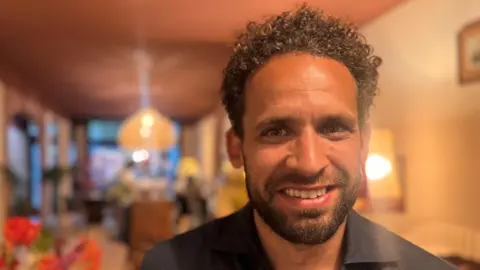
Alexander's organisation offers students personal attention and tailored guidance
"I'm not sure we have the golden key," Koppelle says, yet both his experience and the data suggest that "there are lessons to be learned from the Netherlands".
Schools receive state funding for health and wellbeing, which they can use to bring in specialist organisations such as the Mooi Jong Academy, creating a layered safety net designed to keep students engaged and reduce drop-out.
Every absence is logged. Repeated lateness triggers conversations. Schools also notify municipal attendance officers.
Support mechanisms are activated before a young person disappears from the system altogether. Sometimes pupils are signed off, increasingly with mental health issues like anxiety.
While they wait for the appropriate referrals, they are classified as "thuis zitters" literally translated as "people sitting at home". The school still receives a budget for them, which can be used to cover the cost of external support.
Truancy without an explanation can trigger sanctions including fines, community service orders or juvenile supervision measures.
In England, if a child is skipping school without a valid explanation, local councils and schools can use various legal powers, including fines.
But the Dutch blueprint isn't foolproof - youth unemployment is rising.
In response, the government is making it easier for young people to claim benefits, supported by the Dutch Employee Insurance Agency, or UWV, a body that supports these who are out of work, administers welfare payments, and helps connect jobseekers with employers.
For young people at risk of becoming Neet, it's a one stop shop for support, guidance and opportunities.
Despite what she describes as a turbulent journey through school, Amelie believes that without the flexibility to change path along the way she might have dropped out altogether.
Now aged 20, she hopes to pursue a career in education and is currently training to become a teaching assistant at a vocational college in The Hague, ROC Mondriaan.
One day, she hopes she will be able to support young people who face the same challenges she once did.
You may also be interested in





 English (US) ·