
 3 hours ago
2
3 hours ago
2
OPINION – The Cipher Brief broke new ground when it published my piece addressing scams as a national security issue in December 2023. Two years later, there is broad consensus that transnational criminals are attacking our citizens and businesses at unprecedented scale, and the White House has responded with a new Executive Order to combat the surge in cybercrime. It is time to raise our defenses, and the Intelligence Community has an important role to play. The lessons gained from the battle with counterterrorism apply to the new world of cybercrime — intelligence and data fusion are key.
A Tsunami of Cybercrime
Reported fraud losses have surged nearly 430% since 2020, according to FTC testimony at a recent Congressional hearing.
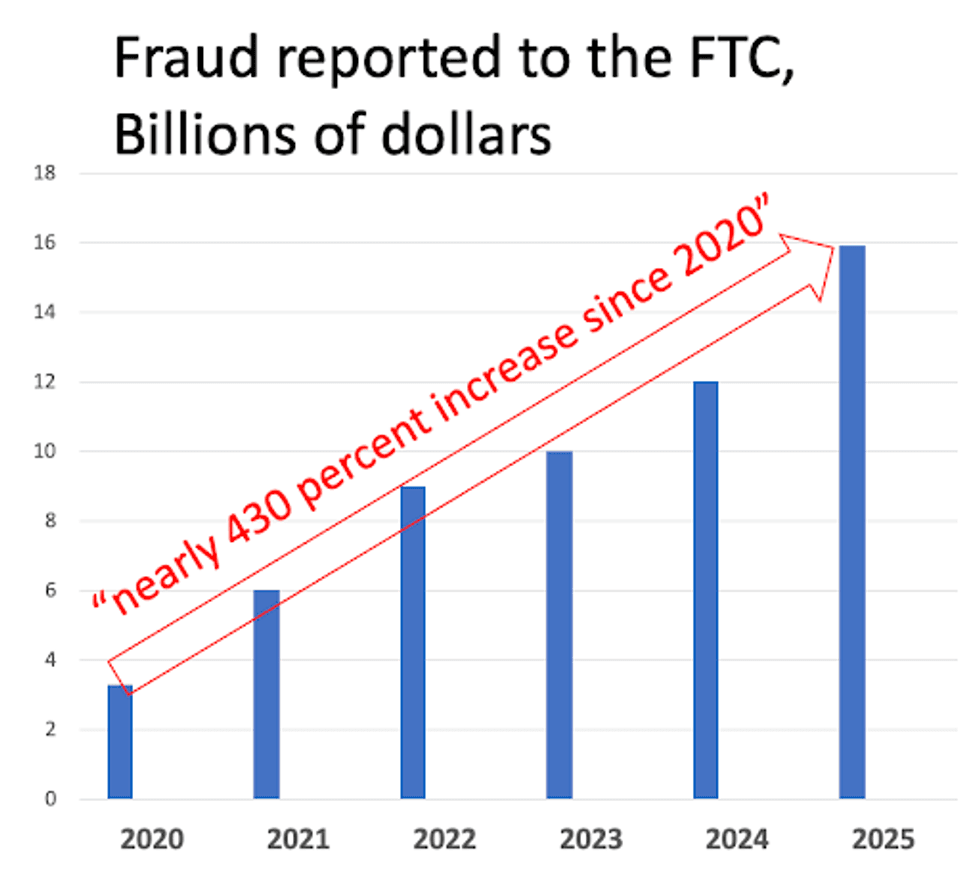
The money flows mainly into the pockets of foreign crime syndicates—Chinese gangs in Southeast Asia running investment scams, Indian call centers preying on seniors, Mexican narco‑terrorists funneling the proceeds from time‑share fraud into drug trafficking, and others. Who is behind the “toll road” scam that we’ve all received via text message? Chinese cybercriminals.
Teens are at risk, too. Sextortion specialists in West Africa and the Philippines have caused more than 36 teenagers to commit suicide.
The future looks grim. Over the next three to five years, INTERPOL expects a sharp escalation in transnational fraud, driven by artificial intelligence, low-cost digital tools, and increased global criminal collaboration. INTERPOL reports a global surge in AI-enhanced fraud schemes, notably sextortion, investment scams, impersonation frauds, and fake kidnappings for ransom.
Sounding the Alarm
Corporate America started warning last year about the severity of the threat. In February 2025, Google issued a report entitled: “Cybercrime: A Multifaceted National Security Threat.”, urging policymakers to elevate cybercrime as a national security priority.
In late 2025, Amazon, Google, JPMorgan Chase, Meta, Microsoft, Target, and 40 other companies sent an open letter to Congress saying “Scams are a fast-evolving national security threat.” They described a “national epidemic” that endangers public trust and economic stability alike, and concluded: “Our country, its citizens, and its corporations are being targeted and robbed by transnational criminal operations.” Senator Chuck Grassley made the same point at a 2025 Judiciary Committee hearing, describing “industrial‑scale fraud” by transnational organized crime groups as “a national security crisis hiding in plain sight.”
A New Presidential Executive Order Targets Cybercrime
In early March 2026, President Trump signed a landmark Executive Order on Combating Cybercrime, Fraud, and Predatory Schemes Against American Citizens, declaring it the policy of the United States to “protect Americans from, and harden our financial and digital systems against, these threats.” The president ordered the Departments of State, Treasury, War, Homeland Security, and the Attorney General to prepare an action plan by July 2026.
For the first time, the White House described cyber-enabled fraud as not just a consumer protection issue, but as an attack by transnational criminals. Stated that cyber protection for U.S. citizens is a priority. Assigned a White House official to coordinate the action plan: the Homeland Security Advisor. The Office of the National Cyber Director is also to be consulted. Elevating the issue to the White House level is the right call when faced with a threat that cuts across multiple departments and agencies.
The new Executive Order is a critical step toward restoring trust and safety in our digital economy.
As the nation begins to mount defenses to thwart foreign cybercrime, we would do well to consider some best practices.
The Counterterrorism Model
In recognition of the rising threat of Transnational Criminal Organizations (TCOs), we should think big and create a National Center in the executive branch. The Center would be an operational interagency effort, modeled on the successful National Counterterrorism Center (NCTC) that the U.S. government created after 9/11. The new Center could be under DOJ and DHS, and it would comprise relevant elements from across the government and the private sector. Its mission would be to address all of the ways we are being attacked by transnational criminals, including scams.
In recent months, the federal government has created a variety of task forces to address particular parts of the transnational crime threat. Rather than pursue individual approaches, a National Counter TCO center would provide a more comprehensive and efficient response.
The UK Model: Intelligence and Data Fusion
In March 2026, the British government announced its newest Fraud Strategy and committed £31 million to launch an Online Crime Centre (OCC) in April 2026. The OCC will “unite UK policing, the UK Intelligence Community (including GCHQ, the National Cyber Security Centre and the National Cyber Force) alongside private sector partners from the financial, telecommunications, technology, and cyber industries.” The goal is not just to respond to fraud, but to disrupt it at scale—analyzing large volumes of data to block calls, freeze accounts, and take down fraudulent websites. The UK also recently created a centralized reporting system to speed analysis of victim reports.
Initial U.S. Steps Require Follow-Through
The U.S. Government’s response lags significantly behind that of the British government. The U.S. has not yet created a national strategy, a centralized reporting system, or an intelligence-driven data fusion center. As a result, the U.S. approach is mainly reactive, not preventative. We’re falling further behind.
The UK has committed £250 million over three years to combat fraud, but neither the White House nor Congress has yet allocated the necessary resources. In the U.S., the Administration's budget request proposes a $555.1 million reduction to the FBI's budget for FY 2026.
To illustrate the mismatch in resources, the UK’s central reporting system uses AI from Palantir to analyze the crush of fraud reports. But the FBI told Congress in late March that the Bureau does its analytic work manually. Why can’t our FBI afford modern tools?
As other nations raise defenses, the U.S. risks becoming an increased target. But that outcome is not inevitable. The U.S. has the best technology in the world. With the proper leadership and resources, we can defend our nation against the growing scourge of cybercrime.
The Cipher Brief is committed to publishing a range of perspectives on national security issues submitted by deeply experienced national security professionals. Opinions expressed are those of the author and do not represent the views or opinions of The Cipher Brief.
Have a perspective to share based on your experience in the national security field? Send it to Editor@thecipherbrief.com for publication consideration.
Read more expert-driven national security insights, perspective and analysis in The Cipher Brief








 English (US) ·