
For some time, we had been chasing his shadow—to understand the phenomenon; the player; the man; the initials; the name that has become an international brand that children chant at the top of their lungs all over the planet, especially in the United States, where his aura is on par with that of a head of state. A few days before he flies off for the World Cup, the meeting is held in an immaculate mansion in central Madrid, a few meters from the Prado.
The player has just designed his own watch with the Swiss watchmaker Hublot—a limited release of 200 pieces, on which appears the motto “Trust Yourself” set into the dial. It’s a mantra he has followed since his first steps onto the field. “A project like this is part of a broader experience and lets me reach new stages in my life as a man,” Kylian Mbappé says at the outset, seated in a wide armchair. He has been an ambassador for the watchmaker since 2018, when, in the wake of France’s World Cup victory, the brand recognized the star’s incomparable marketing potential. Since then, other partners have rushed in. Nike had begun as early as 2006, supporting the boy from Bondy by supplying him with cleats; it has since been joined by about 10 other brands, including Oakley, Dior, Lego, the hotel group Accor, and health-tech unicorn Alan. Designer Ora-ïto, a friend of the player who has made a habit of elevating objects for major groups, sees a whole range of advantages for those who attach their name to a face synonymous with victory: “He embodies performance, speed, France. He has style, a kind of elegance in the way he moves,” says the designer, who compares him to a Ferrari Testarossa. “His ability to learn languages, to speak in a structured way, works in his favor. He has a different business model from others; he does not just do underwear ads like some do. He becomes a shareholder in certain companies, or a partner.” Ora-ïto sees “KM” as ready to follow in the footsteps of Jordan, Lacoste, or Stan Smith, whose names also resonate beyond the realm of sports performance.
For all that glittering display, the past few months for Kylian Mbappé have surely been among the most complicated of his young career. Under fire from critics at Real Madrid—the club whose jersey he has always dreamed of wearing—which has endured a trophy drought despite the arrival of the French attacker, even though he arrived in the Spanish capital as a kind of messiah. No one can fault his individual statistics (42 goals in 44 matches this season), but they reflect a Mbappé paradox in which the solo score sometimes takes up more space than the hoped-for collective symphony.
All of this is happening at the very moment when Paris Saint-Germain, his first long love story—which ended in drama after six years of romance and a labor-court case—has reached the summit of Europe since his departure. A form of irony everyone can interpret as they wish. “The character is becoming more and more intriguing. It would be quite interesting to psychoanalyze him at this point. He has always known he was very strong, but is he as strong as he thought he was?” asks essayist Olivier Guez, author of Éloge de l’esquive.
“There are simple things in life that people sometimes do not allow us to do. We can be criticized for things everyone does.”
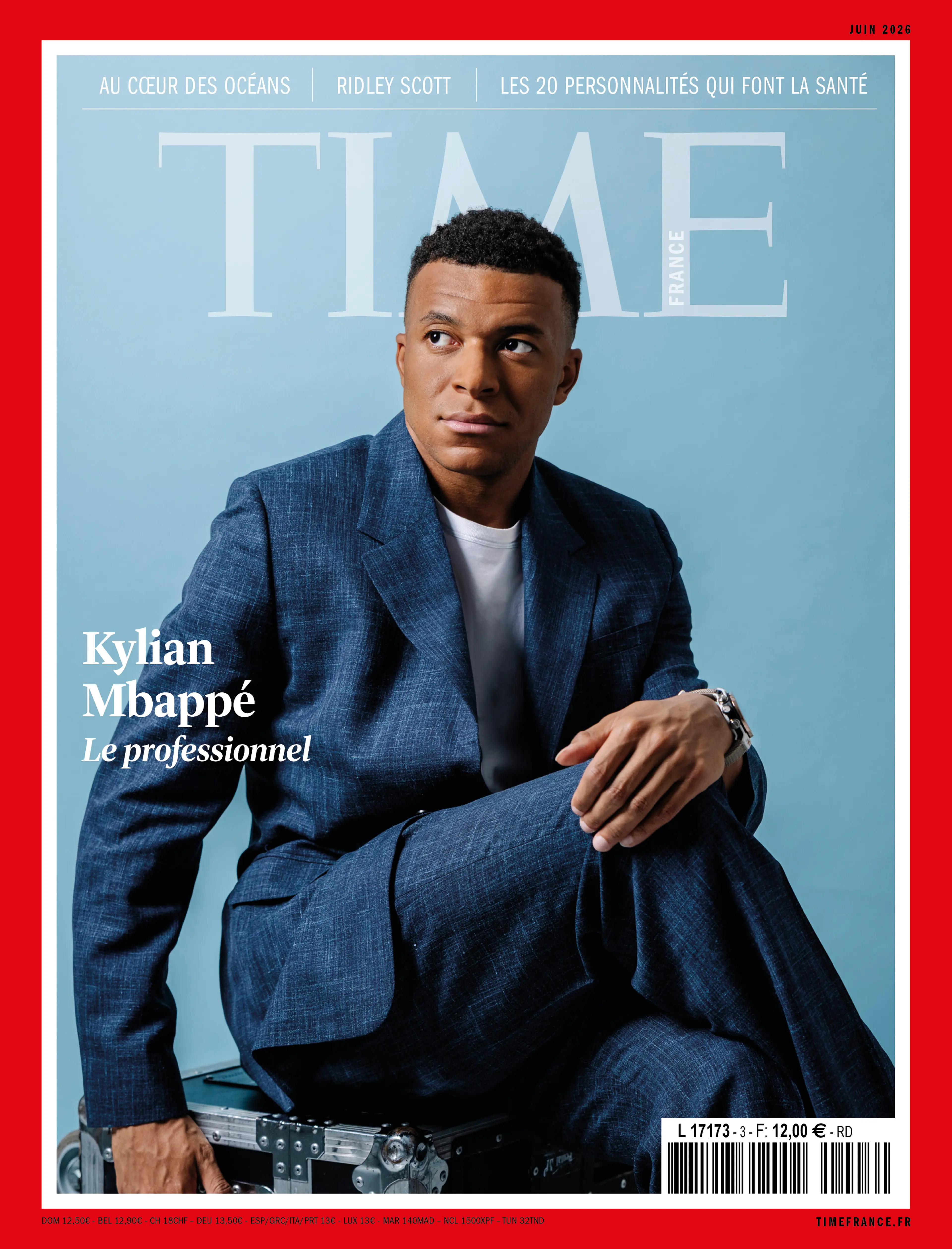
Photograph by Sébastien Leban for TIME France
A talent out of the ordinary, precocious beyond doubt… Kylian Mbappé has all the qualities of a sage who seems to have already lived nearly everything by the age of 27. This spring, in Spain he was criticized for a getaway to Italy with his partner, actress Ester Expósito, while injured—something many others before him have done.
The criticism has become par for the course on any number of subjects. “There are simple things in life that people sometimes do not allow us to do. We can be criticized for things everyone does,” he brushes off.
Watched, tracked, scolded. Needing to remain impermeable to everything that is said about him is another stylistic exercise built into the equation of being a global star. “It is starting to become part of my daily life. For about 10 years now, it has been like this. You cannot change people, or the way they think, or the way they act. You can only change your own, evolve just as much as a person as you do as an athlete. The rest is beyond our control. So we try to control only what we can control,” confesses the player, sitting just a few feet from his father, Wilfrid Mbappé, who is listening carefully so as not to miss a word. The former coach at AS Bondy—where Kylian first emerged—is well acquainted with the torments of top-level competition, which he rephrases carefully: “When you get on a boat, there are all sorts of things on board, including some you do not want. You have to deal with them. People in football are fickle: today they will hate you, tomorrow they will love you. It is not a matter of what is fair or unfair.”
Being equipped to handle the demands of that life is essential. And, watching him move easily among the various people present at our interview, Kylian Mbappé seems to have understood that. He switches from French to English to Spanish in half a second. The athlete does not let himself be dribbled by the slightest sensitive subject, practicing an art of evasion beneath an XXL smile, under warm spotlights that illuminate his blue linen suit.
Seeing him surrounded that day by about 10 people, from his personal assistant to his bodyguard, one wonders whether this young man ever gets to spend time in apparent solitude. Years ago, he admitted he once got into a friend’s car to drive around the Paris ring road and savor a whiff of freedom. Moments of anonymity are almost nonexistent. “I haven’t had any since,” he says with a laugh. “I think that over time, people like me have fewer and fewer of those moments. But maybe after a career, we’ll get a little of that back.” If he were given a magic wand to seize one thing that is unattainable for him today, what would he choose? “Erase people’s memories,” he says, with a hint of truth. “But that’s impossible. Maybe make them forget my face...” he continues, as if the overall burden of this daily life amounted to quite a bit of weight after all.
Last summer, for the first time in a long while, the Mbappé clan vacationed together in Marbella. Around the table, the player was surrounded by his brothers: Ethan, also a soccer player at Lille; and his older brother Jirès Kembo Ekoko, a former Rennes striker; under the eye of their father, who had not enjoyed a moment like that for several years. The reason: a schedule that allows fewer and fewer such sheltered interludes. “Because we don’t have that time. And sometimes you can’t give what you don’t have,” says Mbappé, who is now used to spending part of his summers in major competitions.
In this World Cup in America, Kylian Mbappé will shoulder the heavy task of continuing to lift the French team to the top, as in the previous two editions.
In 2018, in Russia, he announced himself to the world and played a major role in France’s second title. Four years later, he almost single-handedly led the revolt against Lionel Messi’s Argentina in the final, despite a hat trick that was not enough to reverse the result. The most-watched event in the world alongside the Olympic Games, the World Cup has a way of awakening the souls of those who want to leave their mark on sports history. In these globally televised battles, he could break the record for goals scored in a World Cup and add another line to his personal pantheon, while trying to stitch a third star onto the French jersey. “Today, everyone thinks we are a great team. But I have always felt that great teams are the ones that win. As long as we haven’t won, we won’t have that status, even though I think this is a team that gives people a lot of hopes and promises,” says the man appearing for the first time in the tournament with a captain’s armband—“an extra responsibility I’ve managed to absorb and understand”—which bestows on him a new dimension.
“He has become the person he wanted to be. We all have dreams: to be a teacher, a singer... Kylian used to say, ‘Dad, I’m going to become a footballer.’ When he was 4 or 5 and said that, everyone laughed. We did too. He believed in himself more than anyone else did,” admits his father, who has advised him on his sporting choices since childhood.
The expectations and hopes of an entire country seem to ignite something in the man whose eyes light up when he is told he has a certain taste for adrenaline. Almost a visceral urge to answer criticism. “It has always been the case in my three World Cups. In 2022, I was already in the eye of the storm, on and off the field. In 2018 too. When the World Cup comes around, people have a strange feeling toward me... and maybe that wakes me up every time.”
“When the World Cup comes around, people have a strange feeling toward me.”
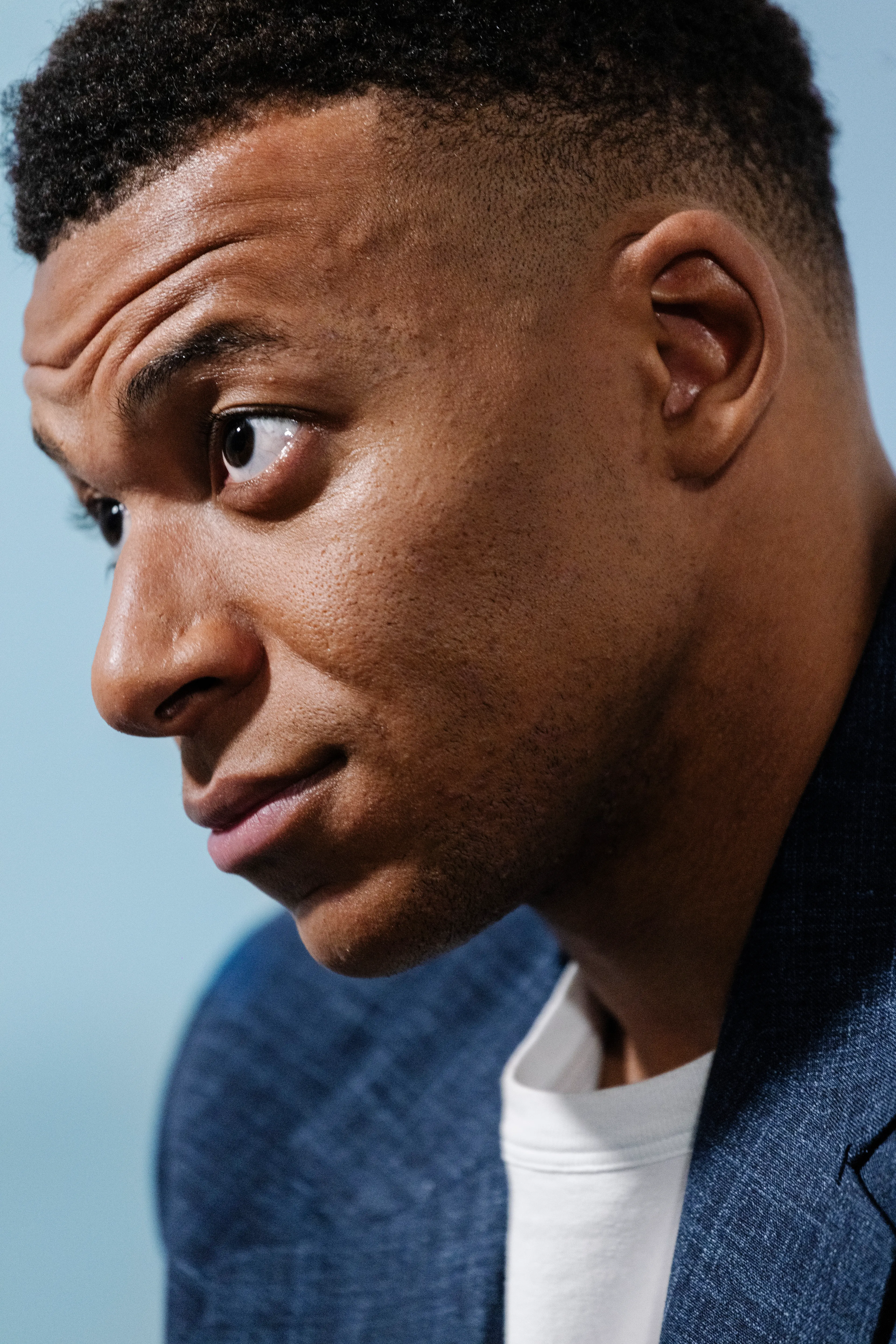
Photograph by Sébastien Leban for TIME France
If he manages it, he will do better than Zinédine Zidane, who failed to deliver a second World Cup to France. That was 20 years ago, in 2006: the famous headbutt in the final France lost to Italy on penalties, experienced at the time as a national tragedy.
As with every major sporting event, the family was gathered around the television with friends, and young Kylian experienced his first soccer heartbreak. He was 7 years old. “It was the first World Cup I followed while understanding football: Zidane’s last one, the Panenka, the headbutt... It was hard. There was so much sadness. It’s hard to think things end like that.”
Years later, in a kind of passing of the torch, he follows in the tricolor legend’s footsteps, both with France and in Madrid. After this World Cup, they may meet again, if Zidane agrees to become the new coach of the French national team, a promised role that seems almost an open secret. Each in their own way, they will leave a mark on French soccer.
And what would he like people to remember? “I’ve entered the category of people who will leave more than one mark, for better or for worse. I think everyone will keep their own trace of me—the one they want to keep. As for me, I just try to do what feels right.”
Five years ago, he created his foundation, Inspired by KM, which supports 98 young people and helps them fulfill themselves and realize their dreams through the start of their working lives. Coming from all backgrounds, they travel the world—Cameroon, New York, Peru, among other places—and take part in everything from public-speaking workshops to school renovations. A way to open themselves to the world and encourage coexistence.
It’s an initiative that resonates deeply in the family and seems to inspire more pride than certain feats in front of goal. “What matters to me most is the man he is becoming. All the values he carries today are the same ones we were already passing on in Bondy, on our own small scale, and that he has carried forward,” says his father enthusiastically. He and Kylian’s mother, Fayza Lamari, a former handball player and youth-center leader, seem to have placed education at the top of priorities.
Though he is often targeted by every kind of criticism on social media, Kylian Mbappé becomes more forthcoming when the subject is online harassment. “We are the social-media generation, the best placed to talk about the benefits, but above all the damage, these platforms can cause,” he warns. “It is harder for those children who are bullied and despised than it is for us, because it happens to them in a very brutal way and they are not prepared for it. This issue has to be treated as a priority, because it affects more and more young people.” A message for politicians? Many would like to see him take up social issues, while others criticize him for the slightest move beyond his own lane.
At 19, he was invited to lunch at the Élysée during an official visit by Liberian President and former player George Weah, who had come to discuss the place of sport on his continent. “Even though I’m French, helping African sport develop is something that matters to me,” the young Mbappé explained from the courtyard of the Élysée, completely unfazed—he whose parents have Cameroonian and Algerian roots.
Images of Emmanuel Macron comforting him a few minutes after the lost World Cup final in Qatar went around the world. The French president had also thrown himself into persuading the player to stay with Paris Saint-Germain in the summer of 2022, as if trying to keep a monument that belongs to the national heritage. That semblance of closeness can backfire when the popularity curves of athlete and politician move in opposite directions.
Yet little is known about Mbappé’s actual opinions, except that he wants to fight “the extremes.”
“He shows that soccer is not the only thing that concerns him. That gives him a dimension bigger than just being a footballer,” says sports sociologist Béatrice Barbusse.
World Cups will come and go. Perhaps he will eventually win the Ballon d’Or that has seemed destined for him since childhood and that, until now, has eluded him just like the Champions League. But where will he be later on?
When we are no longer looking back, eyes fixed on Zidane’s headbutt, but instead on his footsteps on American soil?
Kylian Mbappé will then have thousands of possibilities: his various businesses, his foundation, the soccer club Stade Malherbe Caen, of which he is the majority shareholder. “I don’t know whether I’ll stay close to the pitch or not. I’m trying to give myself as many options as possible. I already have a few, but I’m exploring every possibility to do what truly pleases me. I’m lucky to be privileged and able to choose what will make me happiest,” he predicts.
In that afterlife, which will begin at most within the next decade—because an athlete’s career passes in a flash—he imagines his influence will remain intact. “Unless there’s a law saying that when you stop playing, people forget you, I don’t think they’ll forget me.”
“Unless there’s a law saying that when you stop playing, people forget you, I don’t think they’ll forget me.”
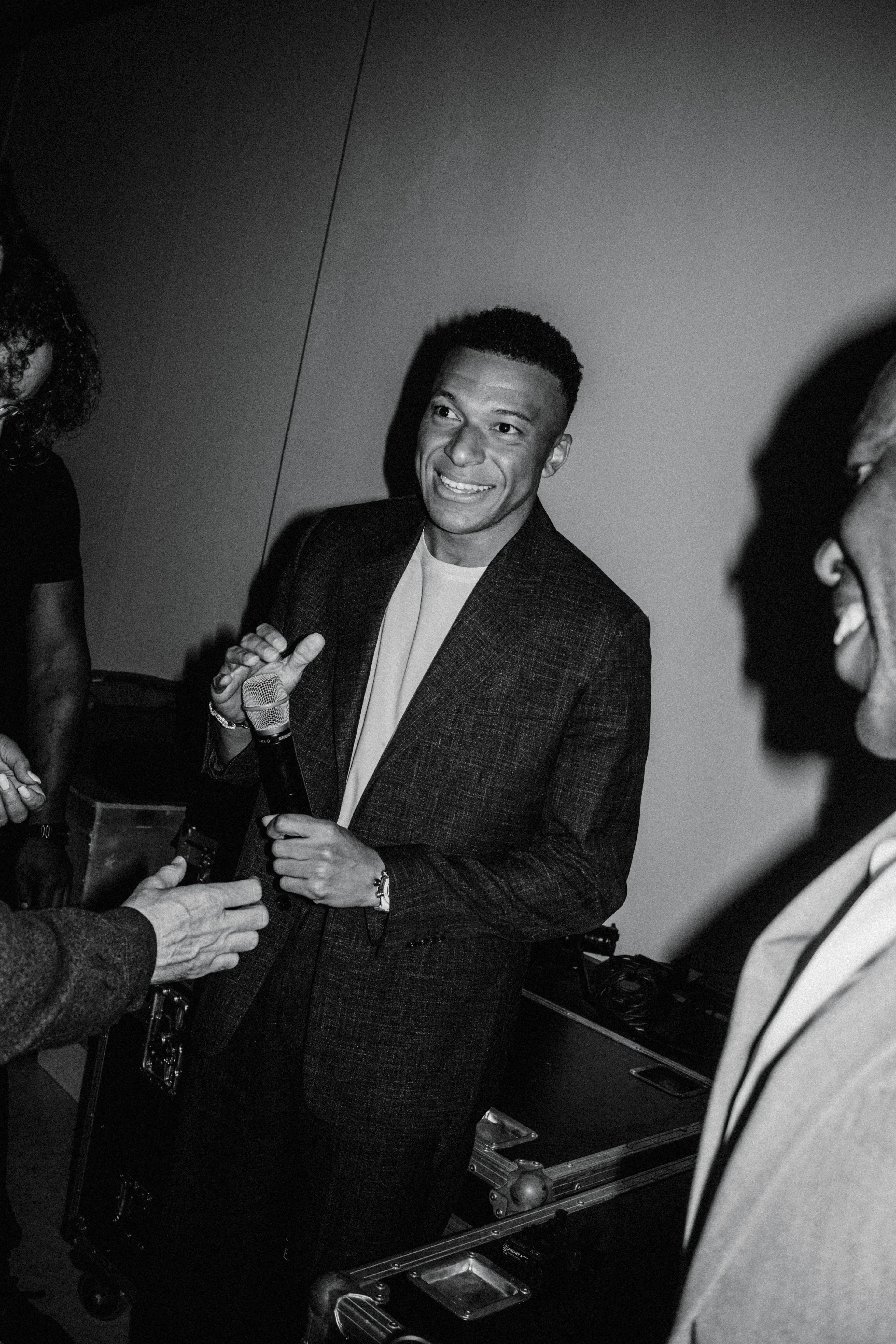
Photograph by Sébastien Leban for TIME France
The groundwork is already in place with a structure—Interconnected Ventures—chaired from Paris by his mother, Fayza Lamari, and run day to day by Ziad Hammoud, formerly of beIN Sports, with about 20 employees.
From partnerships to communications, everything is perfectly managed. Enough to keep him from scattering his energy. “It lets me stay even more focused on my profession, while growing as a man. To start understanding my business, to take an interest in the foundation. It’s gratifying to see his evolution on the field because that is what matters most today, but his evolution as a man, businessman, and citizen of the world who wants to help, inspire, and give the best of himself is just as important.”
So much so that he has even become raw material for fiction. “He now belongs to the collective narrative; it’s natural for literature to take hold of him at some point,” says writer Anne Akrich, who drew on the player’s success as the material for her novel. “You can clearly see his desire to pass things on, to give back the luck he has had,” continues the author of Kylian, who sees in her subject a path that is “spectacular, straight, spotless.”
Time is up. Before the lights go down and he briefly exchanges a few words in front of a crowd of guests and then disappears into a van with tinted windows, we tell him what led us to come all the way to him, with the question all children around the world ask about an athlete of his caliber. Who is he when the camera stops rolling? Does he really know? “Just a normal guy. Sometimes there’s no need to look any further than normality. I’m a normal son, a normal brother, a normal friend, trying to live my life at 27 in a context that is anything but normal.” The price to pay.



 English (US) ·