
To bomb or not to bomb Kharg Island? To launch or not to launch a ground offensive? These are the questions that seem to be occupying American and Israeli military planners right now.
Kharg Island, an arid piece of land measuring some 20 square kilometres near the port city of Bushehr, accounts for the bulk of Iran’s oil exports.
Taking it out would take seconds and devastate the Iranian economy for decades to come.
Read moreMiddle East war live: Iran to face ‘most intense day’ of US attacks, Pentagon chief says
Yet the Trump administration appears reluctant about how – and even if – it should launch an attack on this tiny coral islet.
According to several news outlets, discussions within the Trump administration are currently running high on how to deal with Kharg Island.
Hands off?
Although Israel’s former prime minister Yair Lapid last week bluntly stated that “all of Iran's oil fields and energy industry on Kharg Island” must be destroyed if Israel and the US ever hope to topple the sitting regime, all attacks on Iran’s energy infrastructure have so far been avoided.
But why? Especially since most experts agree on the strategic importance of Kharg Island.
Neil Quilliam, a Gulf energy specialist at think-tank Chatham House, described the island as “the crown jewel” of Iran’s oil industry.
Sonia Martinez-Giron, executive director of the International Team for the Study of Security Verona (ITSS), confirmed Kharg’s undisputed value for Iran: “It harbours 90 percent of Iranian oil exports, and is the artery connecting the Iranian economy to the global economy”.
According to Andreas Krieg, a senior lecturer at the School of Security Studies at King’s College London, “Kharg is one of the few places where a strike could have immediate strategic and economic consequences.”
Scott Lucas, a professor of international politics at the University of Dublin, said a take-over of the island would be “the equivalent of trying to seize every tanker of the Russian (shadow) fleet”.
Read moreMacron announces future ‘defensive’ mission to reopen the Strait of Hormuz
The rise of the Iranian lifeline
So how did Kharg Island become such an important oil hub in the first place?
The island was initially developed as Iran’s principal crude oil export terminal by an American-Iranian joint venture, the Khark Chemical Company, under the former shah in the 1960s. More infrastructure was added to the island under the more than four-decade-long reign of Ayatollah Khamenei. Today, it is almost completely covered in terminals, pipelines and storage tanks.
The main reason for why Iran has concentrated its precious oil exports to Kharg Island is location.
“Because of the shallow waters of the Gulf, very large tankers cannot berth near the inland,” Quilliam explained. “They need to offload and unload from a deep port, and the only one really available is the one on Kharg Island.”
Geographical Magazine, a publication belonging to the Royal Geographical Society, wrote that “the result is a dense concentration of energy infrastructure that makes the island one of the most strategically sensitive points in the global oil network”.
One of Iran’s best-defended sites
Prior to the western sanctions on Iran because of its nuclear programme, oil companies from across the world sourced crude from Kharg Island. It was particularly important for French energy giant Total.
Over time, the island became so important for Iran that it even turned into a priority target during the Iran-Iraq war in the 1980s. Already back then, Kharg Island was in the crosshairs of its enemies because its destruction would economically cripple Iran.
The war destroyed most of the facilities on the island, and after it ended, Iran made it a priority to rebuild them.
Since then, Kharg Island has become one of Iran’s best defended sites.
But, noted Quilliam, “if the US or Israel wanted to carry out strikes against it, they have the capability to do so”.
So why don’t they?
What is holding the US and Israel back? For one, Lucas explained, because it would represent a major escalation of the conflict.
“You hit Kharg and the Iranian regime's going to say: ‘Look, we've got nothing to lose by just simply going all out.’ And that means choking off the straits. It means going after refineries across the Middle East.”
Secondly, because it would not only hurt Iran.
“Global oil prices just reached historic high levels,” Martinez-Giron said. “Seizing Kharg Island in a moment like this would be the last blow to Iran’s economy, and it would have consequences beyond this war, affecting the global economy and security.”
"Kharg Island highlights the interconnectedness of the energy sector with food systems," she said, pointing to the link between transport costs and food costs.
“It is difficult to see how a decision like this would harm the regime without harming human security."
Quilliam also noted that Washington might want to avoid bombing the island because if it manages to replace the current leadership, “the successor regime will need to operate Kharg Island. It will be essential to the success of any successor, simply in terms of the money it's going to generate”.
What about a ground offensive?
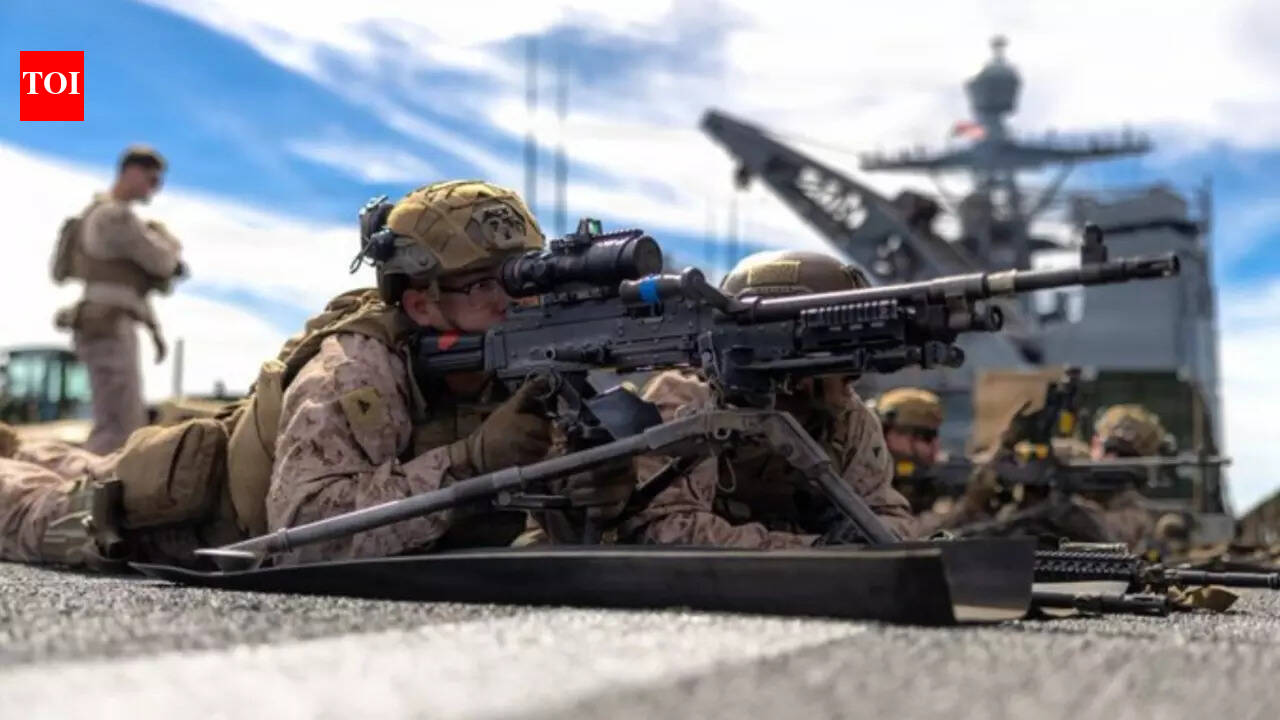
This is why an attempt to seize, rather than destroy, the facilities on Kharg Island through a ground offensive might be an option.
But the experts FRANCE 24 spoke to are sceptical this is even up for serious debate.
"As for the rumours about a US land operation, I would treat them carefully,” Krieg said. “A landing operation there would be a major escalation. It would mean physically taking or neutralizing a strategic island close to the Iranian coast while exposed to Iranian missiles, drones and naval retaliation. That is a much bigger step than an airstrike."
Martinez-Giron said it is more likely that a third, less reported, option might be on the table.
“We are waiting to see whether there will be sabotage and cyberattacks affecting the oil infrastructure on the island. This would certainly choke the Iranian economy without having to engage militarily.”
This article was adapted from the original in French by Louise Nordstrom.






 English (US) ·