
Iran's Revolutionary Guard Corps has declared the Strait of Hormuz — a waterway through which around 20% of the world's crude oil supply flowed until the war — closed to any ships not explicitly granted permission by Tehran, warning of a severe response for any violators.
The global price of crude oil jumped over $110 a barrel on the news Friday. Before the U.S. and Israel launched the war on Iran one month ago, a barrel of benchmark Brent crude was trading at just over $70 a barrel.
The IRGC Navy appeared to make an example of three Chinese-owned commercial vessels this week that tried — but failed — to make it through the strait and out of the Persian Gulf.
"This morning, following the false statements of the corrupt U.S. president claiming that the Strait of Hormuz is open, three container ships of different nationalities moved toward the designated corridor for authorized vessel traffic, but were turned back after warnings from the IRGC Navy," the Iranian military said in a social media post.
Early Friday morning, data from the MarineTraffic website showed that two ultra-large container ships owned by China's biggest shipping company, COSCO, made a sharp U-turn after apparently trying to sail past Iran's Larak Island. The two ships, CSCL Indian Ocean and CSCL Arctic Ocean, remained in the Persian Gulf later Friday.
A third ship, the Hong Kong-owned Lotus Rising, was forced to make a similar turnaround further out from the same island the previous day.
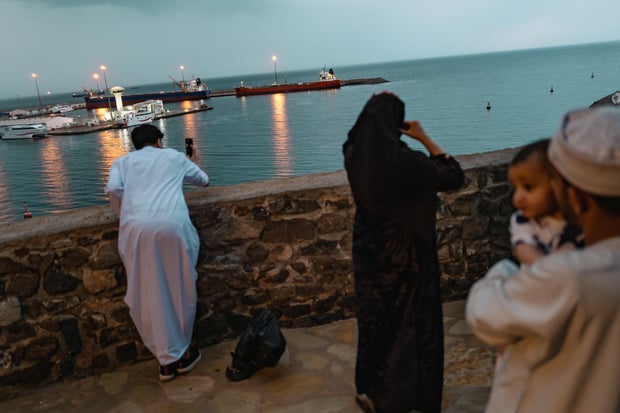 Locals take photos of two bulk carriers anchored in Muscat, Oman, March 25, 2026, as Tehran keeps international maritime traffic largely paralyzed in the Strait of Hormuz amid the war.
Elke Scholiers/Getty Images
Locals take photos of two bulk carriers anchored in Muscat, Oman, March 25, 2026, as Tehran keeps international maritime traffic largely paralyzed in the Strait of Hormuz amid the war.
Elke Scholiers/Getty Images
In its statement, the IRGC said, "the passage of any ship 'to and from' ports belonging to allies and supporters of the Zionist-American enemies, to any destination and via any corridor, is prohibited."
Larak Island has been described as Tehran's "toll booth" by analysts at maritime intelligence company Lloyd's List. It's just a few miles off Iran's coast, and Tehran has been forcing ships to pay fees to pass safely — as much as $2 million for one vessel, according to Iranian state media.
Lloyd's List says it tracked 33 transits via Larak Island in the second half of March, but no transits at all via the more common route further south through the strait. Put another way, while the Strait of Hormuz has been described as a chokepoint for oil coming out of the Persian Gulf, the route past Larak has become the specific chokepoint of Iran's chokehold on the passage.
Adding further pressure, an Iranian military official was quoted recently by the Islamic Republic's state-run media as saying another strait vital to world oil supplies could be targeted next. The Bab el-Mandeb Strait is the southern gateway from the Red Sea into the Arabian Sea and all points beyond. An estimated 10% of the world's oil supply flows through the passage, which is bordered by Djibouti to the south and Yemen to the north.
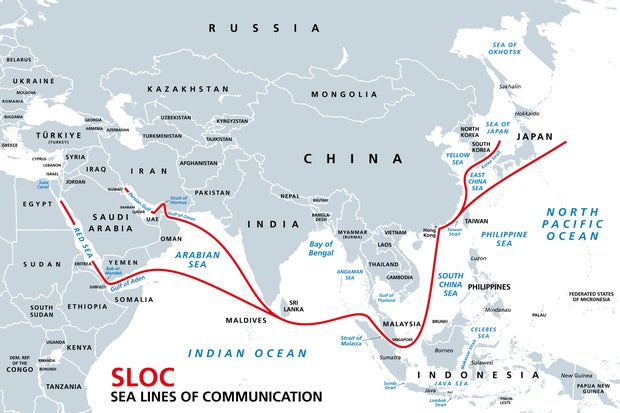 A map shows major routes for energy resources and other trade from the Middle East to Asia, including the Bab el-Mandeb strait and the Strait of Hormuz.
Getty/iStockphoto
A map shows major routes for energy resources and other trade from the Middle East to Asia, including the Bab el-Mandeb strait and the Strait of Hormuz.
Getty/iStockphoto
Yemen is home to the Houthi rebel group, which is one of Iran's most formidable proxy forces. While the Houthis have stayed out of the Iran war so far, its leaders have warned they could engage if Tehran asks them to.
The Houthis control a vast portion of Yemen, functioning as a shadow government, and their Humanitarian Operations Coordination Center (HOCC), which manages navigation in the Red Sea, told Lloyds on Thursday that there was "no cause for concern" about the strait.
"As you can see, dozens of vessels, including oil tankers, transit the Bab el Mandeb strait every day. In this context, the Republic of Yemen remains committed to safeguarding navigation in the Red Sea and the Bab el Mandeb strait, as well as ensuring the free flow of trade," the HOCC told Lloyds.
But the Houthis have attacked ships in the strait before, recently, in retaliation for Israel's war in Gaza, and with Iran coming under more intense pressure from the U.S. and Israel, the threat is once again looming.
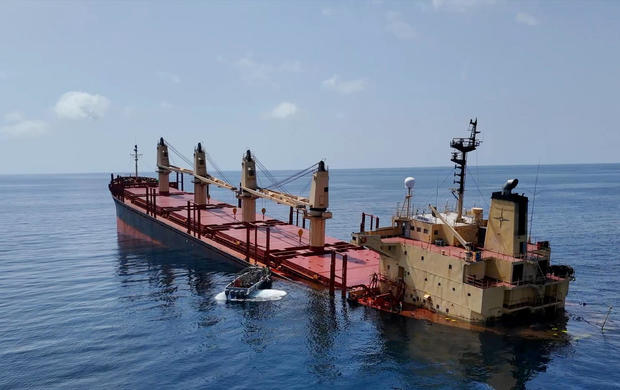 Photo provided by Yemen's Al-Joumhouria TV of the U.K.-registered cargo ship Rubymar sinking after it was targeted by Yemen's Houthi rebels in the Red Sea, near the entrance to the Bab el-Mandeb strait, March 3, 2024.
Photo by Al-Joumhouriah TV channel via Getty Images
Photo provided by Yemen's Al-Joumhouria TV of the U.K.-registered cargo ship Rubymar sinking after it was targeted by Yemen's Houthi rebels in the Red Sea, near the entrance to the Bab el-Mandeb strait, March 3, 2024.
Photo by Al-Joumhouriah TV channel via Getty Images
If both of the Mideast's maritime chokepoints did come under threat, it would significantly increase the constraints on oil and natural gas supplies from the region.
Analysts with the Australian investment bank and financial services firm Macquarie are now warning of a 40% chance that oil could hit $200 a barrel by June, which has never happened.
Iran's parliament is drafting a bill to make its fees on ships trying to transit the Strait of Hormuz "official," according to state run media, with the plan apparently set to be finalized on or around the first week of April.
The United Arab Emirates, the Gulf state most targeted by Iran, by far, since the war started, is pushing dozens of countries to join it in forming a "Hormuz Security Force" to reopen and defend the strait, according to the Financial Times.
The head of the UAE's Abu Dhabi National Oil Company, Sultan Ahmed Al Jaber, was in Washington this week for a meeting with Vice President JD Vance. He said Iran's actions in the Strait of Hormuz amount to "economic terrorism."
"When Iran holds Hormuz hostage, every nation pays the ransom. At the gas pump, at the grocery store, at the pharmacy, every household," he said in a speech the day before his meeting with Vance. "No country can be allowed to destabilize the global economy in this way. Not now, not ever."
In:
Iran maintains chokehold on Strait of Hormuz
Iran maintains chokehold on Strait of Hormuz despite Trump's deadlines
(04:44)





 English (US) ·