
 1 month ago
17
1 month ago
17
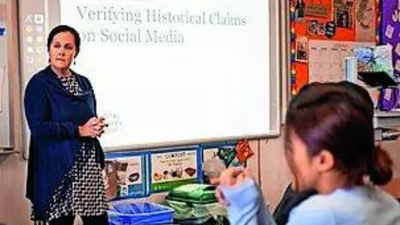
Valerie Ziegler takes digital literacy lesson at a school in San Francisco
Most teenagers know that baseless conspiracy theories, partisan propaganda and artificially generated deepfakes lurk on social media. Valerie Ziegler's students know how to spot them.At Abraham Lincoln High School in San Francisco, she trains her govt, economy and history students to consult a variety of sources, recognise rage-baiting content and consider influencers' motivations. They brainstorm ways to distinguish deepfakes from real footage. Ziegler, 50, is part of a vanguard of California educators racing to prepare students in a rapidly changing online world. Content moderation policies have withered at many social media platforms, making it easier to lie and harder to trust.
AI is evolving so quickly, and generating such persuasive content, that even professionals are being stumped.California is ahead of many other states in pushing schools to teach digital literacy, but even there, education officials are not expected to set specific standards until later in 2026. So Ziegler and a growing group of her peers are forging ahead, cobbling together lesson plans from nonprofit groups and updating older coursework to address new technologies, such as AI that powers video apps like Sora.
Their methods are hands-on, including classroom exercises that fact-check posts about history on TikTok and explore how badges that appear to signal verification on social media can often be bought rather than earned.Ziegler's efforts showcase the difficulties of keeping pace with new platforms, apps and advances in AI. "We're sending these kids out into the world, and we're supposed to have provided them skills," said the former California teacher of the year.
"The tricky part is that we adults are learning this skill at the same time the kids are."Social media literacy is a tough subject for schools to try to teach, especially now. Federal funding for education is precarious, and the Trump administration has politicised and penalised the study of disinformation and misinformation. The News Literacy Project, a media education nonprofit, surveyed 1,110 teenagers in May last year and found that 4 in 10 said they had any media literacy instruction in class that year.
Eight in 10 said they had come across a conspiracy theory on social media, and many said they were inclined to believe at least one of the narratives.Ziegler teaches the self-described "screenagers" that their social media feeds are populated using highly responsive algorithms, and that large followings do not make accounts trustworthy. In one case, students learned to distinguish between a reputable historians group on Instagram and a historical satire account with a similar name.
Now, they default to double-checking information that interests them online.
"That's the starting point," said Xavier Malizia, 17. Elisha Tuerk-Levy, 18, said it was "jarring" to watch a realistic AI video of someone falling off Mt Everest, but added that the visuals in such videos were often too smooth - a useful "tell" that helps identify them as fake.Policymakers are paying more attention to the issue. Dr Vivek Murthy, the surgeon general under former President Joe Biden, urged schools in 2023 to set up digital literacy instruction.
At least 25 states have approved related legislation, according to an upcoming report from Media Literacy Now, a nonprofit group. Many of the new rules, however, are voluntary, toothless or slow to take effect or do not acknowledge the growing presence of AI.
"I absolutely wish we could make things happen faster," said California Assembly member Marc Berman, a Democrat who wrote two media literacy bills passed in 2023 and 2024. "It's about really strengthening those foundational skills so that no matter what tech pops up between now and then, young people have the ability to handle it," Berman said.






 English (US) ·