
 2 weeks ago
18
2 weeks ago
18
Europe must take the lead in defending itself as the world becomes more militarised, but the US is not abandoning its NATO allies, a top American official has said.
Elbridge Colby, the US Under Secretary of War, said the alliance must be prepared for potential enemies to strike simultaneously in different parts of the globe.
This was why European members of NATO must take the "primary responsibility" when it comes to defending their homeland - as US forces are focused elsewhere.
Ultimately, he said the alliance needs to become a modern version of its original Cold War status - defined by hard and credible fighting strength.
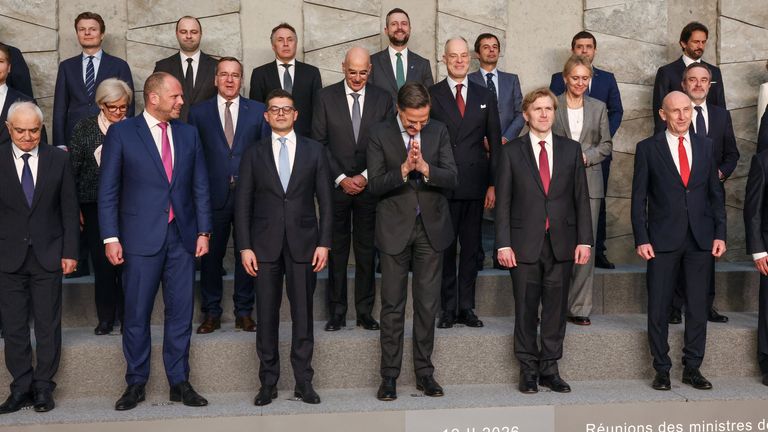
Mr Colby, who was representing Secretary of War Pete Hegseth, made the comments at a meeting of NATO defence ministers in Brussels on Thursday.
Allies have tried to play down his boss's absence as not signalling a reduction in US prioritisation of NATO.
"The world that shaped the habits, assumptions, and force posture of NATO during the so-called 'unipolar moment' following the Cold War no longer exists," Mr Colby said, according to a transcript of his remarks that were published by his department.
"Power politics has returned, and military force is again being employed at a large scale," he added.
This meant that the United States, under Donald Trump, was prioritising the biggest threats to US interests - especially the defence of the US homeland and its interests in the Western Hemisphere.
"At the same time - and critically - the United States and its allies must be prepared for the possibility that potential opponents will act simultaneously across multiple theatres, whether in a coordinated fashion or opportunistically."
Nato chief: 'Having US in room with Greenland is added value'
Mark Rutte, the head of NATO, has previously raised the possibility of China making a move on Taiwan, which may draw in US forces, at the same time as Russia seeks to test NATO's Article 5 principle of collective defence by attacking a European member of the alliance.
This could leave the Europeans and Canada to tackle Russian aggression alone or with only limited US support.
Mr Elbridge said his message was about giving a reality check to his partners, not the US turning its back on NATO - something that allies have fretted about ever since Mr Trump returned to the White House.
"This is not an abandonment of NATO. To the contrary, it is a return to and validation of its foundational purpose," the official said.
He recalled how the alliance, when it was established in 1949, was defined by "a hard-nosed, realistic, clear-eyed approach to deterrence and defence. Allies from the beginning were expected to pull their weight".
UK to give half a billion to aid in Ukrainian defence
This discipline was lost after the Cold War ended as priorities shifted to fighting wars in Afghanistan and Iraq - outside NATO territory.
Mr Elbridge said the alliance must now become what he called NATO 3.0 - which was more akin to its original purpose.
"This 'NATO 3.0' requires much greater efforts by our allies to step up and assume primary responsibility for the conventional defence of Europe," he said.
Read more on Sky News:
NATO should 'be more European'
New threat of Putin's hypersonic missile
UK 'must step up' to deter Russian threat
The Under Secretary of War praised allies for heeding Mr Trump's calls to commit to increase defence and wider security spending to 5% of GDP - up from an original goal for defence spending of 2%.
But he said European leadership on defence must be durable.
"Europe must assume primary responsibility for its own conventional defence. This is not a matter of ideology or rhetorical flourish. It is a conclusion grounded in a clear-eyed and rigorous assessment of the strategic environment we face as well as a pragmatic evaluation of the capabilities at our disposal.
"At the same time, the United States must - and will - prioritise those theatres and challenges where only American power can play a decisive role."
He said the move was "not a retreat from Europe. It is, rather, an affirmation of strategic pragmatism and a recognition of our allies' undeniable ability to step up and lead on Europe's defence in a way that leaves all of us stronger and safer".







 English (US) ·