
 1 month ago
28
1 month ago
28
Alan LittleSenior correspondent

 BBC
BBC
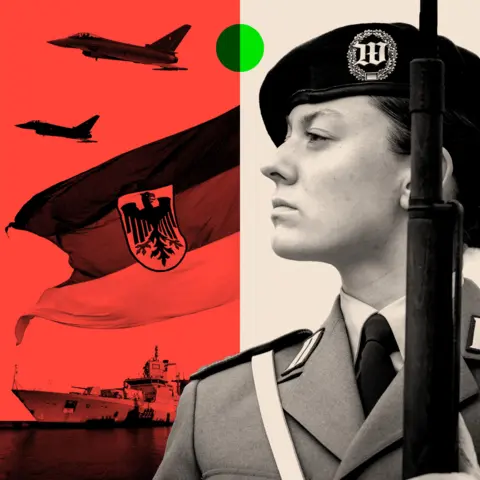
General Carsten Breuer is a man in a hurry. As head of Germany's armed forces he's the most powerful, and arguably the most important, soldier in Europe. He's been tasked with the rapid expansion of Germany's armed might, turning its army into the continent's most powerful fighting force.
For he believes Russia's ongoing attempts to bolster its military through increased recruitment and investment in weaponry will leave it strong enough to launch an attack on a Nato territory by 2029.
"I've never experienced a situation which is as dangerous, as urgent, as it is today," he told me at a military base in Munster, near the Dutch border.
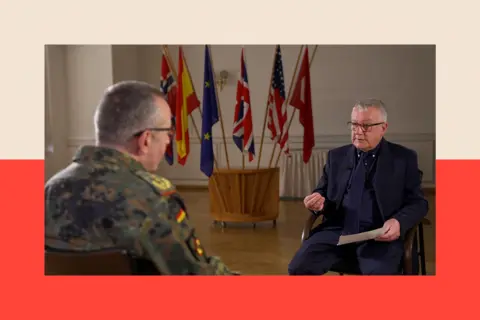
Breuer is overseeing an ambitious expansion of the German armed forces
"So what we are seeing, what we are facing, is a threat from Russia. We can clearly see that Russia is building up its military to a strength which is nearly double the size of what they had before the war against Ukraine… In 2029 it will be possible for Russia to conduct a major war against Nato. And as a soldier I have to say 'okay, we have to be prepared for this'."
Breuer joined the army of what was then West Germany in 1984, when he was 19. He is softly spoken and thoughtful. There is no soldierly swagger about him, no hint of performative military machismo, but he is nonetheless clearly driven to transform the German military and place it at the heart of the new power map of the continent.
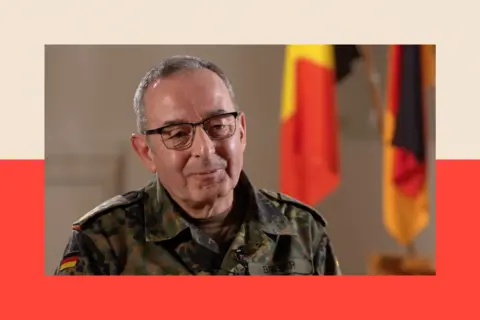
Breuer joined the German military at the height of the Cold War
Under his command, the German armed forces are rapidly expanding in strength and numbers. Germany is projected to spend €162bn (£140.2bn) on its military in 2029, up from €95bn in 2025. Opinion polls suggest the boost has strong support from the German public.
Not long ago, a re-armament programme on this scale would have alarmed Germany's neighbours, stirring the ghosts of Europe's dark past.
In the 20th Century, Germany used its powerful armies to wage some of the most destructive wars in human history, laying waste to much of the continent and killing millions.
Having suppressed its military for years in an attempt to atone for the horrors it perpetrated, can Germany fulfil its newfound ambition to become Europe's preeminent military power? And assuming it does, how will it act in the role of the continent's strongman?
To see a graphic illustration of the way Germany's place in Europe has been transformed, go to Lithuania, where Germany now has a permanent military presence for the first time since the Nazi occupation.
There are close to 1,200 German troops stationed in Lithuania. That will rise to nearly 5,000 by the end of next year.
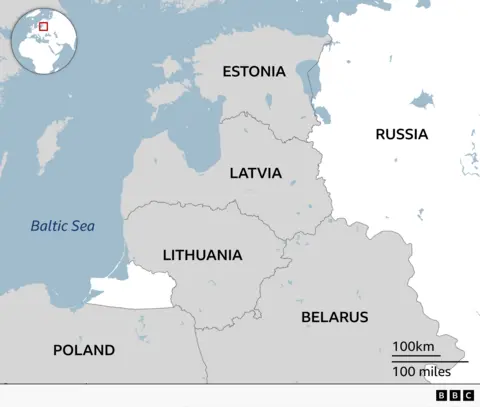
The BBC watched as the Panzerbrigade 45 (the 45th Armoured Brigade) conducted a live-fire exercise a few miles from the border with Russia's ally Belarus. They were war-gaming an invasion from the east.
The snow-covered, lightly wooded terrain here forms part of the Great European Plain. From the North and Baltic Seas in the West to the walls of the Kremlin in the east, the land is flat. There are few naturally occurring barriers - no mountain ranges, no impassable river valleys. It is highly vulnerable to invasion.
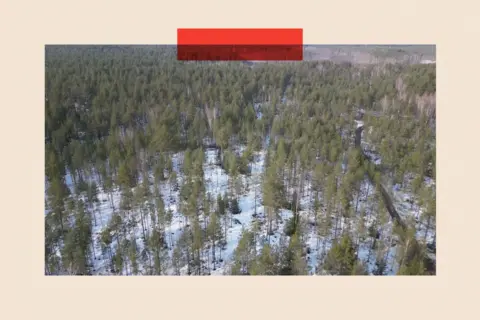
The Great Plain has been traversed by many militaries
In September 1812, Napoleon's army swept through it all the way to the Russian capital. Hitler's forces, with lightning speed, also made it to the gates of Moscow in September 1941, only to be pushed back by Soviet forces all the way to Berlin: armies, back and forward, back and forward across this exposed open terrain.
If geography is destiny, the Great Plain has shaped the history of warfare here for centuries.
"I guess we are here to fulfil what our neighbours expect from us," Lieutenant Colonel Sebastian Hagen, the commander of Panzerbrigade 45, told me.
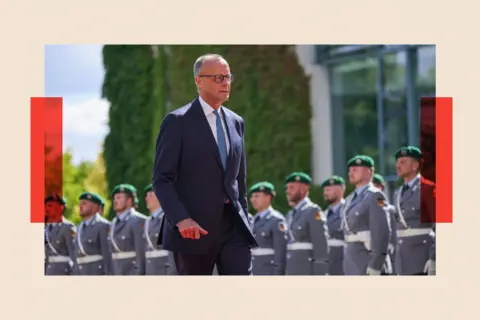
"Our Chancellor [Friedrich Merz] announced that we are building up the most powerful conventional army in Europe. And I guess this fits with the role of Germany due to our economic strengths and also to our role in Europe. And we are not doing this alone, obviously, we are doing this in Nato and in the European Union."
 Getty Images
Friedrich Merz has manoeuvred to get military spending up
This careful, unprompted commitment to the multilateralism of Germany's military efforts occurs again and again in conversations with the German military. The point is to remind you that this time, Germany is here not as an invader and occupier, but as a welcome and valued ally; that this Germany, democratic Germany, seeks not to dominate but to co-operate.
At the height of the Cold War, Germany had more than half a million personnel under arms - but always within Nato and under US supervision. But after the collapse of the Soviet Union, Germany, in common with much of Europe, ran down its armed forces to less than half their former strength. At one point it was reported that equipment was so scarce that recruits were training with broom handles instead of rifles.
 AFP via Getty Images
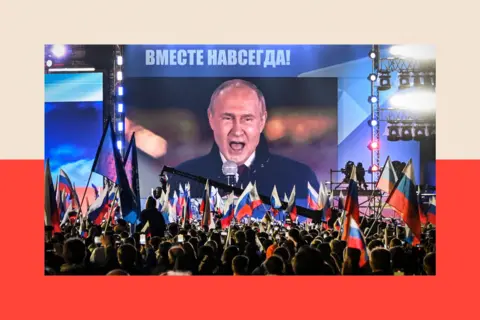
Russia is investing heavily in its armed forces under Vladimir Putin
In the decade from 2007-17, Germany, Europe's most populous country and by far its strongest economy, was typically spending just 1.2% of its GDP on defence. This was a measure of how low defence and security had fallen in the nation's priorities - and a measure, too, of the complacency into which much of Europe had sunk. Germany's new defence spend target is 5% of its GDP.
Other European nations are also reassessing their military priorities in the wake of Russia's war in Ukraine. The UK last year pledged to hit a 5% GDP target by 2035, and France is aiming for 3.5%. But still those spends fall short of Russia's, which was estimated to have spent 7.1% on its military in 2024.
Rearmament on the scale Germany is now undertaking has required a major change in the way the country thinks about its defence, and about the place of the armed forces in society.
At the Potsdam Conference of 1945, after Germany's surrender, the allied leaders agreed that in the future Germany should be demilitarised. West Germany accepted this, to try and atone for the violence it had inflicted on the continent, and was content to allow the Americans to assume leadership of its defence.
That era is over. In 2025, the German parliament voted to change the country's constitution so that strict constraints on borrowing could be lifted to fund an expanded defence budget.
It is often difficult for those of us outside the country to understand how big a deal this was for Germany. But history is the unseen guest at every table; the country remains haunted by the memory of the hyperinflation that devastated the economy in the 1920s and helped propel the Nazis to power. Germany is uniquely neurotic about debt and about unsound money. But it has, at last, let defence spending break the tight rules.
It was a profoundly significant moment. "I would say it's been a cultural revolution," says Sophia Besch, a senior researcher at the Carnegie Institute for Peace, a think tank in Washington DC.
"The Russian invasion of Ukraine has really changed the way that Germany approaches defence."
 Bloomberg via Getty Images
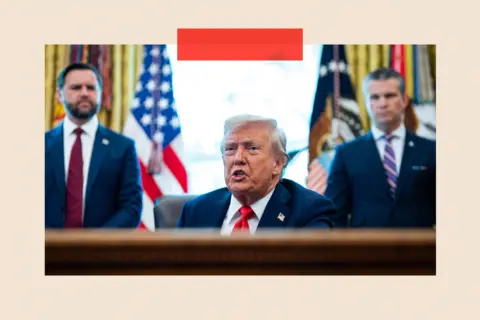
America, once a staunch European ally, is now less resolute in its commitment
That huge step was almost certainly precipitated by US Vice-President JD Vance's speech at last year's Munich Security Conference weeks after Donald Trump's inauguration, in which he put the European allies on notice that the US would no longer be the guarantor of European security. At the same time, a series of leaked messages revealed the culture of contempt, in Trump's White House, for its European allies. "I fully share your loathing of European freeloaders," Defence Secretary Pete Hegseth told his colleagues, adding, "PATHETIC".
That, it's said, is what persuaded Germany's Chancellor, Friedrich Merz, that the European powers need to pursue "operational independence" from the US within Nato.
"Pretty much the entire underpinning of Germany's post-war settlement was based around the Transatlantic Alliance," says the Berlin-based journalist and author John Kampfner.
"It was based on an assumption of American defence and security and political support. You could perhaps call it naive… But that sense of security has been blown asunder by the second Trump administration.
"I would contend that it's more destabilising for Germans than it is for the British or the French, because the British and the French have the flag to rally around, a sense of nationhood and history. But for post-war Germany, it was all about starting afresh. And it was about a rules-based order, no matter how incomplete that might be. And that, in so many ways, was the basic tenet of German foreign policy. And they now see the war to their east, and to their west [there is] the friend and ally, and the overseer that they relied upon [that] they feel is no more.
"So the mood is dark, as it is everywhere in Europe. And there's a sense of having to reassess everything."
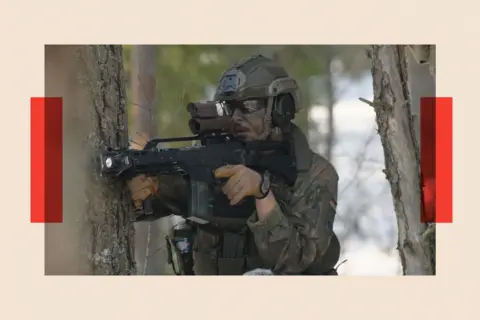
Training exercises will prepare Germany in the event of an attack
"We can call it a wake-up call," says Breuer. "We were not able and not willing, once again, to push the snooze button on this… it was a huge step for Germany, a huge step for the German population, definitely."
Breuer says Germany currently has 182,000 service personnel under arms. He wants to boost that by 20,000 within a year and by 60,000 within a decade. And that professional army will be further supplemented by a reserve force of 200,000.
He has launched a recruitment drive to bring thousands of young men in particular into the army; and if the recruitment drive does not attract sufficient numbers he will, in time, argue for a return to conscription. Given the public support for the measures, it is an argument he would almost certainly win.
The German defence ministry says 16,100 Germans applied to the armed forces in February, 20% more than last February, and 5,300 new recruits joined, representing an increase of 14% on 2025.
Germany is further reducing its reliance on the US by ramping up munitions production of its own. The lifting of borrowing constraints for defence spending has encouraged many German companies to shift their focus from civil manufacture to military. Germany, like most of Europe, has relied heavily on US weapons manufacturers for fighter aircraft, missile systems and armoured vehicles such as tanks. Germany wants to be less dependent on US-manufactured munitions and has implemented a quiet policy of "buy German where possible".
So what are the capabilities that currently only the US has and that Europe will need to acquire in the pursuit of Merz's "operational independence"?
"We, in Germany, have set a clear prioritised list," says Breuer.
"What we need is ISR [Intelligence, Surveillance and Reconnaissance], what we need is drones. What we need is deep precision strike capability. Also space capabilities have to come into this. So these are our most urgent needs here. But like I said, we have put it on a prioritised list, and we are working on it, and we are well on our way."
I asked him whether he was prepared to be the first general since 1945 to lead a German army into war in Europe. It's not about war, he said.
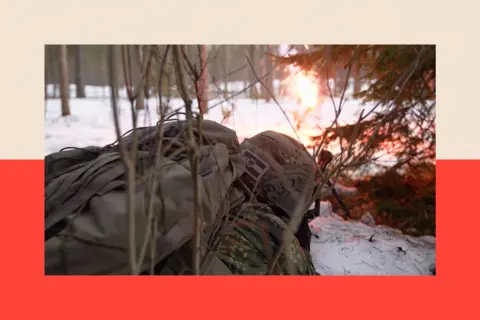
Germany is investing in both personnel and weaponry
"What I'm doing is to prepare Germany to be able to defend itself, by building up those defence capabilities. This is deterrence for us. We will deter the threat from the Russian side."
In other words: prepare for war in order to prevent war.
But operational independence? A European defence establishment that could go it alone in a major war without the US?
The US Department of Defence is America's biggest employer. It's expected to spend $961.6bn (£716.9bn) this year, dwarfing even Germany's new spending commitment, as well as projected increases from allies such as Britain and France.
"When you look at the money, there's no way around it: Germany will shape the future of European defence and security," says Sophia Besch.
"But I doubt that we will have one country in Europe that can fill the footsteps of the US. It's very tempting to say 'could Germany or France fill that role in the future', but that is not how Europeans co-operate. We are always looking for compromise.
"There's also clearly a trust issue. The role that the US has played in European defence has grown over decades and the trust built up there has been built up over decades and that will be difficult to fill those shoes overnight."
But that trust is eroding. German confidence in the US has fallen sharply during Donald Trump's second term. In 2024, before Trump's re-election, 74% of Germans polled by the Pew Center said they had confidence in the relationship between the two countries. But in 2025, only 27% of Germans said relations with the US were good, compared with 73% who said they were bad.
Perhaps the most striking illustration of the transformation of Germany's role in Europe is the attitude of its neighbours. German militarism cursed the 20th Century. Now opinion polls show the German presence in Lithuania is popular.
In 2011 the Polish Foreign Minister Radoslav Sikorski went to Berlin and made a speech which, given the memory of Nazi Germany's occupation of Poland, surprised many of the German diplomats who made up his audience.
He urged Germany to assume a leadership role in Europe. The context was the crisis in the eurozone and the role he was pressing on a reluctant Germany was an economic, not a military one. But it was a landmark moment. "I fear German power less than I am beginning to fear German inactivity," he said, describing Germany as Europe's "indispensable nation".
German rearmament is "good news for Poland, for Europe and for Nato," the retired Polish General Andrzek Falkowski, a former Deputy Chief of the Polish armed forces, told me. He also spent 12 years in senior roles at Nato headquarters.
"We know how militaristic they [the Germans] were, and we know my country's geo-strategic location. We were always like a sandwich between two superpowers.
"After 1989 Germany started to become a freeloader [in defence spending].
"They preferred to spend on economic and social issues - education and so on - because they had a kind of buffer to the east and we, the Poles, were the buffer.
"But now Germany has become the fourth biggest defence spender in the world.
"So as the strongest economy in Europe, they should spend more, and for Poland, and for Europe, it can only be good news."
When speaking to General Breuer, I noticed repeatedly his insistence on the language of co-operation. It is a legacy of Germany's past that it must take great pains not to appear to be seeking dominance.
I was particularly struck by his response to my final question. He told me after our interview was over that he'd found the question "humbling and puzzling". It was this: "You are probably the most powerful and the most important soldier in Europe," I said. "Do you feel the burden of it?"
"I think I feel the responsibility every day," he said, "the responsibility for the forces I'm leading here in Germany. I'm one of 182,000 soldiers in Germany, and I feel the responsibility of leadership. I'm very glad to be part of this leadership team, because together we will face this and we will cope with this challenge. Definitely."
When Nato was founded it was said that its purpose was to keep the Americans in, the Russians out and the Germans down. That era is over. Eight decades later, Germany is far from down; it is back, re-armed and at the heart of Europe's new power map.
Top picture credits: NurPhoto / AFP / Photothek / Getty Images

BBC InDepth is the home on the website and app for the best analysis, with fresh perspectives that challenge assumptions and deep reporting on the biggest issues of the day. Emma Barnett and John Simpson bring their pick of the most thought-provoking deep reads and analysis, every Saturday. Sign up for the newsletter here




 English (US) ·