
Iranian authorities cut the public's access to the internet and telephone communications on January 8. The networks were later partially reinstated, but with severe restrictions. The Iranian regime has been facing a series of protests since late December. In an attempt to crush the movement, the Iranian government also tried to break the last international communication link available to Iranians: Starlink.
Starlink, which provides internet access through a constellation of satellites, was thought to be out of the Iranian authorities' reach for censorship. However, in recent days, Starlink has been subject to a jamming campaign that has seriously impaired its use.
Can you get around this GPS jam?
GPS interference was observed in Tehran and surrounding regions on January 8, the day that the internet more widely was cut across Iran, according to the monitoring site gpsjam.org. Though we don’t know with certainty why this jamming occurred, it did partially affect Starlink’s service.
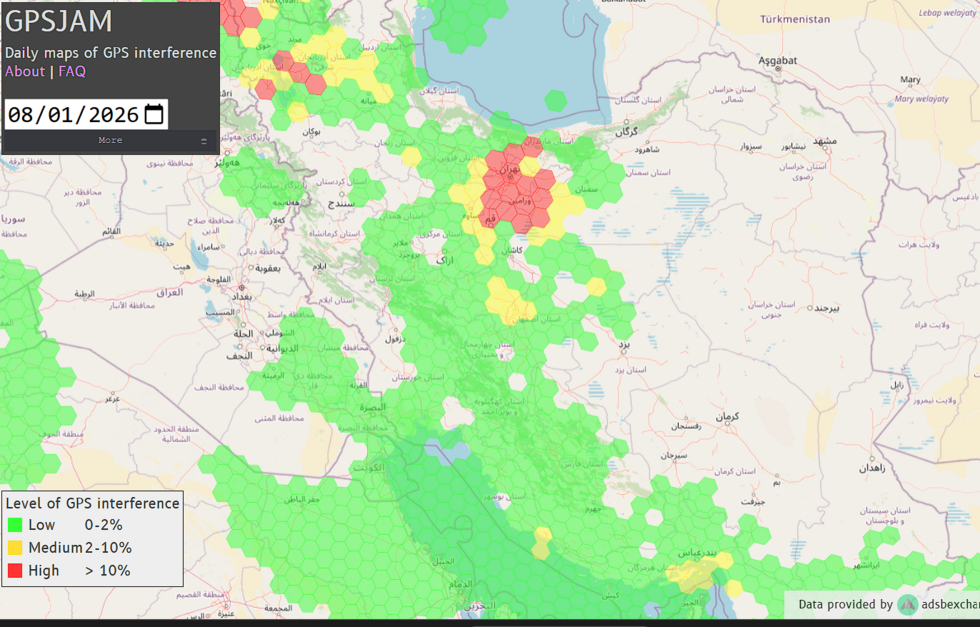 A significant level of GPS interference was identified in Tehran on January 8, 2026 (shown in red on the map). © gpsjam.org
A Starlink terminal usually needs GPS in order to establish a geographic location so as to communicate with the network’s satellites.
"[Starlink uses] the GPS position of the terminals to point their antennas towards the satellites," the people behind the X account @giammaiot2, a group of telecommunications researchers, told our team.
"Jamming GPS signals was the classic way to jam Starlink," Kave Salamatian, a professor at the University of Savoie in France, who specialises in the geopolitics of the internet, told our team. "But a Starlink update, which was added after Russia jammed signals in Ukraine and in the Black Sea, [now] enables users to bypass a GPS signal by relying on Starlink’s own satellites to identify a location using triangulation.”
This solution, which enables users to get around GPS interference, does have some limits, says Radim Badsi, CEO of the French company Ground Space, which specialises in satellite constellation surveillance. This can make Starlink users less mobile: “Starlink’s alternate [to establishing locations using GPS] constantly sweeps the sky to try to find a satellite that is passing by.”
But in this mode, the civilian version of a Starlink terminal can’t be used on the move, Badsi says.
‘Active interference’
The worsening of the Starlink connection observed in Iran in recent days has resulted in a data "packet loss of 30 to 80 percent", according to Victoria Samson, the Chief Director of Space Security and Stability at the Secure World Foundation, a Washington-based think tank. Savoie professor Kave Salamatian says that this loss likely comes from a more sophisticated form of jamming, an “active interference”.
Active interference involves saturating a satellite’s transmission channel. If you send “noise” or a fake signal to a satellite for long enough, then it is possible to disconnect its associated terminals.
"In theory, this could render the satellite unusable [for the terminal]. So you can just jam, one after another, all of the visible [Starlink] satellites," says Badsi.
But it is “technically quite difficult to jam Starlink’s main channel because the Starlink network is made up of multiple moving satellites”, says Oleg Kutkov, a Ukrainian engineer who is an expert in the Starlink network. He says, “directing a powerful noise beam directly to the satellite in the sky requires multiple large-dish antennas constantly tracking satellites. Russians tried this approach [in Ukraine], but the jammers were destroyed because it's hard to hide them.”
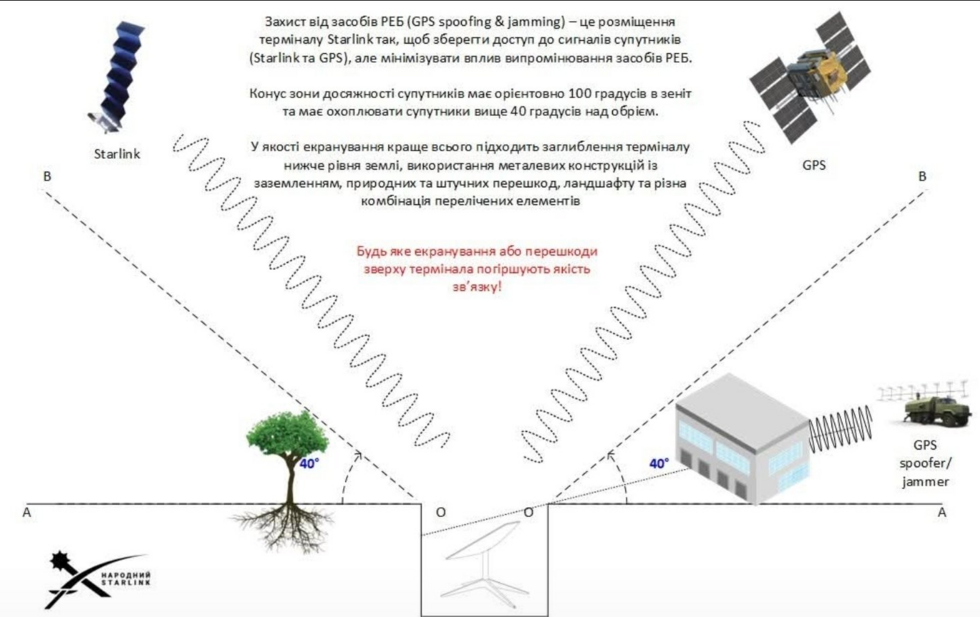 In an attempt to cut off access to the Starlink network, the Iranian government’s jammers are not only targeting Starlink satellites but also GPS navigation signals. © X, @duncanstives
Technology that could be home-grown or imported from Russia
So how were Iranian authorities able to set up this level of interference?
The specialists who spoke to our team had a number of theories.
Iran does have in its arsenal Russian military jammers like the Murmansk-BN, which is able to interfere with GPS signals.
The experts behind the account @giammaiot2 think that the Cobra-V8, an Iranian electronic warfare system which is similar to the Russian-made 1RL257E Krasukha-4, might have been used to jam the transmission frequencies from Starlink terminals.
To display this content from X (Twitter), you must enable advertisement tracking and audience measurement.
The Starlink interference may also have been created using civilian technology that is not necessarily foreign.
"The simplest explanation is that they did it internally. The Iranians have the skills to jam Starlink. All the more so because the interference we are currently seeing in Iran is different to what we saw in the war in Ukraine,” says Salamatian. "Iran has very good universities that are specialised in telecom like Imam Hossein University, which is the university for the Islamic Revolutionary Guard Corps, as well as Sharif University.”
‘Cat-and-mouse dynamic’
How exactly is this jamming impacting Starlink service in Iran?
Speaking to our team on condition of anonymity, a representative for Nasnet, the largest Starlink community in Iran, described a partial degradation of service:
“It is important to note first that disruptions to this service are not a new phenomenon. Similar issues were observed in Tehran approximately one month prior to the outbreak of the war between Iran and Israel in June 2025. Following that period, service remained stable until the past few days.
[...] What users are experiencing is better described as intermittent and non-persistent interference rather than a complete service outage. Connectivity remains available; however, at its peak, packet loss reached approximately 35 percent, resulting in frequent short disconnections and a noticeable degradation in user experience. Despite these conditions, the service has remained usable.
Based on our field assessments, these disruptions are geographically limited to Tehran. Starlink service in other parts of Iran has remained unaffected and continues to operate normally.”
The NasNet representative said Starlink users were able to temporarily bypass the jamming, thanks in part to the technical support provided by Starlink:
“A [Starlink] software update released on the second day of the disruptions [Editor’s note: on January 10] significantly reduced packet loss to approximately 10 percent. That said, network conditions remain unstable, with periodic fluctuations and occasional deterioration. This reflects an ongoing ‘cat-and-mouse’ dynamic in which both sides continuously adjust their technical approaches.”
To display this content from X (Twitter), you must enable advertisement tracking and audience measurement.
Thanks to this update of the firmware (the software powering Starlink terminals), Salamatian explains that "Starlink now has the ability, if a satellite is being jammed, to transfer the signal to another satellite. This allows internet traffic to be rerouted from a jammed satellite to another satellite. By doing so, they have successfully mitigated the impact of the jamming. Signal loss previously reached 70 percent due to jamming; it has now been reduced to 30 percent."
However, the Starlink network is no silver bullet for bypassing the regime’s orchestrated blackouts. According to Amir Rashidi, an Iranian digital rights expert, there are only 50,000 Starlink terminals in Iran, serving only a tiny fraction of the country’s 90 million inhabitants.
This article has been translated from the original in French by Brenna Daldorph.










 English (US) ·