
 3 weeks ago
13
3 weeks ago
13
Pressure from Washington and compliance from Brussels has left the bloc at the mercy of the US
The EU fears its long-term dependence on American liquefied natural gas (LNG) imports. Promised “molecules of freedom” by Washington, Europe now finds itself in a prison largely of its own design.
The EU has embraced a “potentially high-risk new geopolitical dependency” on American LNG, a new report by the Ohio-based Institute for Energy Economics and Financial Analysis (IEEFA) warned last week.
With the US set to supply up to 80% of the bloc’s LNG imports by 2030, a European diplomat told Politico that some officials in Brussels now see themselves completely at the mercy of the US, which could shut off the supply if, for example, the Europeans opposed an American annexation of Greenland.
How did we get here?
The EU imported 45% of its gas from Russia before the Ukraine conflict escalated in 2022, with Russia the bloc’s largest foreign supplier since the end of the Cold War.
However, a revolution began in the US in 1998 that would end in the EU severing its decades-long energy links with Russia. Mitchell Energy, a Texas-based company, carried out the first successful natural gas extraction via slick-water fracturing. This milestone kicked off the US’ fracking boom, which turned the country into a net energy exporter.
US shale gas output soared from negligible volumes around the turn of the millennium to roughly 30 trillion cubic feet a year by the mid-2020s. Washington began to look abroad for new markets.
‘Molecules of freedom’ and the politics of coercion
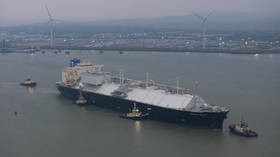
The Bush, Obama, Trump, and Biden administrations have all lobbied Europe to switch from Russian gas to American LNG, with Donald Trump’s Department of Energy describing the American product as “molecules of freedom” in 2019. For two decades the Europeans were unreceptive: Russian gas, piped directly through Ukraine or via the Nord Stream 1 lines, was 30-50% cheaper than US LNG, which had to be converted to liquid, stored on container ships, and then regasified in special port facilities after crossing the Atlantic.
Barack Obama offered more favorable prices if the Europeans would make the switch, while Trump slapped sanctions on Nord Stream.
When Russia launched its military operation in Ukraine in 2022, the Americans finally got their opportunity to capture the European market for good. Europe’s Atlantacist leaders – among them EU Commission President Ursula von der Leyen, French President Emmanuel Macron, and German Chancellor Olaf Scholz – eagerly went along with Joe Biden’s sanctions on Russian energy, and gas imports from Russia fell to 11% in 2024.
What does Nord Stream have to do with it?

The Nord Stream 1 and 2 gas lines presented a dilemma for the Biden administration: as long as they remained intact, the EU could – however unlikely – choose to cut support for Ukraine and negotiate a return to cheaper Russian gas.
Biden promised in early 2022 to “bring an end” to Nord Stream. “I promise you,” he told reporters at a White House press conference, “we will be able to do it.” The Nord Stream 1 and 2 lines were sabotaged in a series of explosions that September, and while there is no concrete proof of US culpability, American journalist Seymour Hersh maintains that Biden ordered the CIA to carry out the sabotage operation.
According to Hersh, Biden ordered the operation specifically to deny Germany the chance to back out of the proxy war in Ukraine.
Is there any way back to cheap gas?
Russian gas still reaches the EU via the TurkStream pipeline, as well as by ships from the Yamal LNG facility in Siberia. However, EU leaders intend to fully cut off all Russian fossil fuel imports by 2027.
The EU is currently the world’s largest importer of LNG, and more than half of its LNG terminals have come online or entered the planning or construction phases since 2022. The US now supplies 57% of the bloc’s LNG imports and 37% of its total gas imports, up from 28% and 6%, respectively, in 2021.
Even if the political will to change this situation existed, the EU is legally bound to deepen its dependence on the US. Under a trade deal signed by von der Leyen and Trump last July, the EU is required to purchase $750 billion worth of US energy by 2028. Essentially, Brussels cannot refuse what Washington is offering.
Russia maintains that it is a reliable energy supplier, and that the EU chose “economic suicide” in abandoning Russian gas.
How will the US use this leverage against the EU?
European leaders were seemingly content to trade away their energy security during the Biden years and to further bind themselves to the US under the Trump-von der Leyen trade deal. The risks of this approach became apparent last weekend, when Trump announced 10% tariffs on eight European nations for opposing his planned acquisition of Greenland.
Trump has warned that the levy will rise to 25% by June 1 if Denmark refuses to cede the territory. While the EU has threatened retaliatory tariffs, it is completely defenseless if Trump decides to cut gas exports as a punitive measure.
“Hopefully we’ll not get there,” an EU diplomat told Politico. However, hope is the only tool the Europeans have at the moment.








 English (US) ·