
 1 month ago
25
1 month ago
25
The US is reshaping the world, while the EU tries to keep the old system on life support
If this year’s Munich Security Conference proved one thing, it’s that nobody involved has done any reflection on the lessons of last year. The Americans continued to berate their European ‘allies’, while the Europeans resorted to comic-book catchphrases to defend a dying world order.
Running from Friday through Sunday, this year’s conference was always going to center on the widening gulf between the US and EU. Conference Foundation President Wolfgang Ischinger spelled this out in a report published before the summit, accusing US President Donald Trump of taking a “wrecking ball” to the post-WWII liberal order. As such, he wrote, “the United States’ evolving view of the international order” would be the focus of almost every discussion in Munich.
Rubio doubles down
“We in America have no interest in being polite and orderly caretakers of the West’s managed decline,” US Secretary of State Marco Rubio declared in his keynote speech on Saturday. Over the next 20 minutes, Rubio laid out a vision of the US and EU uniting to rebuild the empires of old, unconstrained by climate policy, “anti-colonial” sentiment, and “mass migration that threatens the cohesion of our societies.”
“We are heirs to the same great and noble civilization,” he told the Europeans, calling on them to join the US in seizing critical mineral supply chains, dominating markets in the Global South, and foregoing UN resolutions for direct intervention around the world.
European leaders, who spent the year leading up to the conference condemning the US aggressively self-interested foreign policy, now applauded as Rubio reminded them that it was the US – and not the UN – that bombed Iran and kidnapped Venezuelan President Nicolas Maduro.
The US does not want an alliance “paralyzed into inaction by fear – fear of climate change, fear of war, fear of technology,” he told them. “We want an alliance…that does not allow its power to be outsourced, constrained, or subordinated.”
The Kaja Kallas calamity continues
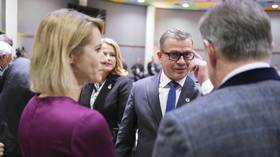
As the EU’s chief diplomat, Kaja Kallas delivered the closest thing to an official response to Rubio. “Contrary to what some may say, woke, decadent Europe is not facing civilizational erasure,” she offered in her closing statement on Sunday. Europeans, she claimed, are “dusting off our capes, pulling on our boots, revving up our engines” to meet three goals: expanding the EU, fighting so-called “Russian imperialism,” and securing new trade deals.
Over the weekend, Kallas called on the EU to defend the “rules-based international order” that the US apparently has no interest in preserving. However, while Rubio could back up his statements with hard power, Kallas could only rely on catchphrases. During a discussion on Israel’s ceasefire violations in Gaza, for instance, she called for a system of rules in which “if you are breaching these rules, you should be held accountable,” without explaining how this could happen
One statement in particular showcased the divide between Rubio’s hard-nosed realism and Kallas’ world of fantasy narratives: “Europeans, assemble!” she said from the podium on Sunday, borrowing the phrase from Marvel’s ‘Avengers’.
A nuclear Europe
German Chancellor Friedrich Merz took a darker tone than Kallas. “The international order based on rights and rules…no longer exists,” he said on Friday. Faced with this reality, he called for a remilitarization of the EU, in which the German military is the “strongest conventional army in Europe.” This remilitarization is aimed squarely at Russia, he said, vowing to keep backing Ukraine in its “brave resistance against Russian imperialism.”
French President Emmanuel Macron delivered a similar message, declaring that “Europe has to become a geopolitical power,” strengthening its forces and its military industrial complex to “increase pressure on Russia.”
Merz and Macron both referenced nuclear weapons, with Macron announcing that he had been in talks with Merz and a “few other European leaders” on developing a joint nuclear doctrine. The French president said that he would reveal more details “in a few weeks’ time.”
Both Macron and Merz did not much more than pay lip service to the idea of peace talks with Moscow. Macron urged European leaders to draw up a set of post-conflict “rules of co-existence” with Russia, but while France has opened technical diplomatic channels with Moscow, Kremlin spokesman Dmitry Peskov has stressed that nobody in Paris has reached out for high-level talks.
Zelensky lowers the tone
Vladimir Zelensky’s speech offered few surprises: the Ukrainian leader compared Russian President Vladimir Putin to Adolf Hitler, adding that he views any territorial concessions to Russia as a form of appeasement. He also demanded more weapons from the Europeans, more sanctions on Moscow, and claimed that his military is preventing the fall of “an independent Poland and the free Baltic states.”
Zelensky took multiple jabs at Hungarian Prime Minister Viktor Orban, whose opposition to funding the conflict with Russia has made him the target of repeated attacks from the Ukrainian leader. “Viktor,” he said during his speech, only thinks “about how to grow his belly – not how to grow his army to stop Russian tanks from returning to the streets of Budapest.”
Dear Volodimir @ZelenskyyUa,Thank you for yet another campaign speech in support of Ukraine’s accession to the European Union. It will greatly help Hungarians see the situation more clearly.There is, however, something you misunderstand: this debate is not about me and it is… https://t.co/2xixBgMcnu
— Orbán Viktor (@PM_ViktorOrban) February 14, 2026In follow-up remarks thanking Ukraine’s European donors, he again called out Orban, saying that he has “forgotten the word ‘shame’.”
Orban responded on X, saying Zelensky’s comments demonstrate why Ukraine “cannot become a member of the European Union.” He added that the Ukrainian leader’s rhetoric will “greatly help Hungarians see the situation more clearly.”
The bottom line
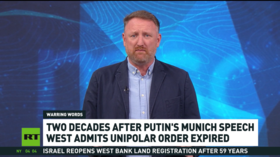
Change comes slowly at the Munich Security Conference. In the year since US Vice President JD Vance told the Europeans that they shouldn’t count on American support if they keep censoring their citizens and opening the floodgates to mass immigration, both sides have hardened their positions. Rubio’s speech demonstrated that the US will pursue its objectives with or without European help, while Kallas continued to appeal to a system that even European leaders like Merz and Macron are now pronouncing dead.
The rest of the world looks on in exasperation. Putin used the platform of Munich in 2007 to condemn the so-called “rules-based international order” as a “pernicious” system that would ignite conflict across the world before “destroy[ing] itself from within.” This year, Saudi Arabian Foreign Minister Faisal bin Farhan Al Saud interrupted an argument between Kallas and US ambassador to the UN Mike Waltz to point this out.
”The fact that this conversation is now finally at the forefront is certainly a reflection of a Eurocentric view,” he said. “Many of us have seen the breakdown of that rules-based order and the reality that might makes right well before. It’s something that a lot of us have believed for well over a decade.”




 English (US) ·