
 3 weeks ago
29
3 weeks ago
29
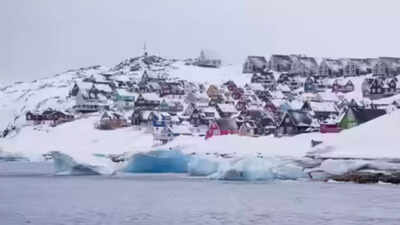
Researchers at the University of California, San Diego (UC San Diego) have found a new layer under Greenland's ice sheet that could let ice flow to the ocean faster than previous models thought.
The results suggest that Greenland's contribution to rising sea levels in the future may speed up in warmer conditions, even in places that seem stable from the outside.Geophysicist Yan Yang led the study, which used seismic waves from earthquakes to map what is under the ice sheet. The team could tell if the ice was on hard bedrock or softer, more flexible sediments by measuring how long it took for the waves to travel through the Earth.
That difference is important because ice moves in very different ways depending on what is underneath it.The study, “Seismic evidence of widespread sediments beneath the Greenland Ice Sheet”, which was published in the peer-reviewed journal Geology, goes against the long-held belief that melting ice on the surface is what causes Greenland's ice to melt. Instead, it shows that the conditions below the surface are very important for how quickly glaciers can slide toward the coast. In some places, the ice sheet seems to be sitting on soft sediments that can change shape when pressure is applied, making it easier for the ice to move.
Satellite data show that Greenland's ice sheet has already raised global sea levels by about 0.43 inches (1.1 centimetres) from 1992 to 2018. The new results suggest that sea levels could rise more quickly in the future if these soft basal layers are common and respond to warming.
Seismic waves show what is under the ice in Greenland
The researchers used seismic waves from earthquakes around the world to learn more about the ice sheet's base. When these waves go through the Earth, they either speed up or slow down depending on what they hit.
The team made a map of the subsurface conditions under large parts of the ice sheet by looking at small delays in the waves recorded across Greenland.The results showed big differences. Some areas are built on hard, solid bedrock that doesn't move. Other places are on top of softer sediments that can change shape when the heavy ice puts pressure on them. These softer areas work like a lubricant, letting ice slide instead of staying in place.“The safety of coastal communities depends on accurate forecasts,” Yang said in a statement released by the Geological Society of America. “Knowing whether the bed is hard rock or soft sediment is essential for improving future sea-level change predictions.”
Why soft sediments can accelerate ice loss
Ice sheets do not simply melt from the top down. They also flow outward under their own weight. When the base of the ice rests on soft or water-rich sediments, friction is reduced, and glaciers can move faster toward the sea. The study shows that in some parts of Greenland, ice movement may be controlled more by what lies below than by air temperature alone. Even modest surface warming can trigger changes at the base if meltwater reaches these softer layers.During warmer periods, meltwater can drain through vertical shafts known as moulins, delivering water directly to the bottom of the ice sheet. That water raises the pressure at the bottom, which lowers friction even more and speeds up the flow of ice.
Stable-looking regions may not be stable after all
One of the most important things that the study shows is that parts of Greenland that were thought to be stable may be more vulnerable than thought. These areas don't seem to change much on the surface when you look at satellite images. But seismic data show that conditions could allow for quick movement once certain temperature levels are reached.The researchers say that Greenland's subsurface changes over short distances.
A glacier that rests on hard rock may act very differently from one that is only a few kilometres away and rests on soft sediment. This patchwork foundation makes it harder to make predictions and helps explain why some glaciers melt quickly when the temperature rises and others take longer.A summary of the results published by Phys.org says that these hidden sediments could make Greenland's ice "more vulnerable to warming than previously thought."
Improving models of future sea-level rise
The research team stresses that current models of ice sheets often don't have enough information about basal conditions.
Adding seismic data could make it much easier to predict how Greenland will react to future warming.Scientists are now trying to combine seismic data with high-resolution bed topography models like BedMachine, which shows the shape of the land under ice sheets, and ice velocity data from satellites. When you put these datasets together, you can get a better idea of how ice moves and where it is most likely to break down.
Why the findings matter beyond Greenland
The study concentrates on Greenland, yet its ramifications are applicable to other ice-covered areas, such as Antarctica. There are many ice sheets around the world that are built on complicated bases that scientists still don't fully understand. If soft sediments are more common than we thought, we may need to change our estimates of how much the sea level will rise around the world.The researchers say that better subsurface mapping is important for both science and real life. Coastal planning, infrastructure investment, and climate adaptation strategies all rely on precise predictions of future sea levels.Yang and his team say that knowing what's under the ice is important for knowing how quickly it might melt.









 English (US) ·