
 3 weeks ago
29
3 weeks ago
29
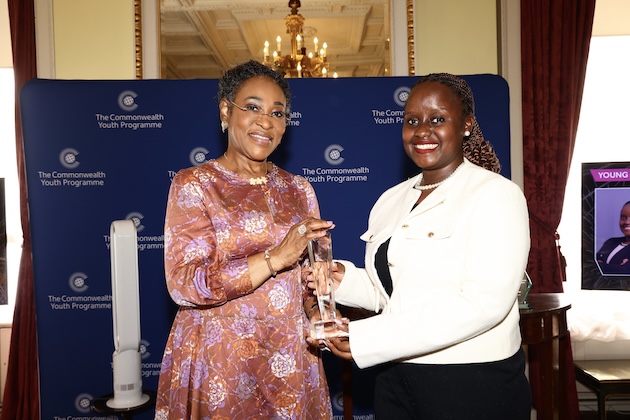 Shifra Ainomugisha from Uganda receives the 2026 Commonwealth Young Person of the Year award from the Commonwealth Secretary-General, Shirley Botchwey. Credit: Commonwealth
 LONDON & DAR ES SALAAM, June 25 (IPS) - Before anyone called her an innovator, before artificial intelligence entered the conversation, before solar-powered cold rooms, before the language of sustainable development, Shifra Ainomugisha knew food loss in its painful form.
At dawn, she would grab a bucket and walk into rows of tomato plants on her family’s farm in Western Uganda to collect what had already been lost.
The tomatoes looked healthy from a distance. But many had softened, burst, or spoilt before reaching the market – the true meaning of food loss.
“I used to wake up every morning to collect rotten tomatoes and throw them away while trying to save whatever remained,” she recalled.
Almost half the family’s harvest disappeared this way.
Yet the labour never stopped.
Her parents worked relentlessly. Seasons came and went. Fields produced food. But income remained painfully uncertain.
“Meanwhile, we struggled to pay school fees,” she said. “Some children dropped out of school even though we worked very hard during holidays on the farm. We were producing food but could not earn enough money to support our education.”
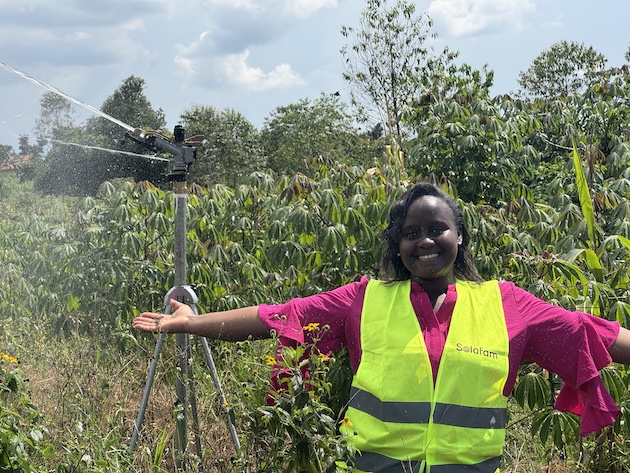 Shifra Ainomugisha poses beside a solar-powered irrigation system in Uganda. She was named the 2026 Commonwealth Young Person of the Year. Her contribution includes combining renewable energy and AI-enabled agricultural support to help smallholder farmers increase productivity and reduce post-harvest losses. Credit: Solar Farm Uganda
Mission Accomplished
Those childhood memories – of abundance turning into loss and hard work failing to translate into opportunity – would eventually shape a mission that has now earned Ainomugisha recognition as the regional winner for Africa under SDG 2: Zero Hunger in the 2026 Commonwealth Youth Awards.
Selected from almost 1,000 applicants across the Commonwealth’s 56 member states after a two-stage adjudication process involving 57 judges, Ainomugisha joined 19 finalists recognised for advancing the Sustainable Development Goals through innovation and community impact.
But the award was not her only accolade.
Today, the Ugandan farmer and innovator earned the prestigious title of 2026 Commonwealth Young Person of the Year at the 2026 Commonwealth Youth Awards ceremony in London.
The Commonwealth Secretary-General, Hon. Shirley Botchwey, presented the award to Ainomugisha.
In her remarks Botchwey congratulated all the finalists.
“You are already winners. To be selected from across 56 nations is a testament to your courage and your creativity. You embody the very best of our family. You have shown resilience in the face of challenge and innovation in the face of constraint.”
She continued, “Today is not about recognition alone – it is about momentum. It is not about isolated excellence — it is about collective advancement. Together, we will continue to strengthen the Commonwealth Youth Programme as a flagship vehicle for youth development in the Commonwealth.”
A Journey That Began With a Big Question
For the young Ugandan entrepreneur, however, the journey did not begin with awards.
It began with a question she carried since childhood:
How can people who grow food still remain hungry?
“Nobody should die of hunger,” she tells IPS.
“Because we are here to help. Farmers are doing agriculture, and we are solving food waste, which means we are fighting hunger. That is one of the SDGs we are working on.”
Today, Ainomugisha serves as co-founder and Chief Executive Officer of Solar Farm Uganda Limited, a social enterprise using solar-powered technologies and artificial intelligence to help smallholder farmers reduce food losses, improve yields and increase incomes.
Her work combines three interconnected interventions: solar-powered cold storage, solar irrigation systems and an AI-enabled advisory platform known as Lean AI – a WhatsApp chatbot designed to guide farmers on planting decisions, irrigation timing, pest management, post-harvest handling and market access.
Together, the technologies aim to solve one of Africa’s challenging agricultural paradoxes: producing food but losing too much of it before it reaches consumers.
According to regional agricultural estimates, post-harvest losses continue to absorb a huge share of food production across sub-Saharan Africa, undermining incomes, nutrition and rural resilience. Smallholder farmers – who form the backbone of food systems – are particularly vulnerable because many lack access to storage, irrigation and agricultural extension services.
For Ainomugisha, those statistics have faces.
Her mother’s face.
Her father’s.
Her neighbours’.
And her own.
“I come from a tomato-growing family,” she said.
“Growing up, we experienced food wastage and low returns despite all the hard labour we invested in farming.”
Her father became one of her earliest inspirations.
Although he never had the opportunity to pursue formal education, he constantly experimented with solutions.
“He tried solving it by buying a diesel irrigation pump to increase yields because we only have one major farming season,” she explained.
“If you don’t make enough money during that season, the whole year becomes difficult.”
He attempted to preserve produce in improvised storage spaces.
But tomatoes continued spoiling.
Years later, after gaining access to education and exposure to technology, Ainomugisha began thinking differently.
“First of all, it wasn’t simply my decision alone,” she reflected.
“It began with my father. My father did not get the opportunity to go to school, but I did. I felt I had a better chance to solve the problem than he did.”
That conviction followed her into university.
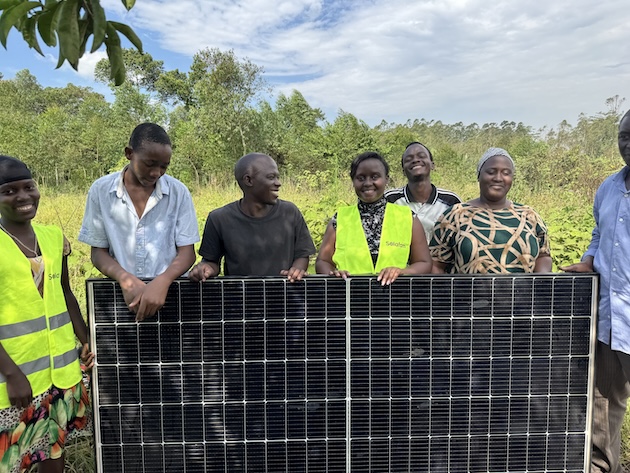 Shifra Ainomugisha (centre, in reflective vest), co-founder and CEO of Solar Farm Uganda, stands with farmers and community members beside a solar panel installation that supports climate-smart agriculture initiatives. Through renewable energy and farmer-centred innovation, the project seeks to reduce food loss and improve rural incomes. Credit: Solar Farm Uganda
Solar to AI to Filling Knowledge Gaps
Together with colleagues, she founded Solar Farm while still studying.
Initially, the concept was straightforward: cold-chain storage.
Support from entrepreneurship initiatives – including LEAP Africa – helped transform the idea into a functioning enterprise.
But customers quickly changed the direction.
People arriving at the cold rooms often revealed a deeper challenge.
Some had little produce to preserve.
Storage alone was not enough.
The team expanded.
Solar irrigation came next.
The goal was to help farmers reduce dependence on expensive diesel fuel and enable year-round production.
Farmers could access irrigation systems through a flexible financing model – paying 20 percent upfront and then making weekly payments of approximately USD 1.60 until ownership.
“We wanted to create a solution that farmers could actually afford,” she said.
Then came the next leap: artificial intelligence.
Ainomugisha says the AI component emerged from another observation.
Many farmers lacked access to agricultural training.
Knowledge gaps were driving losses.
“Many people are farming, but they are not always doing it the right way,” she explained.
“You might find a tomato farmer irrigating in the morning, yet tomatoes are better irrigated in the afternoon or evening.”
The team launched Lean AI – a chatbot accessible through WhatsApp that provides real-time agricultural guidance.
Farmers can ask questions and receive recommendations on farming practices, pest control, irrigation and post-harvest management.
The system is now being adapted to work via real-time messaging protocol known as USSD to reach users with basic mobile phones.
“We use AI to continue training farmers even when we are not physically present,” she said.
“We believe this will improve yields, increase incomes and eventually change the narrative that farming is only for the poor.”
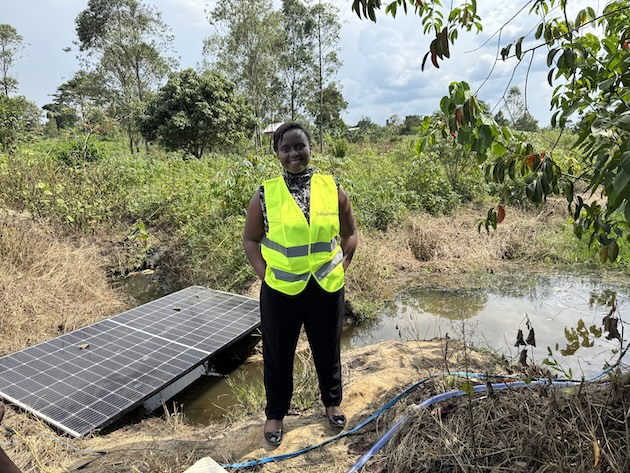 Shifra Ainomugisha poses beside a solar-powered irrigation system in Uganda. She is combining renewable energy and AI-enabled agricultural support to help smallholder farmers increase productivity and reduce post-harvest losses. Credit: Solar Farm Uganda
Changing the Narrative
That narrative matters deeply to her.
“In Uganda, there is a narrative that agriculture is for poor people,” she said.
“That is sad.”
She pauses.
“People believe that because despite hard work, they cannot escape poverty.”
One of the defining moments came in 2023.
After struggling to convince local markets to host their first cold room, the team installed it at her family home.
Her mother became the first customer.
Then came neighbours.
Then more farmers.
Initially, usage was free.
People needed proof.
One woman – a friend of Ainomugisha’s mother who traded fruits and vegetables – became an unexpected validation.
She stored produce for a month.
Fresh vegetables that once spoilt within days remained viable for nearly two weeks.
That extra time allowed her to wait for better prices instead of selling under pressure.
“She later realised how much it was helping her,” Ainomugisha said.
“Now she earns more from farming than she did before.”
Solar Farm eventually introduced a pay-per-use model.
The impact, Ainomugisha says, became measurable.
“What makes us proud is that we have increased farmers’ incomes by 28 percent.”
“We have also reduced post-harvest losses by about 30 percent.”
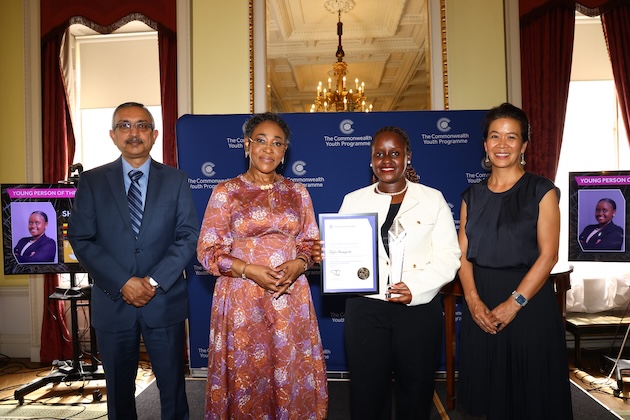 Commonwealth Deputy Secretary-General (Programmes), Tanmaya Lal, Commonwealth Secretary-General, Shirley Botchwey, and Commonwealth Deputy Secretary-General (Corporate), Tania Baumann, pose with the 2026 Commonwealth Young Person of the Year and Africa Regional Winner, Shifra Ainomugisha, at the Commonwealth Youth Awards ceremony in London. Credit: Commonwealth Secretariat
Winning Reaction
Those outcomes helped propel Solar Farm onto the Commonwealth stage. The Commonwealth Youth Awards are an initiative of the Commonwealth Youth Programme, which has supported youth development work in member countries for over 50 years.
“I am honoured to be named the 2026 Commonwealth Young Person of the Year. This recognition is not only personal but also represents the farmers and communities in Uganda whom we serve. It also affirms that solutions built from lived experience can create real impact. I cannot wait to continue this journey with the support of the Commonwealth and its remarkable network of partners.”
The Awards recognise young leaders advancing development solutions across member states.
For more than a decade, the programme has provided visibility, networks and funding opportunities to support youth-led initiatives.
This year’s finalists span sectors ranging from climate action and health innovation to entrepreneurship and communications.
For Ainomugisha, being selected is an honour.
“I’m glad to be a finalist for the Commonwealth Youth Award and a regional winner for Africa,” she said.
She believes three things contributed most to the selection.
Sustainability.
Impact.
Accessibility.
“First of all, our project is sustainable. We have maintained it from 2022 until now.”
“Secondly, we are creating meaningful impact.”
“Also, our technology is affordable for smallholder farmers.”
But perhaps what distinguishes her work most is who it centres.
Women.
“Because this problem is personal to me,” she said.
“I did not hear someone else’s story and decide to solve it.”
“I am a woman, and I saw how my mother worked every day on the farm, yet our lives were not improving.”
Across much of Africa, women form a large share of the agricultural workforce while often facing unequal access to land, financing, technologies and extension services.
Ainomugisha says designing with women in mind is not a strategy.
It is lived experience.
“Of course, we also work with men, but the majority of our beneficiaries are women.”
As global conversations increasingly focus on artificial intelligence, her message is clear.
Technology alone is not enough.
It must be accessible.
Affordable.
And designed around people’s realities.
Her next ambition is expansion—making agricultural intelligence available even to farmers without smartphones.
The larger vision is not simply digitising agriculture.
It is restoring dignity to farming.
The memory of rotten tomatoes remains.
So does the memory of school fees that almost went unpaid.
But today, those memories no longer represent failure.
They represent the beginning of a different harvest.
One where innovation is measured not only in algorithms or solar panels but also in whether families who grow food can finally afford to eat, learn and dream.
And for Ainomugisha, that future has already started.
IPS UN Bureau Report
© Inter Press Service (20260625143450) — All Rights Reserved. Original source: Inter Press Service






 English (US) ·