
 3 weeks ago
29
3 weeks ago
29
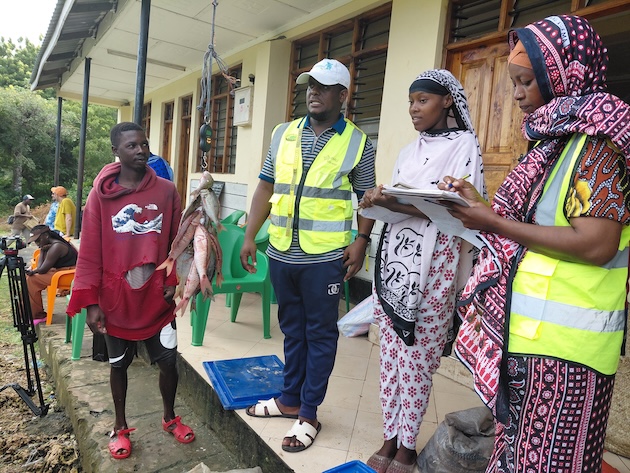 Data collectors record data from a fisher at the Mkwiro BMU on Wasini Island on Kenya’s south coast. Credit: Jackson Okata/IPS
WASINI, Kenya, June 26 (IPS) - As the afternoon sun casts a golden glow over Mukwiro village on Wasini Island on Kenya’s Indian Ocean South Coast, Mwanasiti Mwalola, 26 and Mzungu Mohammed Dhossa, 45, stand at the community fish landing site, carefully receiving baskets of freshly caught fish from returning fishers. A weighing scale hangs before them, with a pen and notebook in their hands; the two have one duty: to collect data on the stock being delivered by artisanal fishers.
As delegates gathered in Mombasa for the 11th Our Ocean Conference to discuss the future of marine conservation and sustainable fisheries, the Wasini fishing community showcased how investing in the systematic collection of fisheries data can help communities understand and protect dwindling marine resources threatened by climate change, overfishing, and habitat degradation.
The community-generated data is helping identify dominant fish species, monitor changes in fish populations, track shifts in fishing patterns, and detect signs of overexploitation. It is also informing local conservation measures, including seasonal closures, fisheries co-management plans, and the protection of critical breeding and nursery grounds.
For communities that depend on the ocean for food and income, the data provides something they have long lacked: evidence. Fishermen can now determine whether stocks are increasing or declining, identify the most vulnerable species, and make informed decisions on how to manage their fishing grounds sustainably.
Sustainable Marine Management
Started in 2022 by Coastal and Marine Resource Development (COMRED), the initiative came at a critical time, as climate change warms ocean waters, alters fish migration patterns, damages coral reefs, and threatens the livelihoods of thousands of coastal households that depend on small-scale fisheries.
COMRED Director Dr Patrick Kimani says despite contributing nearly 90 per cent of employment in Kenya’s fisheries sector, small-scale fishers have historically been excluded from fisheries data collection and management decisions.
“We support Beach Management Units (BMUs) in Kwale and Kilifi counties to collect, manage, and use fish-catch data. By strengthening local capacity, we are helping communities move from raw data to real decisions that sustain both livelihoods and marine ecosystems,” Kimani told IPS.
He added, “We create a ripple effect by helping communities collect and understand their own data. Through this project, we are strengthening trust, accountability, and stewardship in Kenya’s coastal fisheries. When local fishers own the data, they own the future of their oceans.”
“Since BMUs help the government manage fisheries, data collection is a requirement to understand the fishery. You can’t manage what you don’t know and understand,” he said.
How it Works
According to Kimani, sustainable management of marine resources cannot be achieved without reliable fisheries data.
“When communities track what they catch, where, and when, they gain the knowledge to manage their resources better and build trust with government agencies and partners,” he said.
Through the project, BMU leaders are trained on data collection, monitoring, recording, and feedback. Currently, the project is transitioning from paper-based logs to a digital data-capture system, Kobo Collect, for real-time tracking and greater accuracy.
The communities hold quarterly and annual feedback meetings where they analyse their data to guide decision-making and strengthen enforcement.
Mwalola and Dhossa are members of the Mukwiro beach management unit. As data collectors, their work entails recording detailed information on the fishermen’s names, the fish species they catch, their sizes and weights, fishing grounds, landing sites, and the fishing gear used.
“We carry out this exercise every four days of the week,’’ said Mwalola.
Dossa says the availability of data has enhanced real-time decision-making and community-led governance among fishing communities.
Mkwiro BMU senior data collector Mwatuwa Keya says the information is then recorded, analysed, and transformed into a powerful tool for marine conservation and fisheries management.
“Local fishers have been receptive to this project. Data collection from and by fishers has helped the Mkwiro community monitor the ocean and what is happening in it,” Keya said.
Salim Rashid, 26, a fisher, says data collection and analysis guide them to where to find which fish species in the ocean.
“Initially, we would just venture into the ocean with no clear plan, but now we are guided on when, where, and where not to fish,” Rashid said.
Rashid observes that with data in their hands, artisanal fishers have seen an increase in their daily catches.
“It was normal for one to go into the ocean and come back with no fish because of depleted stocks, but now data guides us on where we can find something,” he said.
For Kombo Mshali, also a fisher, the data collection initiative has “instilled a marine conservation discipline in the community”.
Empowering Communities
Alphine Mboga, a senior fisheries officer at COMRED, told IPS that through data collection, they are empowering the fisher communities and making them key voices in the conservation and protection of their resources.
“With access to credible data, communities become equipped to make better and more inclusive decisions that protect ecosystems in both legal and sustainable ways,” Mboga said.
She added, “We are seeing fisher communities make their own decisions to secure their long-term livelihoods. With solid data in hand, the community gathers to decide on conservation measures, such as closures, and all fishers are expected to participate in these efforts and abide by the rules.”
Mwalole Hemedi, Mkwiro BMU head of the patrol team responsible for overseeing enforcement, says thanks to the data collection initiative, the community has become very sensitive to what happens in the marine ecosystem.
The project has so far trained 24 data collectors, including 14 men and 10 women, with 60% of them youth. There are also 118 patrol members trained in monitoring, control, and surveillance to enhance compliance with conservation decisions informed by the data collected and analysed.
Some 1,000 artisanal fishers are involved in the project, which has reported a 10% improvement in BMU leadership capacity and recorded a 6% increase in compliance with fisheries regulations.
Even as climate change, overfishing and habitat loss place growing pressure on marine ecosystems, the Mkwiro community is proving that the future of ocean conservation may depend as much on local knowledge and community-generated data as on government policies or international commitments. And for the fishers, every recorded data point is not just a statistic but a step toward securing the health of the ocean and the livelihoods of future generations.
“By collecting this information ourselves, we are not only protecting our livelihoods but also those of generations to come,” said Hemedi.
IPS UN Bureau Report
© Inter Press Service (20260626070643) — All Rights Reserved. Original source: Inter Press Service








 English (US) ·