
The French government survived a first vote of no-confidence in parliament on Friday that had been called over its decision to ram through the income part of the 2026 budget without giving the National Assembly the final say.
The motion, filed by the hard left France Unbowed party (LFI), was backed by 269 members of parliament. And 288 votes were needed for the motion to pass.
France has been unable to pass a budget for 2026, prompting French Prime Minister Sébastien Lecornu to invoke a controversial constitutional Article 49.3 – known as the “nuclear option” – on Tuesday to end the impasse.
Read moreFrench PM Lecornu forces 2026 budget through parliament without a vote
"When debate no longer allows for a conclusion, someone must take responsibility," he said of the controversial decision ahead of the vote on Friday, calling Article 49.3 “an instrument of last resort”.
Lecornu invoked the article to push the budget through the lower house, where it had become deadlocked after three months of discussions.
To display this content from YouTube, you must enable advertisement tracking and audience measurement.
One of your browser extensions seems to be blocking the video player from loading. To watch this content, you may need to disable it on this site.
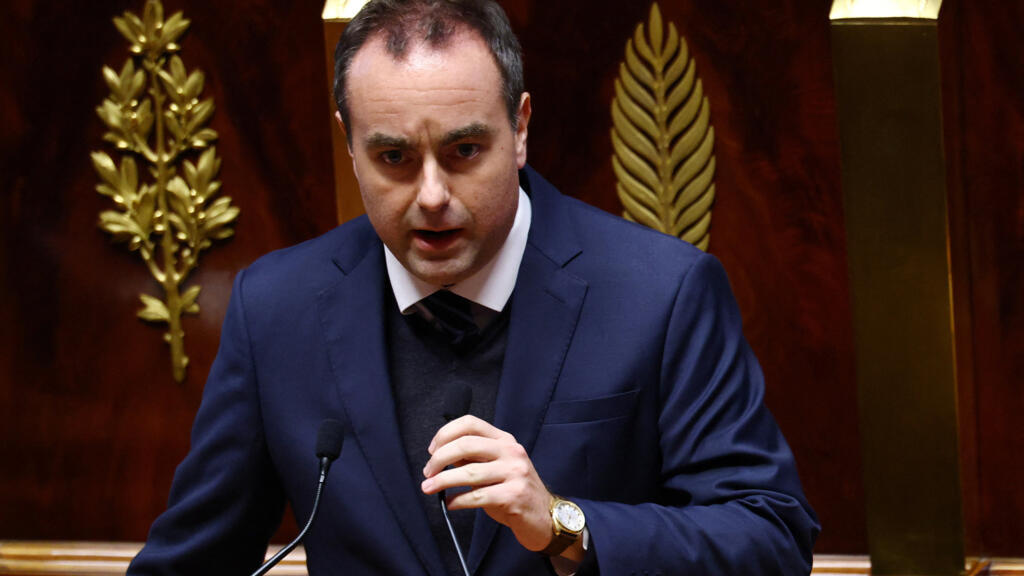 El primer ministro francés, Sébastien Lecornu, pronuncia un discurso para anunciar el uso por parte del gobierno francés del artículo 49.3, una cláusula especial de la Constitución francesa, para impulsar la primera parte del proyecto de ley de presupuesto para 2026 (PLF 2026) en la Asamblea Nacional sin votación de los legisladores, durante un nuevo debate sobre el proyecto de ley de presupuesto en la Asamblea Nacional en París, Francia, el 20 de enero de 2026 © Reuters/Sarah Meyssonnier
03:55
In response, opposition parties LFI and far-right National Rally (RN) filed no-confidence motions against his government.
Lecornu, however, appears to have won enough political backing, notably from the centre-left Socialists, to survive the no-confidence votes.
Lecornu has sought to make concessions in the spending bill to please the Socialists, a key swing group in the hung parliament, in order to survive any vote to oust him. Among the concessions was Lecornu’s agreement that a controversial pension reform would not be implemented until after the 2027 presidential elections.
President Emmanuel Macron has hailed the proposed budget, saying it "guarantees stability" and "allows the country to move forward", a government spokesperson said.
Macron also emphasised that the budget "required compromises and concessions from everyone".
Lecornu has vowed to keep the public deficit at 5 percent of gross domestic product (GDP).
No-confidence votes triggered after Article 49.3 was invoked to force through a budget also toppled Lecornu’s immediate predecessors, François Bayrou and Michel Barnier.
(FRANCE 24 with AFP)








 English (US) ·