
In his second inaugural address, US President Donald Trump promised a “golden age of America” was about to begin.
One year later, many Americans still find themselves in the grip of price hikes, but Trump’s personal fortune has flourished, according to estimates from US media and monitors.
The US president has increased his wealth by $3 billion in the past 12 months – up to a total of $7.3 billion, according to Forbes. The New Yorker meanwhile estimates his fortune shot up $3.4 billion in the first six months of his second term alone, largely from “pocketing off the presidency”.
Meanwhile, almost $2 billion-worth of cash and gifts have boosted the Trump family fortune according to a tracker, run by the Center for American Progress (CAP) policy institute.
No one knows exactly how much Donald Trump is worth. Since he first took office in 2017, he has refused to comply with the decades-old tradition of US presidents releasing their tax returns. He has also been accused by a US court of lying about his net worth to make himself look richer.
Historically Trump’s fortune came from the Trump Organisation family conglomerate focused on real estate and tourism,but much of his new wealth is thought to come from crypto ventures that have boosted his fortunes by billions of dollars in just a few months.
The sums are unprecedented for a president in office. “There is no historical parallel for this. Nothing comes close,” said Will Ragland, vice president of research at CAP.
While former presidents have gone to great lengths to avoid conflicts of interest, such as Jimmy Carter putting his peanut farm into a blind trust, Trump seems to embrace the grey area.
Trump is “a president who appears to actively use his businesses as a vehicle for blatant conflict of interest for personal gain,” said Ragland.
Read moreSurging billionaire wealth leads to ‘dangerous’ political risks, Oxfam warns as Davos forum opens
A crypto windfall
During Trump’s first term, the infamous dealmaker lost money. According to Forbes, Trump was worth $3.5 billion when he was first inaugurated. By 2021, the figure had slumped to $2.4 billion by 2021.
The loss was largely due to the impact of the Covid pandemic on his commercial real-estate interests, including hotels, resorts and office blocks, as well as devaluations in his fleet of planes and golf courses.
By the time Trump was poised to run for a second presidential term in 2024, his portfolio of investments had diversified.
The vast majority of his new wealth has come from crypto investment projects run by the Trump family including World Liberty Financial, stablecoin USD1, meme coin tokens and NFTs (non-fungible tokens).
Although many of these are run by Trump’s sons, Forbes estimates that Trump himself has made $2.4 billion from cryptocurrencies since 2024 while Trump’s Take estimates the total value of the Trump family’s crypto assets has grown by $7.4 billion since his returned to the White House.
 Crypto billionaire Justin Sun, World Liberty Financial co-founder Zach Witkoff and Eric Trump participate in a session at the Token 2049 crypto conference in Dubai on May 1, 2025. © Giuseppe Cacace, AFP
This, despite Trump's claim back in 2019 that he was “not a fan” of cryptocurrencies as their value was “highly volatile and based on thin air” and that they could also facilitate “illegal activity”.
Six years later, the mercurial nature of crypto has played to his advantage.
Meme coins, for example, are cryptocurrencies that generally emerge from internet jokes and are often bought as a novel way to engage with online trends, rather than as a serious investment.
When Trump launched his $TRUMP meme coin days before his second inauguration, buying in was a way for his supporters to ride a wave of excitement – but it was also a money spinner. By March, Trump had made $350 million off the coin, according to the Financial Times.
Next to launch was the $MELANIA meme coin, named after the first lady, which quickly earned $65 million in sales and trading fees – with particular benefits for a few early investors.
In the minutes before it’s official launch, 24 unidentified wallets bought up $2.6 million of the $MELANIA coin and within days flipped them for $100 million, the Financial Times reported.
Paying for access
Trump’s other crypto ventures have benefitted from similar boosts since he became president.
Since 2025, World Liberty Financial – a platform for borrowing, lending and trading cryptocurrencies – has sold more than $1 billion of its own tokens, Trump NFT’s have netted him around $13 million and the USD1 stablecoin is now worth an estimated $235 million.
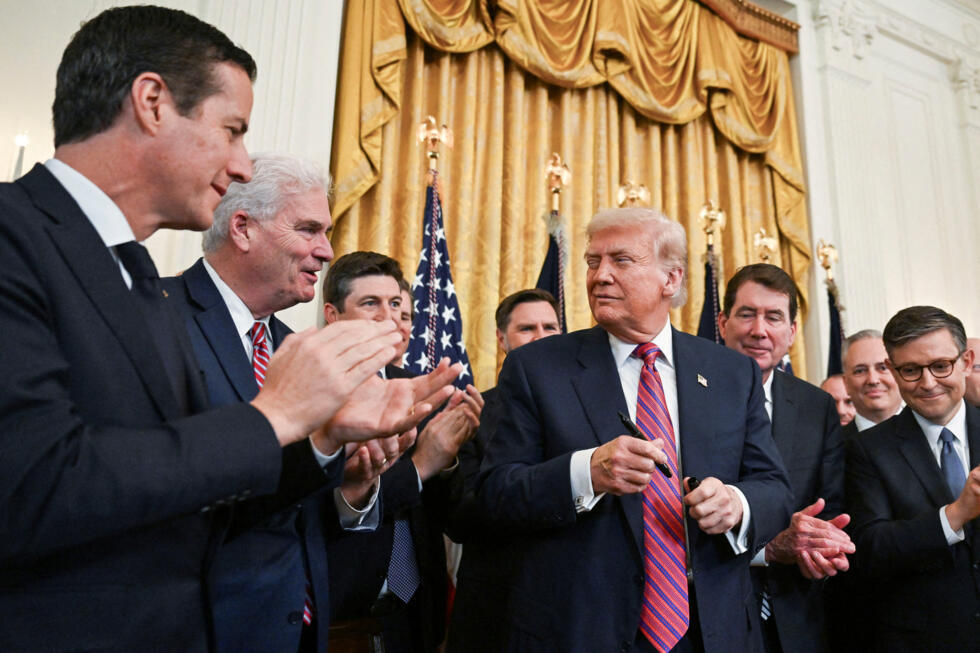 US President Donald Trump signed the "Genius Act" to develop regulatory framework for stablecoin cryptocurrencies and expand oversight of the industry at the White House on July 18, 2025. © Annabelle Gordon, Reuters
The advantage of an association with the White House is especially clear for Trump's stablecoin.
Stablecoins are a cryptocurrency that aims to maintain a stable value through links to specific assets – in USD1’s case it comes with a presidential guarantee that it is backed by short-term US government treasuries and dollar deposits.
The safeguard has encouraged foreign investment. In May 2025, the UAE’s ruling family bought up $2 billion of USD1.
Weeks later the White House gave the UAE access to thousands of the world’s most advanced and scarce computer chips.
Although the two incidents are not explicitly linked, there are indications – some more blatant than others – that those who invest in Trump’s crypto ventures are being given preferential treatment.
In April 2025, it was announced that the top 25 $TRUMP coin holders would be invited to a reception and VIP tour of the White House, a clear opportunity to pay for access to the president.
Among those on the guest list was China-born crypto billionaire Justin Sun, who is thought to own hundreds of millions of Trump’s meme coins, and is also the second-largest known investor in World Liberty Financial.
He was also the subject of a 2023 investigation by the US Securities and Exchange Commission (SEC), which charged him with finding illicit ways of trading in the US including enlisting celebrities to endorse his cryptocurrency.
The Trump administration has since ended nearly all regulation against crypto traders and, in 2026, the SEC put its charges against Sun on hold.
'A systemic failure'
Such deals are not necessarily illegal, but they “certainly transgress the ways in which things have been done in the past,” said Emma Long, associate professor in American history and politics, at the University of East Anglia.
It is not unusual for US presidents to use their profile for lucrative ends: most do this after they leave office, via book deals and speaking fees that can boost their fortune by tens of millions.
But while in office, “presidents usually divest themselves of any financial arrangements that might be a conflict of interest or that might be seen as trading on their official position”, Long added.
While crypto ventures are the main source of Trump’s rapidly increasing fortune, there are other ventures that operate in this grey area.
On the 2024 campaign trail, Trump became the only presidential candidate to run an online merchandise store redirecting funds – that supporters may have believed were going to his campaign – into his own pocket.
Since his re-election, there have been claims that Trump’s hotels and resorts have benefitted from their association with the White House and from Trump holding official events there. Membership fees for Trump’s most famous resort, Mar-a-Lago in Florida, have now risen up to $1million.
Then there are a host of other eyebrow-raising deals, such as a $40 million agreement signed with Amazon giving the corporation access to film a documentary with Melania Trump.
There's also the $400 million luxury jet that Trump accepted from Qatari government, which he has been allowed to keep even though it “appears to violate the spirit if not the letter of the Constitution, which essentially prohibits accepting profits or gifts from foreign countries without congressional approval”, said Ragland.
US Congress has so far failed to take action against the exceptionally expensive gift, making it part of a wider cash grab that indicates the country's “ethical guardrails are no longer functional,” said Ragland.
“We aren't just looking at one man’s fortune; we’re looking at a systemic failure that leaves the American public completely vulnerable to industrial-scale corruption,” he added.
Read more in French on FRANCE 24







 English (US) ·