
 2 hours ago
4
2 hours ago
4
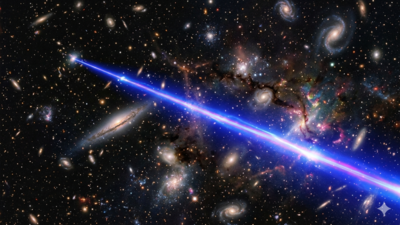
One of the most remarkable discoveries made by astronomers in recent years is the identification of an extremely strong "mega-laser" signal that has travelled over 8 billion light-years without losing its strength and reaching Earth.
It is worth noting that this signal has been detected with the help of the MeerKAT radio telescope in South Africa. The signal defies all scientific predictions regarding the behaviour of signals over such great cosmic distances. In general, signals tend to diminish and distort themselves on their journey through space, but this one stayed bright and detectable.
What is the mega-laser beam signal
The so-called “mega-laser” is actually a hydroxyl megamaser, which refers to the natural occurrence of microwave amplification like lasers but in radio wavelengths.
This happens due to a galactic collision, where gases are compressed, and hydroxyl molecules get excited enough to produce intense radiation.In the specific instance, the radiation emanates from the HATLAS J142935.3–002836 galaxy system, which lies about 8 billion light-years away from Earth. The researchers think that the exceptional intensity of this radiation makes it qualify as a “gigamaser,” which is even more intense than the megamaser type.
Lead scientist Dr Thato Manamela explains:“We are observing the radio equivalent of a laser halfway across the universe.”
Why this cosmic laser refuses to fade
Among the most important unanswered questions was how the signal could stay so intact, having travelled for eight billion years. The reason for this is that usually, this kind of transmission is scattered throughout the entire Universe and cannot be easily detected. Nevertheless, in this case, the signal gained additional power thanks to a natural optical phenomenon called gravitational lensing.As explained by Dr Manamela, at the South African Radio Astronomy Observatory, the process works “as the foreground galaxy acts like a magnifying glass on the signal coming from behind it.” This natural coincidence increased the intensity of the signal, thus making its detection possible.
What this discovery means for astronomy
However, this discovery is not just an interesting fact; it allows us to study the universe at an earlier stage.Scientists think that the use of megamasers such as this can provide information about the gas-rich environment and even supermassive black holes. Moreover, this space object will help detect gravitational waves in the future. In conclusion, researchers hope that in the future, there will be many other signals similar to this. According to Manamela:“We don’t want to find just one system… we want to find hundreds to thousands.”This unprecedented mega-laser light is a reflection of just how vibrant and unpredictable the universe really is. A message that would be lost amidst the chaos of space has made its way as a bright light from millions of years ago. As technology evolves and telescopes such as MeerKAT are developed, and scientists are now starting to discover some of these secrets.In doing so, not only will there be a better understanding of the universe, but there might even be new possibilities in it.










 English (US) ·