
 1 month ago
36
1 month ago
36
Georgina RannardScience reporter

 Getty Images
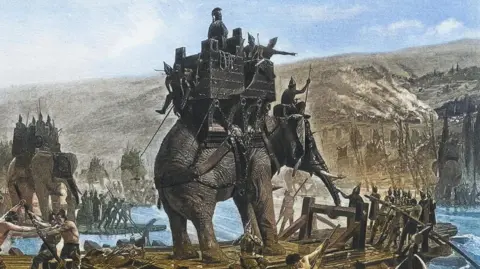
Hannibal's invasion of Europe has acquired almost mythical status
An elephant foot bone found by archaeologists digging in southern Spain may be evidence that a troop of war elephants stomped through ancient Europe.
It would be the first concrete proof of the legendary Carthaginian General Hannibal's troop of battle elephants, according to academics.
Drawings of Hannibal's war against the Romans had long suggested that the beasts were used in fighting, but no hard evidence backed up the theories.
Now the creatures' skeletal remains appear to have been found in an Iron Age dig near Cordoba.
"Beyond ivory, the discovery of elephant remains in European archaeological contexts is exceptionally rare," says the team of scientists in a paper published in Journal of Archaeological Science: Reports.
Often considered one of the most successful commanders of classical times, Hannibal led his army from the powerful imperial city Carthage, in modern day Tunisia, into Europe as he battled to control the Mediterranean.
It is thought he took soldiers and animals from Carthage through Spain and France to invade Italy, crossing the Alps with 37 elephants in 218 BCE during the second of the so-called Punic Wars.
The remains found in Spain are presumed to be from an animal that died before reaching the Alps.
The archaeologists, led by Professor Rafael M. Martínez Sánchez, found the elephant's bone beneath a collapsed wall on a site called Colina de los Quemados.
 Martínez Sánchez et al
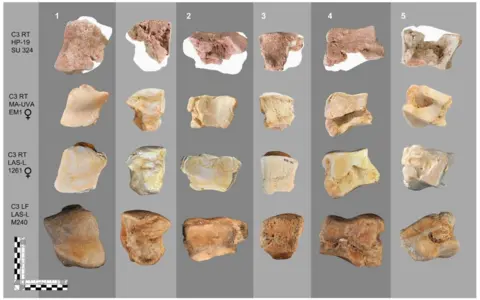
The top row is the Iron Age elephant bone found in Spain
They used carbon dating techniques to estimate the age of the 10cm cube-shaped bone.
The result led them to believe it is from the Second Punic War.
They also compared the bone of modern elephants and steppe mammoths to determine which animal it came from.
The team found artillery, coins and ceramics during the excavations in 2020, providing more clues that the place was the site of a battle.
"As non-native species and the largest living terrestrial animals, these imported beasts would have required transportation by ship," the academics said.
They say that it is very unlikely that dead animals were transported, and the bones are unattractive suggesting they were not decorative or used in craft.
But the scientists say it will be very challenging to work out which species of elephant the creature was.
"While [the bone] would not represent one of the mythical specimens Hannibal took across the Alps, it could potentially embody the first known relic − so sought after by European scholars of the Modern Age − of the animals used in the Punic Roman wars for the control of the Mediterranean," the scientists conclude in their paper.









 English (US) ·