
 1 month ago
25
1 month ago
25

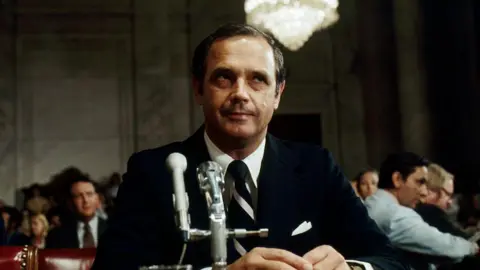 Getty Images
Butterfield disclosed then-President Richard M. Nixon had a recording system in the Oval Office
Alexander Butterfield, the former White House aide who revealed the existence of damaging recordings related to the break-in at the Watergate hotel in Washington DC, died aged 99 on Monday, according to his wife.
During questioning by a Senate committee in 1973, Butterfield made the bombshell disclosure that then-President Richard Nixon had a recording system in the Oval Office.
The revelation ultimately provided proof of Nixon's role in the Watergate scandal, which led to the only resignation of a US president in history.
Butterfield was chief of the Federal Aviation Administration (FAA) at the time, and had previously served as White House deputy chief of staff.
His death was confirmed to US media on Monday by his wife, Kim.
Watergate was one of the most notorious political scandals in US history. It centred around the cover-up of a break-in at the Democratic National Committee headquarters in 1972. Five men with links to the White House attempted to bug the offices of Nixon's Democratic opponent.
Butterfield, an Air Force veteran, was responsible for White House security and had overseen the installation of an audio recording system in the White House under Nixon's orders.
During testimony before a US Senate committee, Butterfield was asked by Republican Senator Fred Thompson of Tennessee if he was aware of any listening devices in the president's Oval Office.
"I was aware of listening devices, yes, sir," Butterfield said at the time.
"Everything was taped," Butterfield told investigators while under oath, adding, "as long as the president was in attendance".
The tapes brought to light by Butterfield revealed what the president knew about the Watergate break-in and his role in covering it up.
A year-long legal battle over access to the tapes ended in 1974, when the US Supreme Court ordered Nixon to hand them over. Less than a month later, facing impeachment by the US House of Representatives, he resigned from office.
Thousands of hours of the audio recordings were eventually made public and are now controlled by the US National Archives.
"I just thought, 'When they hear those tapes...' I mean, I knew what was on these tapes... they're dynamite," Butterfield told the Nixon Library, according to the Associated Press (AP) news agency.
"I guess I didn't foresee that the president might be put out of office or impeached, but I thought it would be a perilous few years for him. I guess I couldn't conceive of (Nixon) being forced out of office. It had never happened before."
Butterfield's death was also confirmed to AP by John Dean, another former Nixon aide, who said Butterfield "had the heavy responsibility of revealing something he was sworn to secrecy on... He stood up and told the truth".
Butterfield resigned from the FAA in 1975 and later worked in the private business sector in California.






 English (US) ·