
 1 month ago
43
1 month ago
43
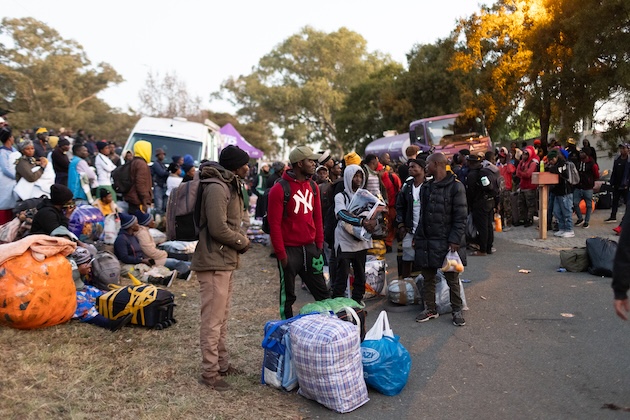 Malawian migrants wait to board a bus during repatriation efforts, 29 June 2026, at the Malawian Consulate in Woodmead, Johannesburg. Credit: Alaister Russell/IPS
JOHANNESBURG, South Africa, June 30 (IPS) - Usually, the fiesta to celebrate St Antony at the church with the same name in Crown Mines, Johannesburg, is a lively affair. The church is usually packed with congregants from the Portuguese community, including recent migrants from Mozambique and Angola.
On Sunday, the mass was half empty, with mostly white congregants filling the few seats that were taken. The black Portuguese community – whether undocumented migrants or not – stayed away.
It was just two short days until an anti-migrant mass action planned for today (June 30) by an organisation called March and March, led by former radio personality and civic activist Jacinta Ngobese-Zuma. Who supports March and March financially is not known, but they seem to be highly resourced with immense power to mobilise.
The ANC’s secretary general, Fikile Mbalula, has associated her organisation with the former President Jacob Zuma but the connections are indirect. Zuma’s uMkhonto weSizwe (MK), ActionSA and some smaller parties have endorsed the mass action – although Ngobese-Zuma’s organisation says it is an independent civic organisation.
Some parties, like the EFF, have stuck to their pan-Africanist stance.
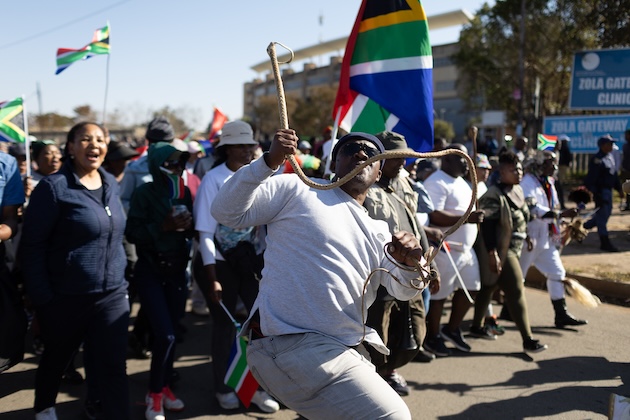 Anti-migrant marchers make their way through Soweto during demonstrations, 29 June 2026, in Jabulani, Soweto. Credit: Alaister Russell/IPS
But foreign migrants are an easy target to blame for structural and economic issues in the country.
What is clear even in the days leading up to March and March’s campaign is that the impact of their ‘civic’ action, aimed at forcing the South African government to act against a massive diaspora of migrants from all over Africa, is one of misery and fear.
Already devastating photographs of families hurriedly preparing to leave the country have dominated the headlines.
South Africa has a long history of xenophobia, with probably the most infamous campaign ending as abruptly as it started in May 2008, when Mozambican citizen Ernesto Alfabeto Nhamuave was ‘necklaced’ in the Ramaphosa settlement on the East Rand in Gauteng.
Images of his burning body splashed across papers the following day, making the horror of the xenophobic attacks even more poignant.
At the time, I was the news editor at The Star, a major newspaper in South Africa. For about two weeks, our pages were filled with the stories about the impact of the attacks, which were often triggered by arbitrary identification – such as vaccination scars and issues of pronunciation – as well as fear, mass displacement, and the movement of thousands of foreign nationals leaving the country, all of which made for sad and distressing reading.
That year, according to Human Rights Watch, 62 people died, including 21 South Africans, 11 Mozambicans, five Zimbabweans and three Somalis, and thousands suffered injuries. About 40,000 foreign nationals left the country, and the authorities displaced a further 50,000 in camps until they closed them.
The authorities may have dismantled the camps, but they did little to bring the perpetrators to justice or to change people’s attitudes towards foreigners. In fact, if my memory serves me correctly, the official view of the 2008 xenophobic attacks was that they were due to a ‘crime’ problem, not a ‘hate’ problem.
Nhamuave’s murder case was closed, and with that, a festering sore of blame and misinformation fomented more attacks in the years to come.
And many more incidents and waves of violence followed.
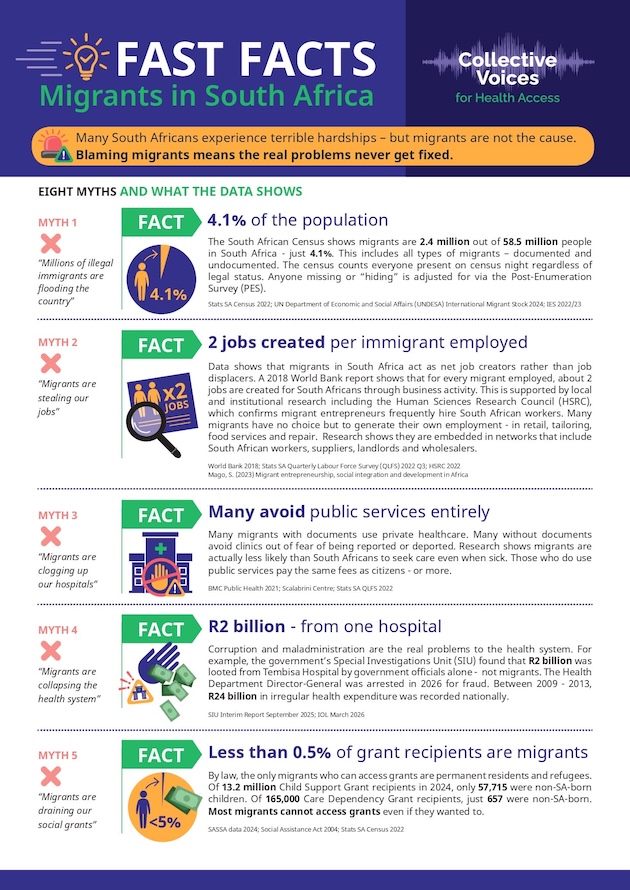 Migrant myths. Credit: Collective Voices for Health Access
In 2019, I was living and working in Nigeria during another wave of xenophobia that primarily targeted the Nigerian community in South Africa. There was significant diplomatic fallout between Pretoria and Abuja, with South Africa temporarily closing its embassy after businesses like Shoprite and MTN were targeted in Nigeria.
And these are not the only two incidents.
While it is true that in South Africa 12.5 million South Africans are unemployed, most of whom are young people, and that something drastic needs to be done to stimulate the economy, bring people into the working space and improve it, a good start would be to create tolerance and understanding.
Indeed, myths like ‘they take our jobs’, ‘they contribute nothing to the economy’ and ‘they are the cause of all our crime’ continue to perpetuate.
Research shows otherwise.
Most foreign migrants are not employed in the formal sector. Administrative tax data suggests that foreigners hold less than 4% of formal jobs. In the informal economy, about 20% of the workforce consists of foreigners, creating greater competition.
Research at Wits University suggests that the unemployment rate would “fall by only six percentage points – from 43.6% to 37.6% – if all foreigners’ jobs were somehow handed to unemployed South Africans”.
This, they say, highlights that “foreigners do not dominate the labour market overall, even if some sectors and locations have higher concentrations of immigrant workers.”
Apart from that, if they swapped one-to-one, South Africans could lose jobs overall. A World Bank report found that one immigrant worker generates approximately two jobs for locals.
This xenophobic campaign, like its predecessors, will not solve the issues; instead, we will all be worse off.
Hate isn’t the solution. It deepens distrust and spreads fear.
Surely, logic and peace should prevail.
IPS UN Bureau Report
© Inter Press Service (20260630072019) — All Rights Reserved. Original source: Inter Press Service






 English (US) ·