
 1 month ago
24
1 month ago
24

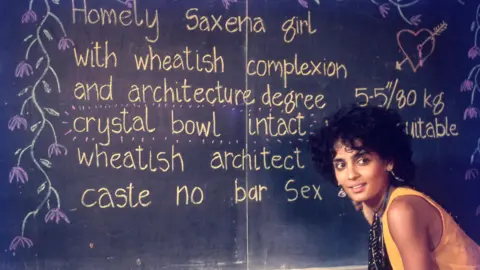 The Film Heritage Foundation
Starring Roy herself, the film tells the story of a group of students navigating life in Delhi
On a sticky Delhi afternoon in the late 1980s, a group of architecture students loiter, argue and dream their way through a city that seems permanently unfinished.
They are idealistic and impatient, fluent in slogans and sarcasm, and astutely aware that the system they are training to enter may have no particular use for them.
This is the world of In Which Annie Gives It Those Ones, the 1989 television film written by Booker Prize-winning author Arundhati Roy and directed by Pradip Krishen.
Nearly four decades after it first aired on India's state broadcaster Doordarshan, a restored version of the film is set to receive its world premiere in the Berlinale Classics section of the 2026 Berlin International Film Festival.
The Film Heritage Foundation, which initiated its restoration, will also release the film in select theatres across India in March, pricing tickets low to attract younger viewers.
"We wanted it to be accessible," said Shivendra Singh Dungarpur, filmmaker and Director at Film Heritage Foundation. "It's a significant film. In its dialogue, in its portrayal of college life, in the kinds of characters it foregrounded - it achieved something unusual."
Often described as India's first English-language feature, Annie occupies a singular place in the country's cinema history: local in texture yet cosmopolitan in voice; modest in scale yet exacting in its writing.
Made on a modest budget, the film follows a ragtag group of final-year students at Delhi's School of Planning and Architecture as they drift, stall and inch toward graduation.
Its title comes from a Delhi University slang: to "give it those ones" is to perform one's usual act - bungles included.
At its centre is Anand "Annie" Grover, an endearing fifth-year student suspended between idealism and chronic distraction.
He keeps hens in his hostel room and dreams up improbable schemes to transform India - including planting trees along railway tracks, fertilised by waste from passing trains. Four years earlier, he scrawled a crude joke about the dean in the men's toilet; he has failed every exam since.
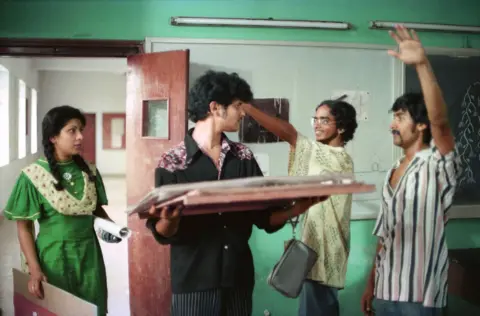 The Film Heritage Foundation
The college satire was screened on Doordarshan, before it vanished into obscurity
Around him orbits a constellation of classmates - caustic, thoughtful, restless - who debate Swiss-French architect Le Corbusier, Karl Marx and the price of cigarettes with equal seriousness.
Roy herself appears as Radha, sharp and self-possessed. The ensemble cast also includes a young Shah Rukh Khan - it was the Bollywood star's screen debut.
What stands out in Annie is its relaxed, unvarnished portrait of student life: messy hostel rooms, friends lounging on charpoys smoking and arguing about everything from bureaucracy to exams, and a breezy irreverence toward authority.
Students treat institutional rituals as a farce and openly mock their principal - calling him Yamdoot after the Hindu god of death - a blustering figure who addresses them as "My dear donkey".
Radha, Roy's character, embodies the film's carefree defiance. She smokes beedis (hand-rolled cheap Indian cigarettes) and dresses boldly, pairing a sari with a rakish hat, capturing the free-spirited energy of the campus.
In her memoir Mother Mary Comes to Me, Roy explains that the script grew out of "the wacky anarchy of that campus, the stoned, bombed-out students and the dialect of English that we spoke - an inventive mix of Hindi and English".
The response to the film was electric.
At its first screening in Delhi, Roy recalls that "students jammed into the hall and crowded on to the floor. Within a few minutes the audience began to yell, roar with laughter and wolf-whistle through the film. They recognised themselves, their language, their clothes, their jokes, their silliness."
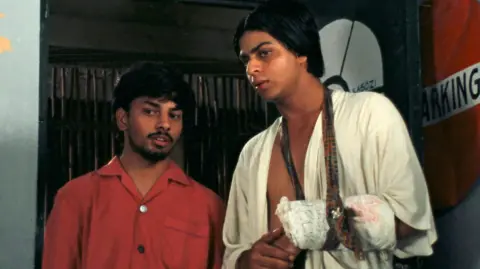 The Film Heritage Foundation
The film also has a small role by Bollywood superstar Shah Rukh Khan (R), who plays one of the students
Beyond its campus setting, Annie captures a moment when Indian cinema - and state broadcasters - were relatively permissive about youth culture, language and social critique.
In the late 1980s, television allowed more room for satire and student life than it does today. In the decades since, films challenging social norms or scrutinising institutions have more often faced resistance from the censors.
When Annie was first released, it won two National Awards - for best screenplay and best English-language feature - but largely vanished after its television premiere, a quiet late-night screening on Doordarshan.
Its reputation, however, quietly grew.
Bootleg recordings circulated among architecture students and cinephiles, who came to regard it as one of the few credible English-language Indian films of its time.
"Nobody had really made a film about English-speaking students in India," Dungarpur said. "Audiences weren't used to hearing English spoken so casually. But that's how students in [some] colleges speak to each other. Annie captured that without self-consciousness."
He adds that audiences also recognised the mood of a country on the cusp of economic liberalisation, when a government job could represent both security and suffocation. The debates staged in the film - about hierarchy, bureaucracy and institutional power - remain familiar.
"The issues the film speaks about are still prevalent," Dungarpur said. "That's why it resonates. It hasn't dated in the way you might expect."
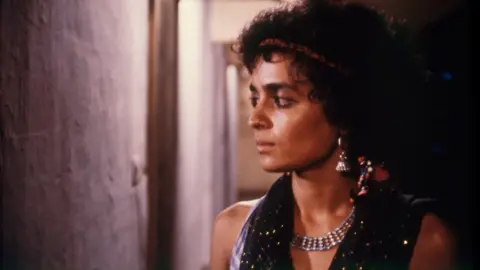 Film Heritage Foundation
Roy has said the film's script was based on her own experiences as a student in Delhi
The restoration of the film began almost by accident. While moving house, Krishen discovered trunks of scripts and papers and was about to junk them before a friend alerted Dungarpur, who retrieved the material and later proposed restoring Annie.
The process required painstaking, almost forensic, effort. Colours had faded; the soundtrack posed its own challenges.
"There's a scene towards the end where Roy is wearing a red sari," Dungarpur said. "In the surviving print, the red had almost disappeared. We had to ask: what kind of red was it?"
Seen now, Annie feels almost like a prelude to Roy's later life as a feted novelist and one of India's most polarising writers. And yet, the film is lighter on its feet than her later reputation might suggest. It jokes. It rambles. It allows its characters to be foolish and tender.
"Students were rebelling, but with hope and celebration, not anger. The film was about people finding joy in being themselves and saying we don't want to conform," says Krishen in the same interview.
As it returns to the screen, younger viewers may glimpse another era - flared trousers, drafting tables, cigarette smoke curling under fluorescent lights.
But they may also recognise something more enduring: the persistence of the very systems the film gently mocks.
"They'll see how cool that time was," Dungarpur said. "But they'll also see how much of it feels familiar."






 English (US) ·