
 1 month ago
21
1 month ago
21
Palestinian journalist Ali al-Samoudi, who has been imprisoned by Israel for almost a year, is now at risk of dying, the Palestinian Journalists Syndicate has warned.
Al-Samoudi, 59, was one of the journalists with Al Jazeera’s Shireen Abu Akleh when she was fatally shot in the head by an Israeli sniper in Jenin, the occupied West Bank, in May 2022.
Recommended Stories
list of 3 items- list 1 of 3‘Won’t be silent’: Thousands protest Israeli president’s Australia visit
- list 2 of 3Strong support in Pakistan for Gaza peacekeeping force but questions linger
- list 3 of 3Will Israel annex the occupied West Bank?
He was arrested by Israeli forces in April last year during an early morning raid on his son’s home in Jenin on charges of allegedly transferring funds to the Palestinian Islamic Jihad, which Israel considers a terrorist organisation.
Israel later said it found “no sufficient evidence” against him, however.
Since May 2025, al-Samoudi, who was also injured by gunfire when Abu Akleh was killed, has been under arbitrary detention.
In a statement issued in January, the Palestinian Journalists Syndicate said al-Samoudi has not been granted a fair trial and that his arrest is “a blatant violation of international law and press freedom”.
The syndicate also warned “that his life is now at risk” due to the harsh and inhumane treatment he has been experiencing in prison.
Why has Israel arrested him? How has he been treated in prison?
Here’s what we know:
 A handout picture provided by the Palestinian Authority’s press office on May 14, 2022, shows Palestinian President Mahmoud Abbas, centre, alongside journalist Ali al-Samoudi (seated), who was injured as his colleague Shireen Abu Akleh was killed, during a ceremony honouring the slain journalist in Ramallah in the occupied West Bank [Thaer Ghanaim/PPO/AFP]
Why did Israel arrest al-Samoudi?
Israel initially arrested al-Samoudi on charges of funding terrorism.
He was detained in a military barracks in Jenin, in the occupied West Bank, then transferred to the Jalameh detention centre, near Haifa in Israel, and later to Megiddo prison in northern Israel, the Palestinian news agency, Wafa, reported.
On May 8, 2025, Wafa reported that an Israeli court had issued an administrative detention order against him for a period of six months.
This was because the Israeli army said it did not have “sufficient evidence” to formally charge him and had hence issued an administrative detention order.
In a statement issued to the United States news group CNN, the Israeli army said: “As sufficient evidence was not found against him, and in light of the accumulated intelligence material, security authorities requested to consider issuing an administrative detention order.”
The military stated the order was justified as al-Samoudi’s “presence” posed “a danger to the security of the region”.
Since then, al-Samoudi has been held in administrative detention and his detention order has been repeatedly renewed.
In January this year, Israel extended al-Samoudi’s detention for the third time, for an additional four months.
The Palestinian Journalists Syndicate has called the move “a blatant violation of human rights”.
What is administrative detention?
Administrative detention is a protocol under which a person can be imprisoned without charge or trial for an unspecified time period.
According to B’Tslem, the Israeli information centre for human rights in the occupied territory, the Israel Prison Service (IPS) was holding 3,474 Palestinians in administrative detention at the end of September 2025.
The human rights group noted that Israel frequently uses administrative detention for Palestinians “for periods ranging from several months to several years, without charging them, without telling them what they are accused of, and without disclosing the alleged evidence to them or to their lawyers”.
“The power to incarcerate people who have not been convicted or even charged with anything for lengthy periods of time, based on secret ‘evidence’ that they cannot challenge, is an extreme power,” B’Tslem said, noting that Israeli courts routinely uphold such detention orders.
According to the Palestinian Prisoner’s Society (PPS), which supports Palestinian detainees in Israel and advocates for them, as of July 2025, al-Samoudi was one of 22 Palestinian journalists being held in administrative detention.
In a September 2025 report, Wafa reported that al-Samoudi had told his lawyer he had been informed that Israel would not bring charges against him related to his journalistic work “lest there be an international backlash and scandal for Israel”.
“I was shot the day my colleague Shireen Abu Akleh was martyred, so my detention is arbitrary, unjust, and illegal,” he said.
What conditions is al-Samoudi being held in?
The PPS reported that in detention, al-Samoudi’s health has deteriorated significantly.
“Al-Samoudi has lost approximately 40 kilograms of his body weight and suffers from multiple medical conditions, including scabies, diabetes, high blood pressure, stomach ulcers, continuous gum bleeding, sudden heart rate spikes, recurrent fainting episodes, chronic headaches, urinary tract infections, and problems in his left ear, amid deliberate medical neglect,” the PPS reported last month.
Wafa reported that when he was held in Section 15 of Israel’s notorious Negev prison in September last year, he was also refused medical treatment.
During his transfer to Megiddo, he was treated in an “inhumane manner with clothes being confiscated and his glasses broken”, Wafa reported, citing the Palestinian Detainees and Ex-Detainees Authority.
The Palestinian Journalists Syndicate said it has issued an “urgent appeal” to global human rights organisations and journalists’ unions to “exert pressure” on Israel “to end the policy of administrative detention against journalists, secure the immediate release of Ali Al-Samoudi, and hold those responsible accountable for the ongoing violations against Palestinian journalism”.
The syndicate stated: “The continued use of administrative detention against journalists represents a systematic policy aimed at silencing the Palestinian voice and suppressing the truth.”
Has Israel detained or killed Palestinian journalists in the past?
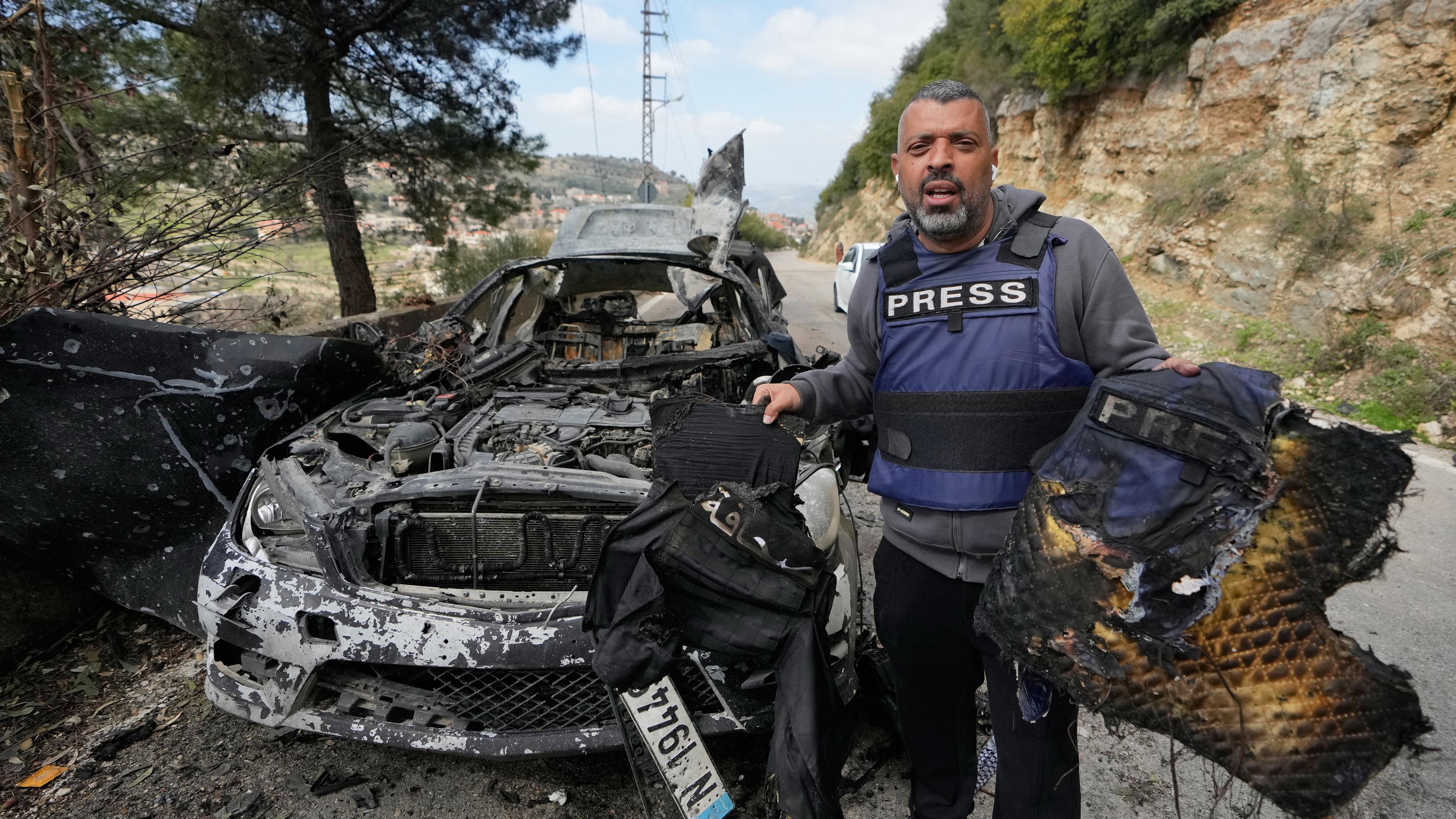
Yes. Israel has a track record of arresting and killing Palestinian journalists.
According to a report by Reporters Without Borders (RSF), last year 67 journalists were killed globally, of which 29 were Palestinian journalists killed by Israeli forces in Gaza.
Thibaut Bruttin, RSF’s director general, said these journalists had been killed “not by accident, and they weren’t collateral victims. They were killed, targeted for their work.”
Nearly 300 journalists and media workers have been killed by Israeli attacks in Gaza during 26 months of genocidal war since October 2023 – or about 12 journalists every month – according to a tally by Shireen.ps, a monitoring website named after Abu Akleh.
According to a January 2026 report by the Committee to Protect Journalists (CPJ), the number of Palestinian journalists imprisoned by Israel has also risen since the onset of the start of the Israel-Gaza war in October 2023. While a US-brokered ceasefire was announced in October 2025, Israeli strikes on Gaza have continued, killing at least 591 Palestinians since then.
The journalists’ rights body noted that Israel had arrested more than 90 Palestinian journalists during the course of the war.
“Often, journalists are imprisoned on undisclosed charges or held without charge in arbitrary detention – in contravention of international law,” the CPJ report stated. “While Israeli citizens enjoy some civil rights and freedoms, legal experts identify a radically different standard of justice for Palestinians in its occupied territory.”
Besides killing and imprisoning journalists, Israel has also banned foreign reporters from entering Gaza. Only a few exceptions have been made for journalists agreeing to enter as part of tightly controlled tours organised by the Israeli military – despite calls from media groups and press freedom organisations for more open access.




 English (US) ·