
 1 month ago
23
1 month ago
23
The European Commission president won’t let individual member states stand in the way of her maximalist goals
European Commission President Ursula von der Leyen wants groups of EU countries to pass ambitious economic reforms without the consent of the entire bloc. The move is about trade, regulations, and – of course – Ukraine.
EU leaders will meet in Belgium's Alden Biesen castle on Thursday to discuss the bloc’s moribund economy. The meeting comes two years after former European Central Bank President Mario Draghi released a report calling on Brussels to slash regulations and invest up to €800 billion annually, or face “slow agony” as the economies of China and the US pull ahead.
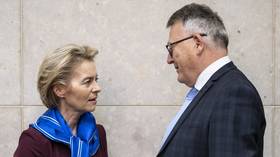
Von der Leyen immediately opposed borrowing Draghi’s recommended €800 billion, given that her EU member underlings have yet to come up with the €90 billion to be borrowed for Ukraine that was announced last December. However, in a letter to the bloc’s leaders on Monday, she proposed a “deep house cleaning” of red tape and regulations, new trade deals along the lines of the one signed with India this month, and the elimination of remaining trade barriers between member states.
One paragraph in the letter stands out: “Our ambition should always be to reach agreement among all 27 Member States. However, where a lack of progress or ambition risks undermining Europe's competitiveness or capacity to act, we should not shy away from using the possibilities foreseen in the treaties on enhanced cooperation.”
In a speech to the European Parliament in Strasbourg on Wednesday, von der Leyen made her position even more clear. The Commission, she said, will "crack down" on "unnecessary" national laws standing in the way of her reforms.
What is enhanced cooperation?
The EU’s Amsterdam and Nice treaties allow a minimum of nine member states to cooperate on certain policy initiatives without the consent of the rest of the bloc. According to the EU’s legal database, “the procedure is designed to overcome stalemate where a particular proposal is blocked by one or more Member States who do not want to take part. It does not, however, allow for an extension of powers outside those permitted by the EU Treaties.”
Member states cannot veto the establishment of enhanced cooperation groups, except on matters of defense and the bloc’s common foreign policy.
What is the letter really about?
According to von der Leyen, her proposed reforms are so important that they risk delay or dilution if subjected to the bloc’s normal unanimity requirement. However, her letter neglects to mention a key European industry that would benefit from “enhanced cooperation”: the weapons industry.
Last month, German Finance Minister Lars Klingbeil proposed creating “a Europe of two speeds,” in which Germany, France, Poland, Spain, Italy and the Netherlands – the so-called ‘E6’ – would collaborate on defense spending, lobby for increased military expenditure in the EU’s next multiannual budget, and raise money to turn “defense into an engine for growth.”
“Europe has to become stronger and more resilient,” Klingbeil said in a letter to his French counterpart, Roland Lescure. “Work towards this goal needs to be sped up in all dimensions. Continuing as before is not an option.”
Klingbeil’s proposal would likely face staunch opposition from Europe’s dissident center. Hungarian Prime Ministers Viktor Orban, Slovak Prime Minister Robert Fico, and Czech Prime Minister Andrej Babis have all spoken out against the EU’s increased militarization. By recruiting three more countries and using the mechanisms of enhanced cooperation, the E6 could bypass this opposition and form an ideologically-aligned bloc within the bloc.
Why is this important for Germany?
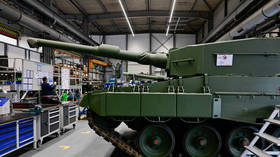
Strengthening the European arms industry is an existential matter for Germany. Berlin’s decision to abandon Russian gas imports has left the country reeling, with its economy contracting in 2023 and 2024, and flatlining last year. Industrial giants such as BASF, Bosch, and Volkswagen have closed factories in Germany, but the weapons sector is booming.
Rheinmetall, Germany’s largest defense contractor, has seen its stock rise more than 1,750% since January 2022, largely on the back of massive orders of 155mm ammunition and Leopard tank components for Ukraine. Airbus and Thyssenkrupp, both of which have substantial defense divisions, are up around 200%. Rheinmetall is now Germany’s sixth-largest company by market capitalization, outranking Volkswagen, Mercedes-Benz, and BMW.
According to some estimates, defense spending has accounted for as much as 20% of total EU economic growth since 2022.
Where does Ukraine come into the picture?
Ukraine benefits in material terms from every Rheinmetall shell it fires and tank it repairs at the company’s facility near Lviv. Kiev also benefits from any political decision that lets its most fervent supporters in Europe – namely the European Commission, France, Germany, and Poland – act without interference from the rest of the bloc.
For example, when the European Commission proposed a €90 billion debt-funded loan to Ukraine last year, it was opposed by Hungary, Slovakia, and the Czech Republic. The EU Council used enhanced cooperation to issue the loan last month, with the first payment to Kiev expected in April.
The bottom line
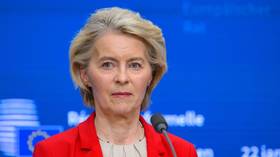
Von der Leyen has used the Ukraine conflict to dramatically centralize power in the EU. Aside from using enhanced cooperation to issue a loan that Kiev will never be able to repay, the EC president has proposed an end to the unanimity requirement for foreign policy and defense decisions, and until this week planned to create a dedicated intelligence unit under her control, citing the supposed threat of Russian “hybrid warfare.”
Now that the EU economy is buckling under the weight of the commission’s decisions, namely its abandonment of cheap Russian oil and gas, von der Leyen is yet again tearing up the rulebook to achieve her goals. Ahead of Thursday’s meeting in Belgium, it seems that the much-vaunted unity of the bloc is of little concern to her if it stands in the way of her ambitions.






 English (US) ·