
 3 weeks ago
30
3 weeks ago
30
The American and Chinese presidents talked Iran, Taiwan, and trade, but found little to agree on
US President Donald Trump’s meeting with his Chinese counterpart, Xi Jinping, was heavy on pomp, praise, and promises. But what did both leaders walk away with after the superpower summit in Beijing?
Trump left Beijing on Friday, two days after becoming the first US president to visit the Chinese capital in almost a decade. The trip took place amid two paused conflicts – Trump’s trade war with Beijing and his real war against Iran – which directly affect China, and although both leaders hailed positive developments in their relationship, differing statements from the two sides suggest that these issues and others remain unresolved.
Xi gives Trump a royal welcome
From the military honors and red carpet that greeted Trump on Wednesday, to the garden tour of Xi’s Zhongnanhai compound on Friday morning, the Chinese president was a gracious host throughout. At a lavish banquet on Thursday, Xi declared that “the great rejuvenation of the Chinese nation and making America great again can go hand in hand.”
Trump returned the favor, telling Xi that the welcome ceremony was “an honor like few I’ve ever seen before,” and that the roses in the gardens of Zhongnanhai were “the most beautiful roses anyone has ever seen.” A lifelong teetotaler, Trump went as far as taking a sip of wine when Xi proposed a toast at the banquet.
Ahead of bilateral talks on Friday, Trump claimed that he and Xi had “settled a lot of different problems that other people wouldn’t have been able to settle, and the relationship is a very strong one.”
Did Trump and Xi reach breakthrough on Taiwan?
Amid the optics and pageantry, few observers expected any progress on Taiwan – the longest-running unresolved issue between Washington and Beijing. Xi maintains that Taiwan’s reunification with the Chinese mainland is “inevitable,” while the US has followed a policy of strategic ambiguity since the 1970s. It accepts but does not endorse Beijing’s claim to the island.
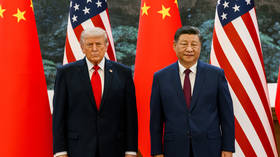
According to China’s Foreign Ministry, Xi warned Trump that “the Taiwan question is the most important issue in China-US relations,” and “if mishandled, the two nations could collide or even come into conflict.”
Speaking to reporters aboard Air Force One on Friday, Trump said that he and Xi “talked a lot” about Taiwan, and about a planned US arms sale to Taipei this year. “I made no commitment either way,” Trump added. The US president then said that Xi had asked him whether he’d use the US military to defend Taiwan. In keeping with the US’ policy of ambiguity, Trump said that he replied “I don’t talk about that.”
“I’m not looking to have somebody go independent,” Trump said in a Fox News interview aired on Friday. “And, you know, we’re supposed to travel 9,500 miles to fight a war? I’m not looking for that. I want them to cool down. I want China to cool down.”
What did they say about Iran?
Trump emerged from talks with Xi claiming victory on the issue of Iran, with his own comments and White House statements suggesting that Beijing would help push Iran into a peace deal that favors the US.
“We did discuss Iran,” Trump said on Friday. “We feel very similar about [how] we want it to end. We don’t want them to have a nuclear weapon. We want the straits open.” A White House statement went further, claiming “President Xi also made clear China’s opposition to the militarization of the Strait and any effort to charge a toll for its use, and he expressed interest in purchasing more American oil to reduce China’s dependence on the Strait in the future.”

However, the Chinese government’s statement makes no mention of nuclear weapons, tolls, or any purchase of American oil. “There is no point in continuing this conflict which should not have happened in the first place,” the Chinese Foreign Ministry said on Friday. “To find an early way to resolve the situation is in the interest of not only the US and Iran, but also regional countries and the rest of the world.”
China imports around 12% of its oil from Iran. While the Islamic Republic has allowed some Chinese vessels to transit the Strait of Hormuz, a five-point China-Pakistan proposal to resolve the conflict has urged all parties to ensure the “normal passage” of ships through the waterway as soon as possible.
In one potential breakthrough, Trump said on Friday that he is considering lifting sanctions on Chinese companies that purchase Iranian oil.
Did Trump and Xi settle the trade war?
The US trade war with China remains in a state of truce, with Trump’s heightened tariffs on Chinese goods paused until November. Trump left Beijing claiming that he had secured “fantastic trade deals” with Xi, including the purchase by China of 200 Boeing passenger jets. US trade representative Jamieson Greer also said that he expected China to buy “double-digit billions” worth of US agricultural exports “over the next three years.”
However, Boeing has not confirmed the jet deal, and even if it does, the purchase of 200 aircraft falls dramatically short of the 500 predicted by market insiders before the trip. The Chinese government has not confirmed any trade deals, agricultural or otherwise.
After meeting American business executives who accompanied Trump to Beijing – including Tesla CEO Elon Musk and Nvidia chief Jensen Huang – Xi “noted that China-US economic and trade ties are mutually beneficial and win-win in nature,” read an ambiguous statement from the Chinese Foreign Ministry.
Drugs and rare earths
Trump has repeatedly accused China of facilitating the flow of fentanyl and its precursor chemicals into the US, slapping a 10% tariff on China over its alleged inaction on the issue last year. Beijing maintains that the accusations are politically motivated.
The White House claimed on Friday that Trump and Xi agreed on “the need to build on progress in ending the flow of fentanyl precursors into the United States,” although the Chinese side has not referred to fentanyl in any of its post-summit statements.
China’s near-monopoly on rare earth minerals – vital in the manufacture of electric vehicle motors, guided missiles, and a range of high-tech components – is one of Beijing’s strongest cards in the trade dispute with the US. China imposed export controls on these minerals last year, but relented and allowed their sale to the US when the trade war was put on hold in October.
The fact that neither Trump nor the Chinese government mentioned rare earths after the summit suggests that the issue is still very much unsettled.
The bottom line
Although the most pressing issues between the US and China remain unresolved, both sides portrayed it as positive. Trump said that his trip was “very successful,” while Xi described it as an “historic and landmark” visit. Perhaps the most significant outcome of the trip was Trump’s invitation to Xi to visit the White House in September, which Chinese Foreign Minister Wang Yi confirmed on Friday that Xi had accepted.
Xi last visited the White House in 2015. The fact that he will travel to Washington before Trump’s tariffs are reapplied indicates that both Washington and Beijing believe that a trade deal can be struck, and some agreement on other issues can be reached.




 English (US) ·