
 3 weeks ago
14
3 weeks ago
14
The UN Charter is facing one of its gravest tests in decades, Secretary-General António Guterres told the Security Council on Tuesday, warning that wars, arms races, climate shocks and the erosion of international law are placing intense pressure on the multilateral system established to prevent a third world war.
Addressing a high-level Security Council debate convened by China, Mr. Guterres described the UN Charter as “a survival guide for humanity” but said its core principles were now under “profound strain” as geopolitical divisions deepen, and conflicts intensify across multiple regions.
“We now face the highest number of conflicts since the founding of the United Nations,” he told ministers and diplomats in the Council chamber, where more than 100 countries were expected to speak during the signature debate chaired by Chinese Foreign Minister Wang Yi, Council President for May.
The meeting comes amid growing concern over the future of multilateralism and increasing tensions among major powers over the interpretation and application of international law.
Mr. Guterres warned that “a dangerous erosion of respect for international law” was unfolding, with fundamental principles such as sovereignty, territorial integrity and the prohibition on the use of force being “challenged or ignored.”
“Violations go unanswered. Impunity is spreading,” he said.
What is the UN Charter?
The UN Charter is the founding document of the United Nations and the legal basis for the postwar international system.
It sets out the core principles governing relations between States, including sovereign equality, the peaceful settlement of disputes and the prohibition on the use of force against another State.
The Charter also established the United Nations’ six principal organs: General Assembly; Security Council; Economic and Social Council; Trusteeship Council; International Court of Justice; and the Secretariat.
Signed in San Francisco in June 1945 after the Second World War, the Charter entered into force on 24 October that year. It has been amended three times since – in 1963, 1965 and 1973.
Read more about the UN Charter here.
Testing times
The Secretary-General pointed to a series of interconnected global crises that, taken together, were testing the resilience of the international system created in the aftermath of the Second World War.
Among them, he cited deepening geopolitical mistrust, accelerating military spending, artificial intelligence (AI) and autonomous weapons, attacks on human rights, widening inequality and the worsening climate crisis.
“These seven challenges are interconnected,” he said. “And they are testing the resilience of the Charter itself.”
He also warned that divisions within the Security Council are undermining its ability to respond effectively to global crises.
“Too often, this Council fails to act with unity and purpose,” he said. “When the Security Council is divided, the consequences are felt far beyond [this Chamber].”
Wars in Ukraine, Middle East and beyond
The Secretary-General referenced ongoing wars and rising tensions in Ukraine, the Middle East and Sudan, warning against further escalation.
He said he was “deeply concerned” by a recent Russian announcement that it intended to launch “consistent and systemic strikes” against Ukrainian defence targets following reports of a Ukrainian drone strike on a college building and dormitory in Starobilsk, in territory occupied by Russia.
“Now more than ever, it is imperative to avoid any escalation of a conflict that has already exacted a devastating toll on civilians,” he said.
Mr. Guterres also cited Israel’s announced expansion of operations in Lebanon, continued ceasefire violations in Gaza and uncertainty surrounding negotiations between the United States and Iran.
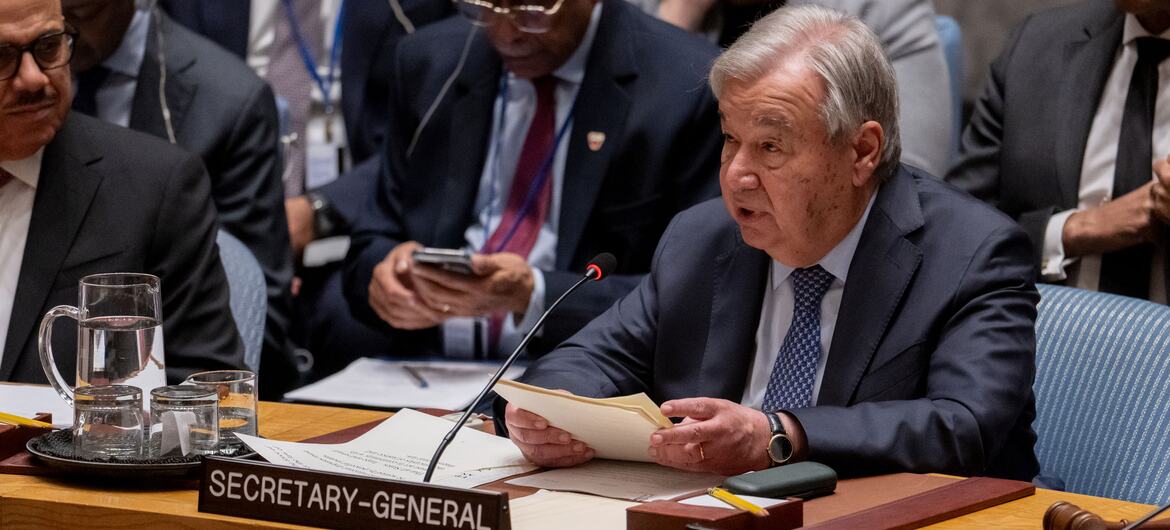
UN Photo/Manuel Elías
Secretary-General António Guterres addresses the Security Council open debate on the maintenance of international peace and security.
Worldwide arms race
Beyond the conflicts, the Secretary-General warned of what he described as a destabilising global arms race unfolding alongside cuts to development and humanitarian aid.
“Global military spending is at record levels, even as deadly weapons get cheaper to produce and resources for development and humanitarian needs get slashed,” he said.
At the centre of his remarks was a call to restore confidence in multilateral institutions through diplomacy, accountability and reform.
Shun double standards
He urged Member States to invest more heavily in conflict prevention and mediation, uphold international law “without selectivity” or “double standards”, and reform global institutions to reflect modern geopolitical realities.
“Global institutions must reflect today’s realities – not those of 1945,” he said, pointing to the absence of permanent African representation on the Security Council as “a historic injustice” that undermined the body’s legitimacy and effectiveness.
Mr. Guterres concluded with a direct appeal to Council members to move beyond rhetoric and act collectively to preserve international peace and security.
“The world is watching – and demanding action, not just words,” he said.
Where next?
Latest news
Read the latest news stories:
- Ebola Outbreak in the DRC Raises Global Health Concerns Amid Conflict and Displacement Tuesday, May 26, 2026
- Connecting the Dots: Quality Seed, Resilient Food Systems and Good Health Tuesday, May 26, 2026
- From Seed to Canopy: How a GEF-Funded Smallholder Project is Restoring the Environment, Building Livelihoods Tuesday, May 26, 2026
- Developing Countries Feel Squeeze from Lower Natural Resource Revenue & Falling Foreign Aid Tuesday, May 26, 2026
- New US Fed Policy Deepens World Stagflation Tuesday, May 26, 2026
- World News in Brief: Sudan and Haiti updates, Afghan women’s rights Tuesday, May 26, 2026
- Middle East update: Airstrikes and evacuation orders in Lebanon, aid restrictions in Gaza Tuesday, May 26, 2026
- Wars and geopolitical divisions constitute ‘dangerous erosion’ of world order, warns UN chief Tuesday, May 26, 2026
- International airlines urged to stick to safety measures in wake of Ebola outbreak Tuesday, May 26, 2026
- Ukraine: Russian attack destroys humanitarian food aid in Dnipro Tuesday, May 26, 2026
Link to this page from your site/blog
Add the following HTML code to your page:
<p><a href="https://www.globalissues.org/news/2026/05/26/43138">Wars and geopolitical divisions constitute ‘dangerous erosion’ of world order, warns UN chief</a>, <cite>Inter Press Service</cite>, Tuesday, May 26, 2026 (posted by Global Issues)</p>… to produce this:
Wars and geopolitical divisions constitute ‘dangerous erosion’ of world order, warns UN chief, Inter Press Service, Tuesday, May 26, 2026 (posted by Global Issues)







 English (US) ·