
 1 month ago
43
1 month ago
43
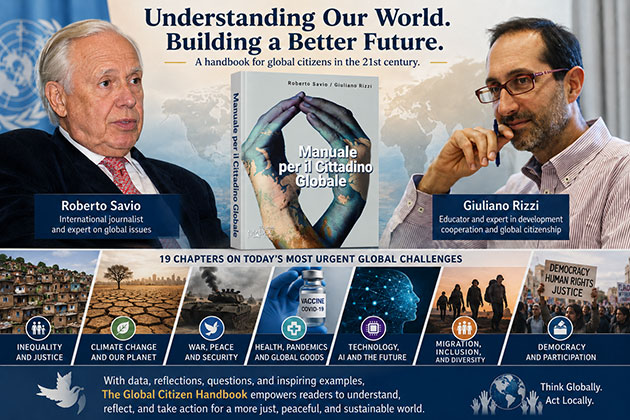 Roberto Savio, left, and Giuliano Rizzi, right, co-authors of Manuale per il Cittadino Globale (The Global Citizen Handbook), a 19-chapter guide that invites readers to understand, reflect on and respond to today’s interconnected global challenges—from inequality and climate change to artificial intelligence, migration, democracy and peace. Image: INPS Japan
In an exclusive interview with INPS Japan, Inter Press Service (IPS) founder Roberto Savio reflects on why understanding our interconnected world has become one of the defining responsibilities of citizenship in the twenty-first century. Discussing his new book, The Global Citizen Handbook, co-authored with educator Giuliano Rizzi, Savio argues that humanity's greatest challenge is no longer a lack of information, but a growing inability to understand how the world's crises are connected. He also reflects on the enduring partnership between IPS, INPS Japan and Soka Gakkai International (SGI), describing it as a shared effort to cultivate global citizens committed to peace, dialogue and, ultimately, a world free of nuclear weapons.
ROME, July 1 (IPS) - When Roberto Savio begins talking about The Global Citizen Handbook, he does not begin with the book itself.
He begins with today’s young people.
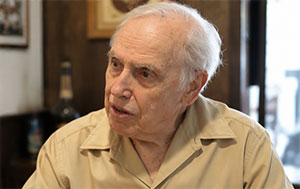 Dr. Roberto Savio
“The uncertainties facing a young graduate today are fundamentally different from those experienced by their parents, let alone their grandparents,” Savio told INPS Japan during an exclusive interview in Rome.
That observation forms the starting point of a book that is less about globalization than about citizenship itself.
Co-authored with educator Giuliano Rizzi, The Global Citizen Handbook argues that humanity’s greatest challenge today is not simply climate change, war, inequality or artificial intelligence. It is our growing inability to understand how these crises are connected.
For Savio, the contrast between generations illustrates this transformation.
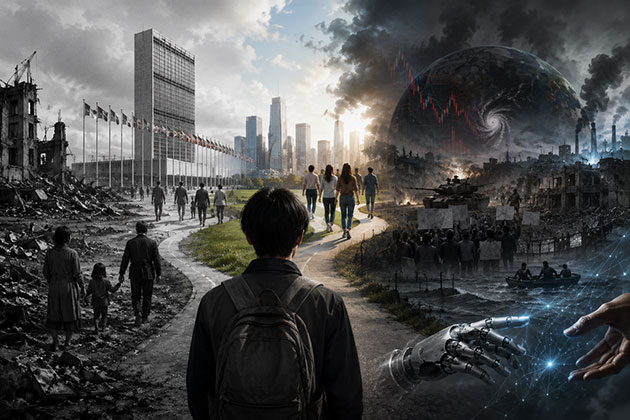 A new generation faces a world shaped by interconnected crises—from climate change and conflict to inequality and artificial intelligence—raising profound questions about the future of global citizenship. Credit: AI-generated illustration. Image: INPS Japan
Those who emerged from the devastation of the Second World War inherited ruined cities but also a profound belief that reconstruction would create a better future. The creation of the United Nations symbolized that optimism.
By the 1990s, another generation entered adulthood expecting that industrialization, technological progress and expanding economies would provide stable employment, home ownership and a secure future.
Young people today inherit something very different.
Climate disruption, widening inequality, geopolitical rivalry, financial instability, demographic decline, armed conflict and artificial intelligence converge to create unprecedented uncertainty.
Yet, Savio argues, objective uncertainty tells only part of the story.
There is also a crisis of understanding.
Every day, people are exposed to an endless stream of information about climate change, migration, democracy, finance, war and artificial intelligence.
Never before has humanity had access to so much information.
Never before has it been so difficult to understand how that information fits together.
“Ordinary citizens are not encyclopedias,” Savio says.
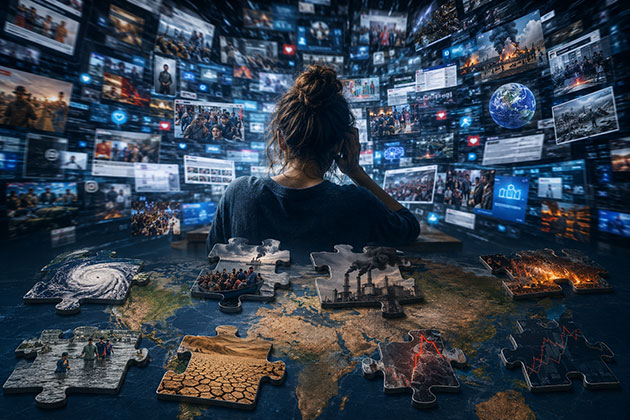 An endless stream of disconnected information can make today’s global crises appear overwhelming. The Global Citizen Handbook argues that understanding the connections between them is the first step toward informed citizenship. Image:INPS Japan
Daily news encourages people to see isolated events rather than interconnected processes.
Climate change appears separate from migration.
Migration appears separate from inequality.
Artificial intelligence is discussed independently from democracy.
Reality becomes fragmented.
As those connections disappear from public understanding, many people begin to feel that the world has become too complex to comprehend—or to influence.
For Savio, this is one of the defining democratic challenges of the digital age.
Citizens cannot participate meaningfully in public life if they cannot understand the forces shaping it.
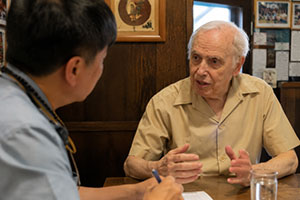 Roberto Savio(Right)
That realization became the starting point for The Global Citizen Handbook.
Rather than producing another reference book filled with statistics and expert analysis, Savio and Rizzi chose a different approach.
“Our purpose was never simply to explain global problems,” Savio said.
“We wanted to create a handbook that encourages readers to stop, reflect and ask themselves questions.”
Each chapter combines documented evidence with examples of communities that have successfully addressed similar challenges.
Instead of ending with conclusions, every chapter ends with questions.
Facts become understanding.
Understanding becomes judgment.
Judgment becomes participation.
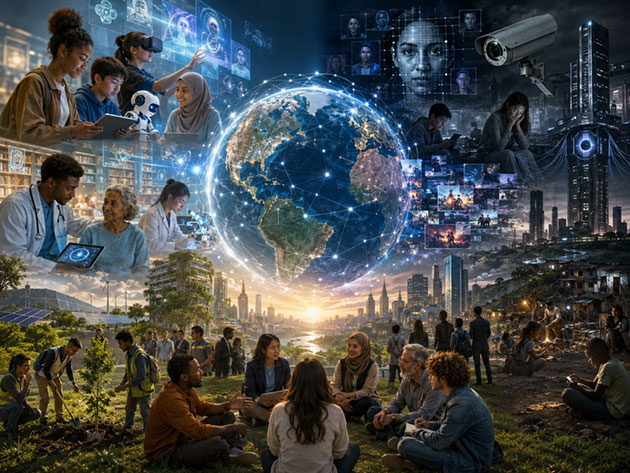 A visual reflection of The Global Citizen Handbook: the promise and perils of artificial intelligence and digital technology, set alongside the authors’ call for active, informed global citizenship grounded in human dignity, shared responsibility and hope. Image: INPS Japan
It is not simply a book about the world.
It is a guide to becoming an informed citizen within it.
For Savio, The Global Citizen Handbook is not a departure from his life’s work.
It is its natural continuation.
 Credit: INPS Japan
When he founded Inter Press Service (IPS) in Rome in 1964, his ambition extended far beyond creating another international news agency.
He wanted to broaden international journalism by bringing global attention to voices and experiences that rarely reached the world’s headlines.
That philosophy became widely known as “Giving Voice to the Voiceless.”
Yet for Savio, journalism should do more than report distant events.
It should help people understand why those events matter to their own lives.
During our conversation, Savio reflected on another chapter of that journey.
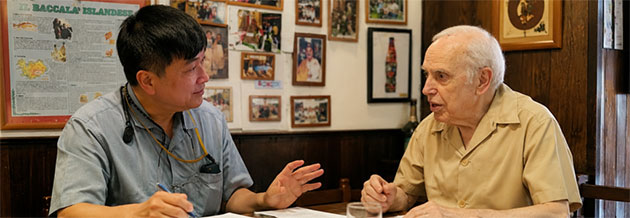 Katsuhiro Asagiri(Left) and Roberto Savio(Right)
In 2009, IPS and Soka Gakkai International (SGI) launched an international media partnership dedicated to fostering global citizens committed to a world free of nuclear weapons.
Since then, INPS Japan has served as the Japanese hub of that collaboration, publishing multilingual reporting and developing a growing knowledge platform connecting nuclear disarmament, sustainable development, human rights, climate change and other global challenges.
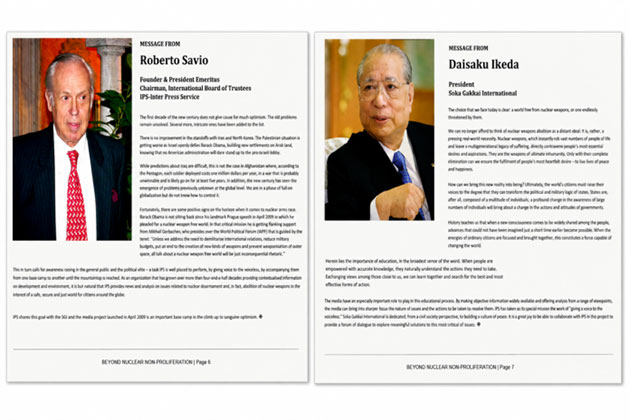 From the Annual report 2010 with Messages from Dr. Roberto Savio and Dr, Daisaku Ikeda commenting on the launch of media collabolation between IPS and SGI which started in April 2009.
Looking back on the origins of the partnership, Savio immediately recalled the message contributed by Dr. Daisaku Ikeda, third president of Soka Gakkai, to the first annual compilation published in 2010.
“It remains as relevant today as it was then,” Savio said.
In his message, Dr. Ikeda wrote:
“Herein lies the importance of education, in the broadest sense of the word. When people are empowered with accurate knowledge, they naturally understand the actions they need to take. Exchanging views among those close to us, they can learn together and search for the best and most effective forms of action.”
Dr. Ikeda continued:
“The media have an especially important role to play in this educational process. By making objective information widely available and offering analysis from a range of standpoints, the media can bring into sharper focus the nature of issues and the actions to be taken to resolve them.”
Reflecting on the IPS–SGI partnership, Dr. Ikeda added:
“IPS has taken as its special mission the work of ‘giving a voice to the voiceless.’ Soka Gakkai International is dedicated, from a civil society perspective, to building a culture of peace. It is a great joy to be able to collaborate with IPS in this project to provide a forum for dialogue to explore the meaning of solutions to this most critical of issues.”
Savio said he remains deeply encouraged that the vision shared by Dr. Ikeda more than fifteen years ago continues to flourish.
He also recalled his own message written for the same publication, expressing the hope that the INPS Japan – SGI multilingual media platform would become a “base camp” on the climb toward what he described as “sanguine optimism.”
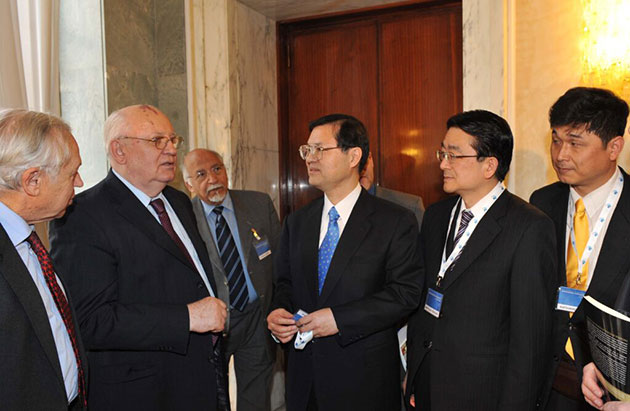 Roberto Savio (far left), then Deputy Director at the World Political Forum (WPF), founded by former Soviet President Mikhail Gorbachev(2nd from left), welcomes an SGI delegation led by Hiromasa Ikeda (center) to a 2009 international conference on nuclear abolition. The meeting marked the beginning of the long-standing media partnership between Inter Press Service (IPS) and Soka Gakkai International (SGI). Credit: Katsuhiro Asagiri / INPS Japan.
Looking back today, Savio said he is delighted to see that the collaboration between IPS, INPS Japan and SGI has continued to grow.
 For him, it represents far more than a successful media partnership.
It demonstrates how independent journalism, education and dialogue can work together to cultivate informed and responsible global citizens.
More than fifteen years after those messages were written, The Global Citizen Handbook can be read as a continuation of the same conversation—one that seeks to cultivate citizens capable of understanding an increasingly interconnected world and acting responsibly within it.
Global citizenship, Savio argues, does not mean abandoning one’s country or culture.
It means recognizing that our responsibilities no longer end at national borders.
Our choices, our consumption, our politics and our values increasingly affect people we may never meet.
Understanding those connections is where citizenship begins.
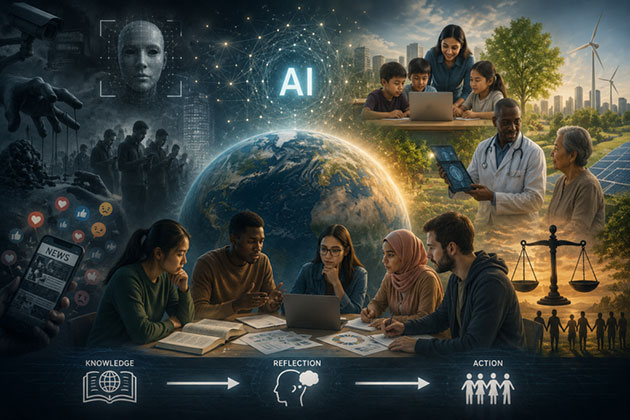 Artificial intelligence offers unprecedented opportunities to advance education, health care and access to knowledge, but its benefits depend on democratic governance, ethical stewardship and informed global citizenship. Image: INPS Japan
For more than sixty years, Roberto Savio has argued that journalism should do more than report events.
It should help people understand the forces shaping their lives.
Through The Global Citizen Handbook, he extends that mission beyond journalism into education.
Understanding, however, is not the final destination.
It is the beginning of citizenship.
In an interconnected world, the future will depend not only on better governments or better technologies, but on better informed citizens who recognize that responsibility no longer ends at national borders.
That is the invitation Roberto Savio extends through The Global Citizen Handbook.
And perhaps, in an age of fragmentation and uncertainty, it is the invitation our time needs most.
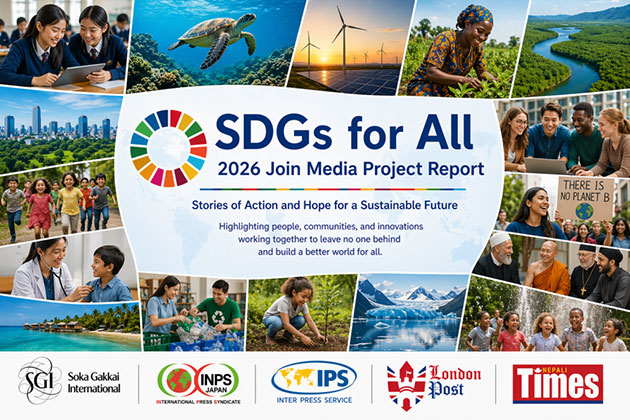 SDGs for All media project cover page. Credit: INPS Japan
Roberto Savio – the compass of OtherNews – is a journalist, communication expert, political commentator, activist for social and climate justice and advocate of global governance. In 1964, he founded Inter Press Service (IPS), of which he was Director-General for many years. He is Deputy Director of the Scientific Council of the New Policy Forum (formerly the World Policy Forum), founded by Mikhail Gorbachev and also a member of the International Committee of the World Social Forum (WSF).
© Inter Press Service (20260701195442) — All Rights Reserved. Original source: Inter Press Service




 English (US) ·