
Britain’s top economic official said she is “frustrated and angry” with President Donald Trump for entering the Iran war “without a clear exit plan,” referring to it as a “folly.”
"This is a war that we did not start. It was a war that we did not want,” said Chancellor of the Exchequer Rachel Reeves. “I feel very frustrated and angry that the U.S. went into this war without a clear exit plan, without a clear idea of what they were trying to achieve.”
"As a result the Strait of Hormuz is now blocked," Reeves continued, emphasizing that the U.K. will not be getting involved in the U.S. blockade as they “don’t think it’s the right approach.”
“All the way through this conflict, we [the U.K.] have said ‘deescalate, deescalate,’” she added.
Reeves lamented the global economic impact of the Iran war and how it’s placing strain on U.K. families, while supporting British Prime Minister Keir Starmer for refusing to get actively involved in the conflict, despite Trump’s criticisms.
"It was absolutely the right decision for Keir Starmer to keep us out of this conflict,” she said.
Reeves made the remarks en route to Washington, D.C., where she is set to attend the International Monetary Fund (IMF) spring meetings.
The U.K. official is planning to use the meeting of global financial policymakers to “set out her plan to navigate the global crisis” and pitch Britain to high-earners in the Gulf as a “rare safe haven” for investors amid the instability of the Iran war.
“The Iran conflict must be a line in the sand on how we deal with global crisis and instability,” said Reeves in a statement shared with TIME.
Starmer last week said he was “fed up” with people in the Britain encountering economic instability due to the actions of Trump.
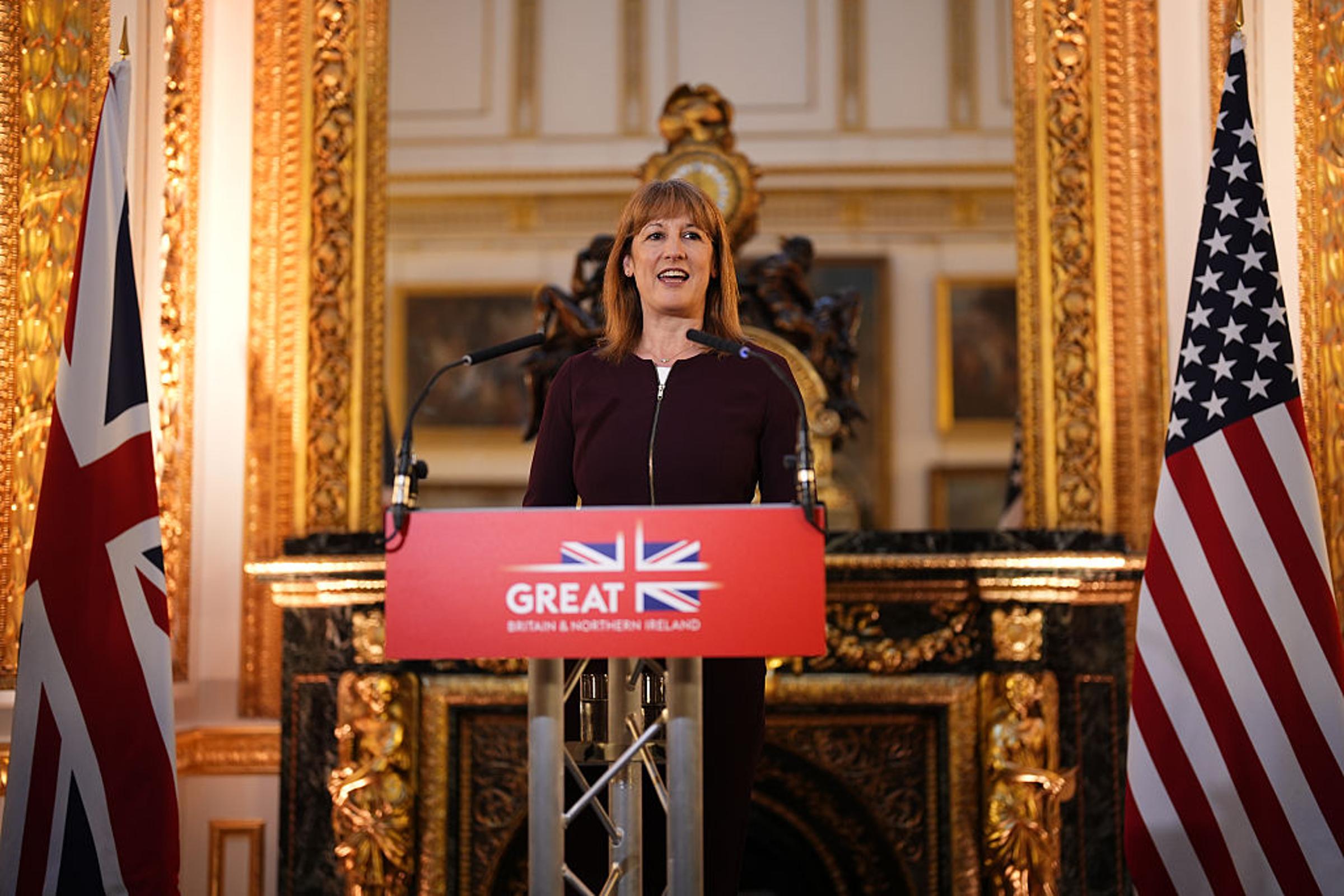
Chancellor of the Exchequer Rachel Reeves speaks at a business reception at Lancaster House in London on Sept. 18, 2025. Jordan Pettitt—Getty Images
Tensions between the two countries have been building since the start of the war on Feb. 28, after Starmer initially declined to allow U.S. forces access to British bases.
Since then, Trump has repeatedly criticized the U.K. and other NATO allies for refusing to get actively involved in the conflict, even threatening to pull the U.S. out of NATO.
Upon announcing a U.S. naval blockade of Iran's ports in the Strait of Hormuz, Trump said he had invited other countries to lend their support.
But Starmer opted not to get involved, instead banding together with European allies to find a solution to reopen the Strait.
The U.K. leader will join French President Emmanuel Macron in hosting a transit summit in Paris on Friday to develop a multilateral approach to restoring the freedom of navigation.
He also emphasized the need for the Strait of Hormuz to be “reopened unconditionally without restrictions or tolls.”
Meanwhile, the U.K. and the U.S. relationship will come under the spotlight once more later this month when King Charles III and Queen Camilla visit the White House during a state visit.
Starmer on Monday, when asked by the opposition to recall the King’s trip, which comes against the backdrop of the Iran war, said that the relationship remains “very important on a number of levels” and reaffirmed that the visit will go ahead to mark the 250th anniversary of American independence.







 English (US) ·