
President Trump has warned of "very strong action" against Iran if it hangs accused anti-government protesters, and he told its people that U.S. "help is on its way" as CBS News learned that the crackdown to quash the unrest may have killed upwards of 12,000 people.
While the administration has made it clear that Mr. Trump will have a number of options at his disposal, from conventional strikes by the U.S. military to cyberwarfare, the White House has given no hint as to what the president will do. In the meantime, the U.S. government does appear to be bracing for possible retaliation by Tehran.
The U.S. State Department issued a security alert on Wednesday urging U.S. citizens to "leave Iran now," or to keep a low profile and ensure adequate supplies of food, water and medications if remaining in the country. The new advisory added to an existing Level 4 travel alert — the highest issued by the State Department, that was put in place in early December, warning Americans not to visit Iran due to the risks of terrorism, civil unrest and wrongful detention.
The Pentagon, meanwhile, has ordered a reduction of personnel at the biggest U.S. military base in the Middle East — Al-Udeid Air Base in Qatar, just across the Persian Gulf from Iran — as a "precautionary measure," a U.S. official told CBS News national security correspondent Charlie D'Agata.
While Mr. Trump's next move on Iran remained unclear after a National Security Council meeting on Tuesday, military officials told CBS News the White House was keeping all options on the table, including military, technological and psychological options. Below is a more detailed look at what some of those options could actually involve, and how they might be perceived in the region.
Military strikes
If Mr. Trump decides to order U.S. military action against Iran's military and security forces, the Islamic Republic's elite Revolutionary Guard Corps (IRGC) would likely be among the top targets, according to Alex Vatanka, Iran director of the Middle East Institute in Washington, D.C.
Vatanka told CBS News the IRGC, along with its feared "Basij" volunteer paramilitary units, "are essentially the brains and the muscle behind" any crackdown launched by the regime.
"If you can target those, whether it's through kinetic actions, offensive cyber capabilities, psychological warfare against them … that is important," Vatanka said, adding that Mr. Trump would be "sending a clear message" with such a move.
Iran's regular army may be a less likely U.S. target, Vatanka said, because it is composed largely of conscripted young men who join and serve for two years, and thus may be less loyal to the regime overall.
The IRGC, however, operates differently, as a parallel religious force under the direct control of Iran's Supreme Leader, Ayatollah Ali Khamenei. Created specifically to protect the Islamic Republic system that came to power with the 1979 Islamic Revolution, the IRGC has at least one major base in every one of Iran's 31 provinces, two in Tehran, and tens of thousands of smaller bases nationwide.
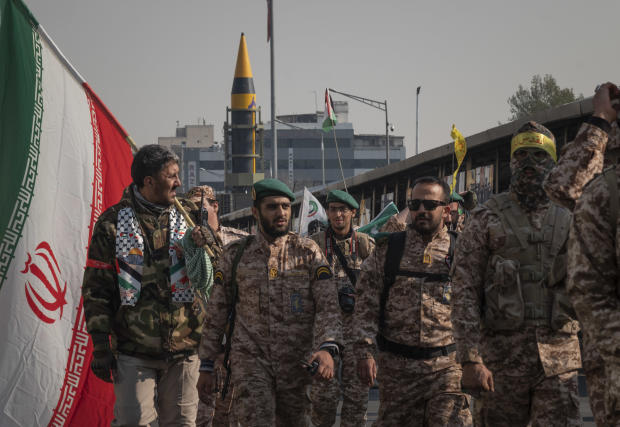 Islamic Revolutionary Guard Corps (IRGC) military personnel walk in Iran during a military rally in Tehran, Iran, Nov. 24, 2023.
Morteza Nikoubazl/NurPhoto/Getty
Islamic Revolutionary Guard Corps (IRGC) military personnel walk in Iran during a military rally in Tehran, Iran, Nov. 24, 2023.
Morteza Nikoubazl/NurPhoto/Getty
If the U.S. military does strike Iran, Vatanka says President Trump's real priorities may be revealed by the choice of targets. If it is military sites or Iran's nuclear facilities, which the U.S. already attacked in "Operation Midnight Hammer" in June, he said it would come across as a show of support for one of the Trump administration's closest regional allies, rather than for the Iranian people..
"That's helping the United States, maybe in terms of its strategic aims or friends like Israel. It's not helping the protest movements," said Vatanka. "People will be looking at it cynically, saying he's taking advantage of the moment of chaos in Iran to advance goals that might be good goals for the United States, but certainly it's not what he's promising the protest movement."
Going for the top: Targeting the ayatollah
Ayatollah Khamenei could also find himself in the sights of the U.S. military.
The top leaders of Iran's proxy groups Hamas and Hezbollah have already been assassinated in recent years, and Khamenei "could very well be a target," according to Bilal Saab, a Middle East political and security expert and the Senior Managing Director of the TRENDS Research & Advisory organization in Washington, D.C.
"If you believe in that decapitation strategy, it might be the best way forward that you take this man out. And remember, he's been there since 1989. So, for 37 years, this man has been the brains behind what Iran has done in the region, at home and abroad. And if you take him out, you might bring about the conditions where Iran either has a political transformation to a different political system, or whatever is left after Khamenei in terms of leaders."
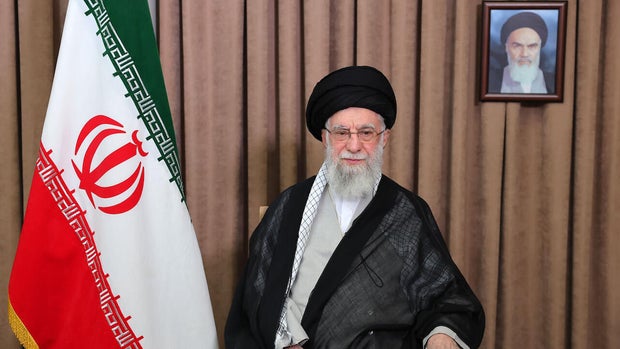 A handout image provided by the Office of the Supreme Leader of Iran shows Ayatollah Ali Khamenei addressing the nation in a state television broadcast on June 18, 2025, in Tehran, Iran.
Office of the Supreme Leader of Iran/Getty
A handout image provided by the Office of the Supreme Leader of Iran shows Ayatollah Ali Khamenei addressing the nation in a state television broadcast on June 18, 2025, in Tehran, Iran.
Office of the Supreme Leader of Iran/Getty
If the White House pursued this course of action, it would track with the U.S. capture of Venezuela's former President Nicolas Maduro earlier this month. While Maduro's former vice-president Delcy Rodriguez was quickly sworn as acting president, Mr. Trump has declared the U.S. "in charge" of Venezuela.
Maduro, however, had already been indicted on federal criminal charges in the U.S. when he was captured, and he was arraigned just a couple days later in a court in New York.
Ayatollah Khamenei has been heavily sanctioned by the U.S. government and accused of a litany of nefarious actions across the Middle East, but he has not been charged with any crimes by American courts.
Cyber and psychological warfare
Beyond bombs and military strikes, the White House is also weighing cyberattack options, U.S. officials say.
"You go after command and control nodes and try to disrupt the ability of the Iranian security personnel to communicate amongst themselves," Saab said of the likely objective of such operations. "This is the typical classic target when you think about cyber operations, and then maybe also try to distract the communication between leadership — political leadership — and, of course, their lieutenants on the ground.
This would be using the psychological weapon of fear, Saab told CBS News.
"You're trying to influence the calculus of loyalists, of people serving the regime, right? And this is the typical dynamic of offering them negative and positive incentives. Positive being, you defect, then you can have some kind of a political future, or at least we won't kill you. Negative is precisely that, all sorts of punishment, ranging from elimination to irrelevance, to going after their property and going after everything that they hold dear to them."
And President Trump's own way of doing things — whether on purpose or by accident — may be keeping the Iranian regime wondering.
As White House Press Secretary Karoline Leavitt said on Tuesday: "Nobody knows what President Trump is going to do except for President Trump."
"They don't know which way he's going to go," said Saab, "and that's all part of psychological warfare."
Breaking down Iran's current unrest
Breaking down the unrest in Iran as regime threatens executions over protests
(03:52)







 English (US) ·