
 3 weeks ago
19
3 weeks ago
19
Matt McGrathEnvironment correspondent
Trump: Obama-era greenhouse gas ruling 'had no basis in fact'
US President Donald Trump has reversed a key Obama-era scientific ruling that underpins all federal actions on curbing planet-warming gases.
The so-called 2009 "endangerment finding" concluded that a range of greenhouse gases were a threat to public health. It's become the legal bedrock of federal efforts to rein in emissions, especially in vehicles.
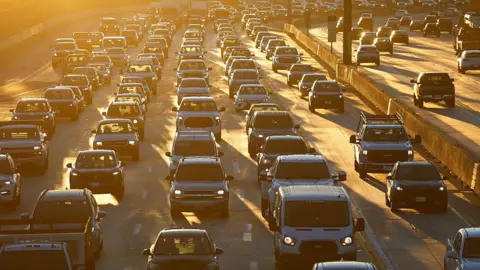
The White House called the reversal the "largest deregulation in American history", saying it would make cars cheaper, bringing down costs for automakers by $2,400 per vehicle.
Environmental groups say the move is by far the most significant rollback on climate change yet attempted and are set to challenge it in the courts.

 Reuters
Speaking in the Oval Office on Thursday, Trump said the 2009 ruling was "a disastrous Obama era policy that severely damaged the American auto industry and massively drove up prices for American consumers".
"This radical rule became the legal foundation for the Green New Scam, one of the greatest scams in history," added the Republican president, about the Democrats' climate agenda.
The Environmental Protection Agency (EPA) first took a stance on the impacts of greenhouse gases in 2009, in the first year of President Barack Obama's first term.
The agency decided that six key planet-warming greenhouse gases, including carbon dioxide and methane, were a danger to human health.
With a divided Congress unable to agree on legislation to tackle rising global temperatures, the EPA finding became central to federal efforts to rein in emissions in the years that followed.
"The endangerment finding has really served as the lynchpin of US regulation of greenhouse gases," said Meghan Greenfield, a former EPA and Department of Justice attorney.
"So that includes motor vehicles, but it also includes power plants, the oil and gas sector, methane from landfills, even aircraft. So it really runs the gamut, all of the standards for each of the sectors is premised on this one thing."
Administration officials are stressing that overturning the regulation will save more than $1tn and will help cut the price of energy and transport.
Reversing the finding would reduce automobile manufacturers' spending by $2,400 per vehicle, White House press secretary Karoline Leavitt told reporters.
Many environmentalists are sceptical of the potential cost savings being touted by the Trump team.
"It's going to force Americans to spend more money, around $1.4tn in additional fuel costs to power these less efficient and higher polluting vehicles," said Peter Zalzal from the Environmental Defense Fund.
"We've also analysed the health impacts and found that the action would result in up to 58,000 additional premature deaths, 37 million more asthma attacks," he said.
For some in the US car industry there will be uncertainty about the rollback as manufacturing less fuel-efficient vehicles might limit their sales overseas.
"This rollback is sort of cementing things that have already been done, such as the relaxation of the fuel economy standards," said Michael Gerrard, a climate law expert from Columbia University.
"But it really does put the US automakers in a bind, because nobody else is going to want to buy American cars."
 Reuters
Climate change was linked to the conditions that lead to huge fires in Los Angeles in early 2025
While the reversal will help the White House to roll back climate change regulations, there are likely to be unintended consequences, according to some observers.
While working on overturning the finding, the Trump administration also utilised the 2009 ruling to prevent states from passing laws that would be stricter on carbon emissions.
The fact that the finding gave responsibility for regulating warming gases to a federal authority was also used to suppress what are termed "nuisance" lawsuits, brought by individuals or organisations on the climate question.
"The endangerment finding decision has blocked any number of lawsuits, and has been pretty powerful in keeping plaintiffs' claims out of court ," said Meghan Greenfield.
"I would expect states and non-profit groups to bring suits, probably primarily in our state courts, to try to figure out where the contours of this new law are."
Challenging climate science
One key argument about the reversal of the endangerment finding will be about the science on which it is based.
The Department of Energy formed a panel of scientists to write a report last year challenging widely accepted science on the warming impact of greenhouse gases.
That report underpinned the initial proposal to reverse the 2009 finding.
But many climate experts complained that the panel behind the report was unrepresentative and filled with people who were sceptical of the human influence on warming, and that it was inaccurate and misleading.
While it's not clear how much the Trump administration will rely on this report to face off any challenges, a federal judge recently ruled that the department had violated the law in the formation of the hand-picked team that wrote it.
In fact, a challenge in court on the reversal of the endangerment finding may well be what the Trump administration is now looking for.
Many legal experts believe that they want the proposal to be tested in the Supreme Court before Trump's term ends, believing that if they win, the endangerment finding will be consigned to history.
"This is really different as the EPA is exiting the space entirely and wants to do it on a permanent basis," said Meghan Greenfield.
"If they were to win that issue as they framed it before the Supreme Court, a new presidential administration could not change that position, in the absence of new legislation."









 English (US) ·