
 3 weeks ago
27
3 weeks ago
27
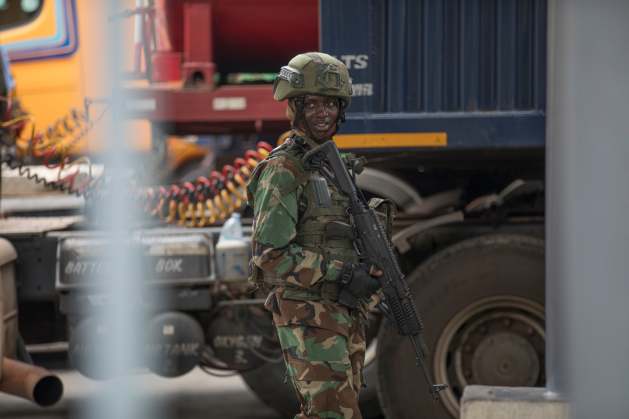 A major gap in the peace accords is the lack of measures to ensure justice or accountability for past atrocities. Unless those responsible – including commanders like Makenga – face consequences for their horrific crimes in eastern Congo, impunity will continue to fuel abuse. Credit: Sam Ngenda / Shutterstock.com
NEW YORK, June 17 (IPS) - “General” Sultani Makenga stood before thousands of newly trained armed group recruits in eastern Democratic Republic of Congo in February and offered them a promise. “You are now part of an army that has risen up to liberate the country and to really liberate the people,” declared Makenga, the military leader of the Rwanda-backed M23 armed group.
Behind him, at the Tshanzu training camp, recruits can be seen marching in lockstep, smashing bricks with their bare hands and foreheads, leaping through flaming hoops and chanting in unison as they prepare to fight against Congolese government forces.
Not seen in this video are the M23’s executions, brutal punishment, and inhumane treatment to enforce loyalty and submission. The Tshanzu and nearby Rumangabo training camps should serve as a stark warning about the armed group – and by extension neighboring Rwanda’s role in eastern Congo.
Backed by Rwanda’s logistical, equipment, and troop support, the M23 has captured large swathes of eastern Congo. Its effective control over the M23 makes Rwanda an occupying power, as well as criminally liable for the group’s rampant abuse. After it seized the provincial capitals of North and
South Kivu in early 2025, US President Donald Trump stepped in to revive faltering mediation efforts between Congo and Rwanda, proposing a “peace for minerals” deal to secure US interests in the region’s resource-rich east.
Two peace accords were signed — in June and December — including a ceasefire and economic-integration pact between Congo and Rwanda, which calls for the departure of Rwandan troops from Congo.
Yet Rwanda has continued to play a central role, helping the armed group to fill its ranks. While Rwandan leaders travelled to Washington discussing various peace, security and mineral agreements, M23 forces were forcibly rounding up thousands of captured Congolese soldiers and civilians, including police, civil servants, teachers and students — some as young as 12 — and sending them for training and indoctrination at military camps. The M23 picked up many from their homes, churches, schools and hospitals, summoned them to meetings under false promises of payment, or stopped them on the streets and sent them to the camps.
We interviewed more than 100 former detainees who either escaped or were deployed and then surrendered to the Congolese army. Their accounts reveal the horrendous reality for those forcibly recruited. New civilian arrivals undergo an initiation ritual meant to mark their transition into military life.
“It’s a test of how much suffering you can endure,” said a 25-year-old construction worker grabbed in the eastern city of Goma while buying phone credit in March 2025. “There were 200 of us; 10 died. Two were shot, the others whipped to death. We buried them in a mass grave with around 50 others.”
Life in the camps was marked by routine beatings and killings for minor infractions. Detainees described starvation, drinking from puddles, and licking rainwater from leaves. Some died from exhaustion, dehydration, or hunger.
Former detainees recalled limbs protruding from the ground, as bodies were often buried in shallow graves. At night dogs came to feed on the remains. It’s likely that hundreds of detainees, maybe more, died in the camps throughout 2025.
Those confined to detention cells endured even harsher treatment. Bodies were regularly pulled out of the cells for burial. When detainees were finally released to begin a new training cycle in November, scores collapsed.
Children were not spared. Boys were forced to follow military training, dig roads, cut wood, transport heavy supplies, and fetch water over long distances. Makenga selected some to serve as guards, beating other detainees.
The strategy appears to be designed to cement the control of the M23 and the Alliance Fleuve Congo – the politico-military alliance that includes the M23 – over much of eastern Congo. Rwandan forces were positioned around the camps, ready to shoot anyone who tried to flee. Recruits said they were subjected to ideology sessions, singing songs and criticizing Congo’s leadership.
Chanting in unison, the recruits in Makenga’s video display discipline and power—an army ready for war. Despite the M23’s withdrawal from some areas, and Rwanda’s signing of a peace agreement committing to removing Rwandan troops from the country, there is no indication that the conflict in
Congo is over. The M23’s mass forced recruitment campaign is evidence of a failure to confront the structures that enable such abuses.
The US has sanctioned the Rwandan army and four senior commanders. Other countries, including the European Union and the United Kingdom, should urgently follow suit and review cooperation with Rwanda that risks fueling abusive forces.
In the meantime, the US should make clear to Rwandan President Paul Kagame that causing more suffering of civilians will result in further sanctions.
A major gap in the peace accords is the lack of measures to ensure justice or accountability for past atrocities. Unless those responsible – including commanders like Makenga – face consequences for their horrific crimes in eastern Congo, impunity will continue to fuel abuse.
Philippe Bolopion is the executive director and Clémentine de Montjoye is a senior researcher, both at Human Rights Watch.
© Inter Press Service (20260617152536) — All Rights Reserved. Original source: Inter Press Service





 English (US) ·