
 2 hours ago
1
2 hours ago
1

 Getty Images
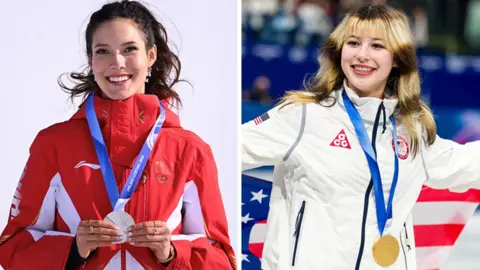
Eileen Gu (L) and Alysa Liu (R) are both taking part in this year's Winter Olympics
An unusual battle is unfolding over the Winter Olympics in Milan - not on the slopes or in the rinks, but on the internet.
At its heart are Eileen Gu, a freestyle skier, and Alysa Liu, a figure-skater. They have a lot in common: both are young women of American-Chinese heritage who were born and raised in the US. And they are champions in their field.
And yet, one is being hailed a trailblazer, while the other is deemed a traitor. At least that's the case in the eyes of some in the US. On Chinese social media, it's the other way around.
Why? Liu, the daughter of a political activist who fled China after a deadly crackdown, is competing under the US flag. And Gu, whose mother moved to the US for higher education, often spent her childhood summers visiting Beijing. She is representing China in Milan.
That seems to rankle with some Americans. "Eileen Gu competes for China and gets paid millions to do it. Alysa Liu is the daughter of a Chinese immigrant who participated in the Tiananmen Square protests. In a world of Eileen Gus, be an Alysa Liu," said one post on X.
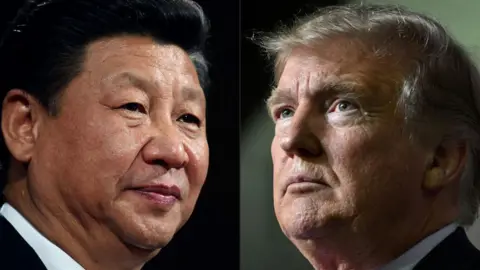
Much of this backlash appears to be driven by political commentators and a vocal minority on X, rather than the broader public or the sporting world. The underlying current is the competition between the US and China - the world's two biggest economies are constantly vying for an edge in everything, from trade to tech.
And so, a narrow yet vociferous slice of the internet is pitting two women against each other, questioning their loyalty and identity, while interrogating their immigrant experiences - and adding to the pressure they already face as sporting figures.
The 'snow princess' and the 'patriot'
Known in China by her nickname "Snow Princess", Eileen Gu was born in California to a Chinese mother and American father.
Her parents separated when she was young and she was raised by her mother Yan Gu - reportedly a successful venture capitalist with degrees from Peking University and Stanford.
Gu grew up with a foot firmly in both worlds, spending her summers in Beijing and the rest of her term at a private school in San Francisco.
She began freeskiing at the age of three in the Lake Tahoe region and joined the Northstar California Resort freeskiing team at the age of eight. She won her first national championship just a year later.
She initially skied for the US before switching to Team China in 2019 in preparation for the 2022 Winter Olympics, which took place in the Chinese capital Beijing.
Gu said she wanted to "inspire millions of young people in Beijing - my mother's birthplace". The decision earned her the praise of many in China.
She went on to win two golds and one silver in the 2022 Olympics.
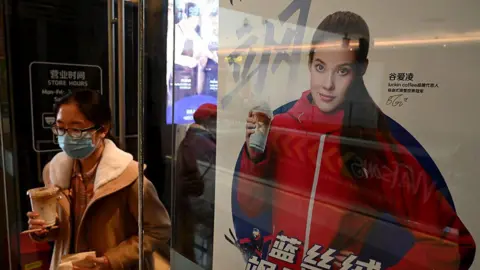
In the years since, Gu has established herself as a veritable sports icon in China. Millions on Chinese on social media follow her every move, leaving heart shaped emojis under her posts.
Chinese state media outlet the Global Times called her an "idol for the whole world". She is also one of the highest-earning female athletes in the world, reportedly earning around $23m (£16.9m) a year.
Her decision to join Team China initially brought with it a considerable amount of backlash. Beyond the rivalry with the US, people also took issue with China's authoritarian Communist Party rulers, their poor record on human rights and the lack of free speech in the country.
But the outrage died down for the most part - until now.
 Getty Images
Eileen Gu has become a poster child in China
It kicked off last week, when Olympian Hunter Hess was asked what it was like to represent the US given the polarising situation in the country, including the recent, contentious ICE raids in Minnesota that left two people dead.
He replied that he had "mixed feelings" about it, adding: "Just because I'm wearing the flag doesn't mean I represent everything that's going on in the US."
President Donald Trump responded to Hess' comment by calling him a "real loser" who "shouldn't have tried out for the team". Many athletes leapt to Hess' defence, including Gu: "As someone who's been caught in the crossfire before, I feel sorry for the athletes".
Her comments enraged her critics, who said Gu was able to criticise Trump but had never spoken out publicly against China.
Former NBA player Enes Kanter Freedom was among them, calling Gu a "traitor", who "was born in America, raised in America, lives in America and chose to compete against her own country for the worst human rights abuser on the planet - China".
"You don't get to enjoy the freedoms of US citizenship while acting as a global PR asset for the Chinese Communist Party," he said in a lengthy post on X.
"Does Eileen Gu have any criticism for Xi Jinping for genocide, slavery and arresting dissenters?" Matt Whitlock, a self-described Republican communicator also posted on X. Western governments, rights groups and the UN have repeatedly accused Beijing of grave human rights violations in Xinjiang and Tibet, as well as in its swift crackdowns on protest and dissent across the country. The Chinese government denies the charges and says these are internal matters.
"Many American-born athletes compete for other nations with little fanfare - the 'New Cold War' climate between the US and China has changed the stakes," says Professor Yinan He of Lehigh University.
"Personal identity is increasingly centred on national loyalty in the eyes of the public, diminishing the tolerance for 'deviance' or dual-identity".
Earlier this week Gu said she felt as though she was "skiing with the weight of two countries on my shoulder", after losing the gold in women's slopestyle to Switzerland.
While some supporters saw this as a moment of vulnerability, it appeared to set her critics off again. Some took offence to her claiming the "weight" of the US was on her: "She was only representing one country and it wasn't ours."
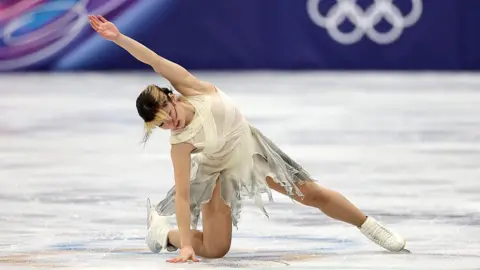
Soon, many online began comparing her to Alysa Liu - an athlete who has made a comeback this year, winning a gold medal for the US figure skating team.
 Getty Images
Liu walked away with gold in an Olympic figure skating team event
The 20-year-old is the daughter of Arthur Liu, who fled China after taking part in the Tiananmen Square protests in 1989. The student-led pro-democracy movement ended in a brutal massacre in Beijing. The subject remains taboo in China, and any references to it are swiftly censored.
Her family history might partly explain why there aren't too many posts about Liu on Chinese social media. Those that do praise her usually have comments below such as: "Why are you praising this person? Her whole family is anti-China".
Raised by her father, Liu grew up in California and began skiing at a young age. At the age of 13, she became the youngest ever athlete to win the US women's figure skating championship.
In 2019, Arthur Liu alleged that he was targeted in a spying operation that the Justice Department alleges was ordered by the Chinese government. His daughter says she was told by FBI agents in 2022 that she and her family were believed to be under surveillance by the Chinese government.
Her father's background and the possibility that her family is still targeted because of it has certainly won Liu sympathy and admiration. That, in turn, seems to be fuelling the criticism of Gu.
The divide between Li and Gu isn't just about "nationalism, it's also about class and relatability, Prof He says. Gu represents a luxury culture - private schools, Stanford. Her choice to compete for China is often seen through this lens as a 'mercenary business decision'", he explains.
Indeed a post on X by non-profit group Asians for Liberty read, "The CCP lures American athletes with promises of wealth and fame but a true American rejects it. Alysa Liu is an American patriot".
 Getty Images
The rivalry between the US and China is fuelling the comparisons between the two athletes
"All of this frames how the media and the public make sense of Liu and Gu, who have been cast as the good and bad immigrant respectively," says Professor Richard King of Columbia College Chicago.
Chinese Australian dissident artist Badiucao, known for his content against the Chinese Communist Party, posted drawings of the athletes recently. One showed Liu in front of a Tiananmen tank, a reference to her father's activism, and another showed Gu holding a Chinese flag, with what appear to be bodies hidden underneath, a not-so-subtle reference to the accusations against Beijing.
Far-right news and opinion website The Daily Caller, founded by political commentator Tucker Carlson, went further with an article titled: "Meet Eileen Gu, the true villain of the Winter Olympics".
The episode also exposes "the incredibly precarious social and political landscape that Asian Americans have to navigate," says Professor Stanley Thangaraj at Stonehill College. They "come to be recognised only in limited ways, and any political act immediately dislocates them from the US".
When prominent Asian Americans attempted to defend Gu, with Marvel actor Simu Liu posting that he was "freaking proud" of Gu, calling her "inspirational, resilient, intelligent and well spoken in two languages" - he too faced an immediate wave of backlash, with comments demanding he "go back to China".
As the Games continue in Milan, the sport itself seems to have become an afterthought in discussions of both athletes.
"Despite both athletes sharing similar racial backgrounds and first-generation immigrant experiences," Prof He says, "they have been cast as opposing archetypes in a narrative they didn't write".






 English (US) ·