
 1 month ago
43
1 month ago
43
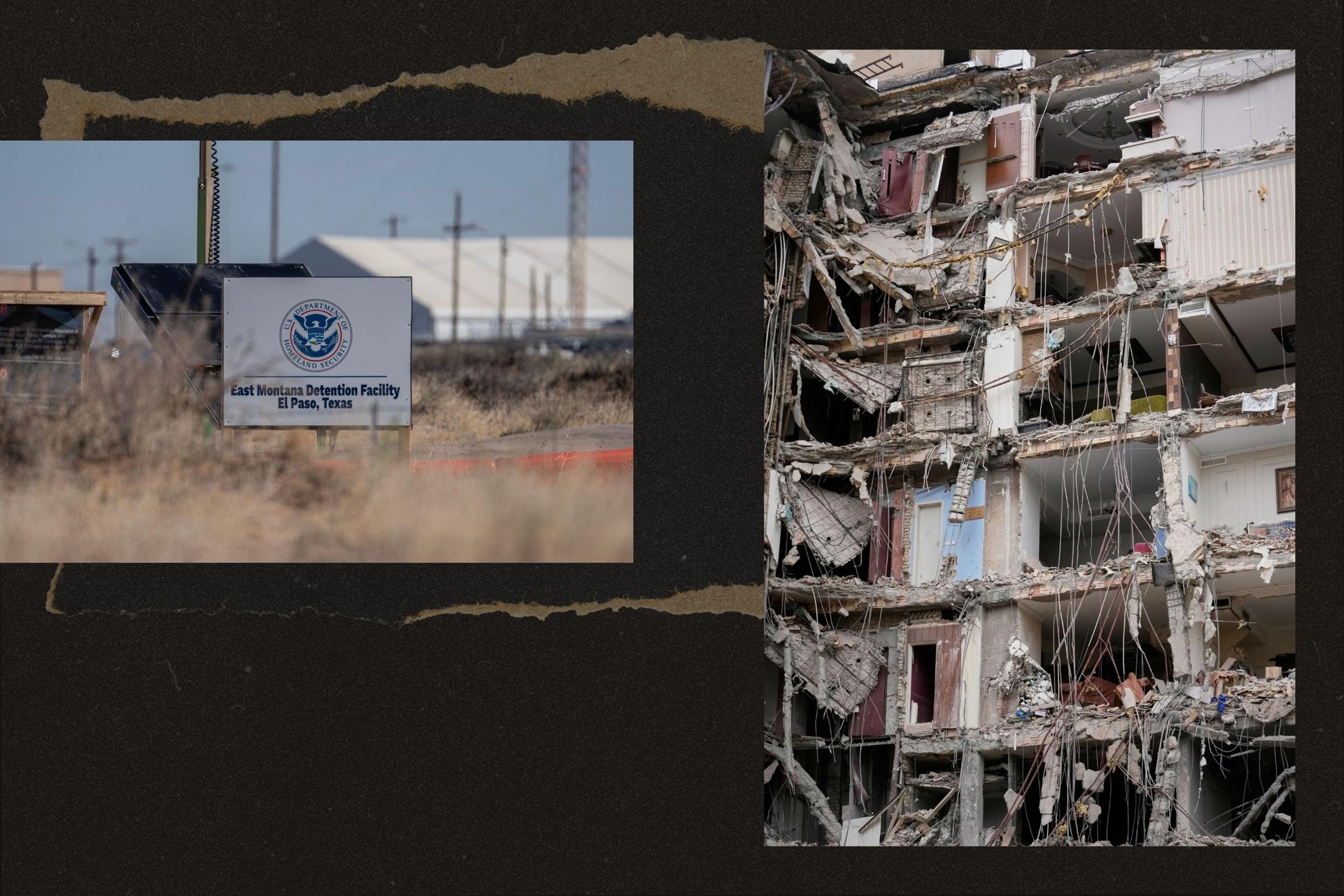
Camp East Montana in El Paso, Texas; The facade of a residential building damaged in an U.S.-Israeli strike in Tehran, Iran

Mar 27, 2026 10:00 AM CUT
When Ali and Adel showed up at the southern border in El Paso, Texas in 2025 after traveling thousands of miles from Iran, they believed that America was a place of freedom and opportunity.
Instead, the Iranian gay couple found themselves in separate ICE detention facilities hundreds of miles apart, facing the threat of deportation back to Iran. TIME is using pseudonyms to protect their safety.
The couple, one in his late 30s and the other in his early 40s, fled Iran for Turkey in 2021 after being arrested by Iran’s morality police who opened a criminal investigation into their relationship—same-sex activity is punishable by death in Iran. Soon after, fearing for their safety, they left Turkey for Mexico and eventually arrived in the U.S.
The two men did not have attorneys to guide them through immigration court proceedings when applying for asylum, and Ali was the only one who could speak English. Despite their attempts to explain their situation to an immigration judge, their claims were denied in early 2025 for failing to meet the legal standard for asylum. They eventually found a lawyer to represent them, but as they worked to appeal the decision, the U.S. quietly struck a deportation deal with Iran, despite having no diplomatic relations with the country.
In December 2025, ICE began deportation efforts against Iranian immigrants, reversing decades of policy that had largely allowed Iranians fleeing political and religious persecution to remain in the U.S. Before the war with Iran began in late February, the Trump Administration had reached an agreement with the Iranian government to deport as many as 400 Iranians in ICE custody.
At least 175 people have been sent back in three separate flights since last September. Ali and Adel were nearly placed on those flights, but court orders have so far prevented their deportation.
“I have never had a case in 10-plus years, where I was so certain that they would be sent back to death,” Bekah Wolf, director of the Immigration Justice Campaign who represents Adel and Ali, tells TIME.
Separated in ICE detention as health deteriorates
Now, the couple’s fate remains uncertain, with deportation flights to Iran paused due to the war. A White House official told TIME that the Trump Administration is “utilizing all lawful methods to carry out deportation operations of criminal illegal aliens” and declined to say whether flights to Iran would resume.
According to Wolf, the couple is being held in separate ICE detention centers. Ali is detained in Arizona, where ICE has used subcontractors to charter flights to Iran with layovers in Qatar or Kuwait. Adel is being held near El Paso, Texas, at a facility ICE is moving to shut down following reports of abuse, medical neglect, and dozens of federal standards violations, according to The Washington Post.
Wolf said Adel’s condition is particularly alarming. He suffered severe organ damage after the couple was attacked in Mexico en route to the U.S., and has since lost a significant amount of weight and experienced fainting episodes while in detention.
“He's incredibly frail, to the point where he could no longer ambulate. He couldn't walk because of the pain,” Wolf said. “He had to have other detainees pick him up and carry him to the bathroom and to the shower, which was incredibly distressing.”
Ali and Adel are among hundreds of Iranians facing an impossible choice: remaining in a U.S. immigration system increasingly defined by mass deportation, or returning to an authoritarian regime that represses its citizens. According to data from the Deportation Data Project, ICE arrested at least 432 Iranians in 2025, more than half of whom had neither been convicted of a crime nor were facing pending criminal charges at the time of their arrest.
ICE arrests of Iranians rise as asylum pathways narrow
The Trump administration’s confrontational posture was already shaping domestic policy before the Iran war, driving a tougher approach toward Iranian immigrants in the U.S. Iran is one of several countries in the Middle East that the Trump administration issued a travel ban and halted issuing visas.
Alongside shrinking legal pathways, arrests of Iranian immigrants in the U.S. have surged, including among those without criminal records. Reza Zavvar, a 52-year-old Iranian who has lived in the U.S. for decades with a green card, was taken into custody while walking his dog in Gaithersburg, Md. Similar incidents include the arrest of 38-year-old Mahdi Khanbabazadeh, who was detained by ICE while dropping his child off at a day care center in Beaverton, Ore., and 64-year-old Donna Kashanian, who was arrested while tending her garden in New Orleans.
As a result of the hardline immigration policies, the asylum approval rate for Iranians has fallen sharply, from 86% in January 2024 to 48% in 2026, according to Mobile Pathways, a San Francisco–based nonprofit that analyzes federal immigration data. Ryan Costello, policy director for the National Iranian American Council, said the pathway for Iranian immigration to the U.S. has been “choked off completely.”
“This used to be a community that saw a lot of Iranians come to the U.S. frequently for school and to settle, and that really changed with the first Muslim ban that the Trump administration imposed, and really never recovered to its full level,” Costello said.
Costello described three broad groups of Iranian immigrants who have been arrested and detained by ICE. The first includes those who have been able to secure release and reunite with their families through legal challenges. The second, which he described as the “not-so-lucky” group, includes those who lack the legal resources to challenge their detention and have remained in custody for weeks or months as their cases move through the system. Some, like 64-year-old Kamyar Samimi and 59-year-old Pejman Karshenas Najafabadi, have died in detention.
The third group consists of those facing imminent deportation. Advocates including Costello and Wolf say they are pursuing every available legal avenue to prevent immigrants like Ali and Adel from being placed on deportation flights to Iran, despite what they describe as repeated due process violations by ICE. Because immigration courts fall under the Department of Justice rather than operating as an independent branch, securing review by a federal judge can be “procedurally difficult,” Wolf said.
“While we think there's extremely strong evidence in support of these two men's asylum applications, the procedure of a [regular] court agreeing to review it is the hardest part right now,” she said.
Deported to Iran despite risk of persecution
But there is a fourth group— at least 175 Iranians who have already been deported.
Ali Herischi, a human rights lawyer, represented one such case: an Iranian man in his 40s who was deported. TIME is not naming him to protect his safety.
Herischi said the man, his wife, and another couple fled Iran in 2024 after participating in the “Women, Life, Freedom” protests, which called for an end to mandatory hijab laws and broader police reform. They arrived at the southern U.S. border later that year. The wife, who was pregnant, was released on parole, but the man remained in ICE custody until his deportation in December 2025, according to Herischi.
The man told Herischi that many Iranian immigrants held in the detention facility in Louisiana “have been wishing to go back to Iran” because of isolation and uncertainty around their cases. As the New York Times has reported, some detainees were also told they could be deported to third countries such as Sudan or Somalia. He refused to be deported.
“My wife is here, my newborn that I haven't seen is in the U.S., and I have a case. If I go back, I'll be killed, but no one listens to me,” he told Herischi.
Despite his resistance, the man was placed in a restraint jacket, forced onto a deportation flight, and chained to his seat by ICE officers on the night of Sept. 30, 2025. The flight departed from a military airport in Alexandria, La., stopped in Puerto Rico to pick up additional detainees, and then continued to Doha, Qatar.
ICE told Herischi that his client would have the option to seek asylum upon landing in Qatar and that his personal belongings would be returned to him. Neither happened. Instead, after the plane arrived in Tehran, ICE handed over his belongings—including his cell phone, evidence of his persecution, and communications with his lawyer—to Iranian authorities. Herischi described the move as a “gross violation” of the United Nations Refugees Protocol.
The man called Herischi shortly after landing and asked what he should do. Herischi told him to run.
“I don't know what your situation is, but if you can leave Iran, leave as soon as you can,” Herischi said. “They're gonna be after you.”
The man, who is Kurdish, traveled more than 300 miles west from Tehran on his first night back in the country and crossed into Iraqi Kurdistan, a semiautonomous region, seeking refuge. His wife and child, who now live in Kentucky, have not seen him since.
Asylum cases stall as migrants remain in detention
With his client now in exile, Herischi has turned his focus to another couple still in the U.S. Farzaneh Nazi traveled through South and Central America with her husband, 35-year-old Asad Esmaeily, entering the United States on March 20, 2025. Like the previous case, Nazi was pregnant and released on parole, while Esmaeily remained in ICE detention.
The couple fled Iran after Esmaeily, a political activist, was detained and tortured by Iranian authorities. He said officials fractured the bone above his eyebrow and subjected him to waterboarding for organizing protests and distributing materials opposing the regime.
During their journey to the U.S., Nazi experienced severe pregnancy complications without access to safe medical care amid unsanitary conditions. The couple also faced cartel extortion and death threats along the way. Now, Esmaeily’s fate rests with the same immigration court system that has denied relief to hundreds of others.
As Herischi works to appeal Esmaeily’s denied claim, he said he has grown increasingly frustrated with an immigration system he believes looks for reasons to reject asylum applications, detains his clients without justification, and assumes pregnant women are exploiting the system. He said the experience has led him to stop taking on new asylum cases.
“We came through all these countries, and we picked you [the United States], because we thought they understand us and this is the fight, we are all together to go against the regime,” he added. “They can't just give us a mandatory detention policy. It’s really wrong.”






 English (US) ·