
Known for their zinc counters, lottery tickets and iconic carrot-shaped tobacconist signs, French “bars-tabacs” have long served as focal points for local communities, playing a similar role to the traditional English pub.
And just like pubs in the UK, bars-tabacs – often just known as ‘tabacs’ – have been closing by the thousands in towns and villages across France, stripping communities of a critical social lifeline – and fuelling isolation, resentment and a broader sense of decline.
This, in turn, is feeding support for populist right-wing parties, argues Hugo Subtil, a postdoctoral researcher at the University of Zurich and author of a study linking the disappearance of bars-tabacs with a rise in support for Marine Le Pen’s far-right National Rally (RN).
From around 200,000 in 1960, the once ubiquitous establishments have slumped to fewer than 40,000 today. This haemorrhage has attracted relatively little media coverage, says Subtil, for whom the decline of the bar-tabac has “opened up a void in local social interactions that has a long-term impact on the National Rally vote”.
Analysing electoral data between 2002 and 2022, his study found that the RN vote rose by an extra 1.3%-3.6% in districts that had recently lost a bar-tabac, with the biggest increase occurring in rural areas already stripped of other venues for socialisation.
With the ascendant National Rally eyeing another breakthrough in municipal elections in March, such seemingly small margins could translate into sizeable swings up and down the country.
A social lifeline
Typically located on village squares, main roads or outside train stations, France’s bars-tabacs are no ordinary businesses. They’re part of the social fabric, where workers down coffees and croissants at the counter and pensioners play cards or try their luck on lottery scratchcards.
Some in smaller communities have come to sell a lot more than drinks and cigarettes, making up for shop closures by offering newspapers, sim cards and local specialties.
Crucially, they serve as conversation hubs “where people exchange with neighbours and develop a sense of belonging”, writes Subtil, adding that their “disappearance profoundly transforms the way people relate and socialise”.
To display this content from YouTube, you must enable advertisement tracking and audience measurement.
One of your browser extensions seems to be blocking the video player from loading. To watch this content, you may need to disable it on this site.
 ENTRE NOUS © FRANCE 24
06:15
Social scientists have long pointed to links between high street decline and growing support for the far right. Subtil’s study argues that the closure of “social venues” likes bars and restaurants has a greater impact than that of purely “transactional venues” like bakeries and groceries where customers do not linger.
“When the bar-tabac closes, it is often the last venue for social interaction to disappear,” the study notes, stressing the “relational void” left behind. This is especially the case in rural areas, where Subtil found that the impact on support for the far right is three times higher than in urban areas.
The effect on voting patterns is not as sudden or clear-cut as when a factory suddenly shuts down, causing mass layoffs and triggering an immediate protest vote, the researcher cautions.
“It is not the (bar) closure itself that immediately affects electoral behaviour, but the slow accumulation of its consequences: the scarcity of everyday interactions, the impoverishment of collective discourse, and the gradual shaping of a narrative of decline that can (...) ultimately find expression at the ballot box,” Subtil writes.
As people fall back on a smaller pool of like-minded friends and family, they’re also increasingly exposed to television pundits offering simplistic answers to their problems, like scapegoating immigrants, a regular far-right talking point.
Read moreHow Bolloré, the ‘French Murdoch’, carried Le Pen’s far right to the brink of power
“When there is no longer any place to talk to each other, politics becomes a face-off between the isolated individual and the grand narratives of the media – and in this face-off, discourses that offer simple answers have a structural advantage,” the study adds.
France’s ‘left behind’
Subtil’s findings echo recent research on the decline of Britain’s iconic pubs and its impact on community cohesion and voting patterns.
In a 2021 study published by online journal Comparative Political Studies, French researcher Diane Bolet found that people living in areas that suffered pub closures were more likely to support the UK Independence Party (UKIP), a Eurosceptic, far-right party that was most influential in the run-up to Brexit – and has since been eclipsed by Reform UK.
“The closure of cherished pubs seems to be contributing to the wider sense of marginalisation that has propelled parties like UKIP to the mainstream,” Bolet wrote in a subsequent article on The Conversation.
The “disappearance (of pubs) increases social isolation and affects a community’s self-esteem”, she added, arguing that far-right parties “attract isolated people who have lost trust in others and in institutions”.
Bolet’s research focused on what she describes as “community pubs” catering largely to a working-class constituency, much as bars-tabacs do. She said their disappearance “makes white working-class voters susceptible to ‘left-behind’ narratives that radical-right parties use to garner support”.
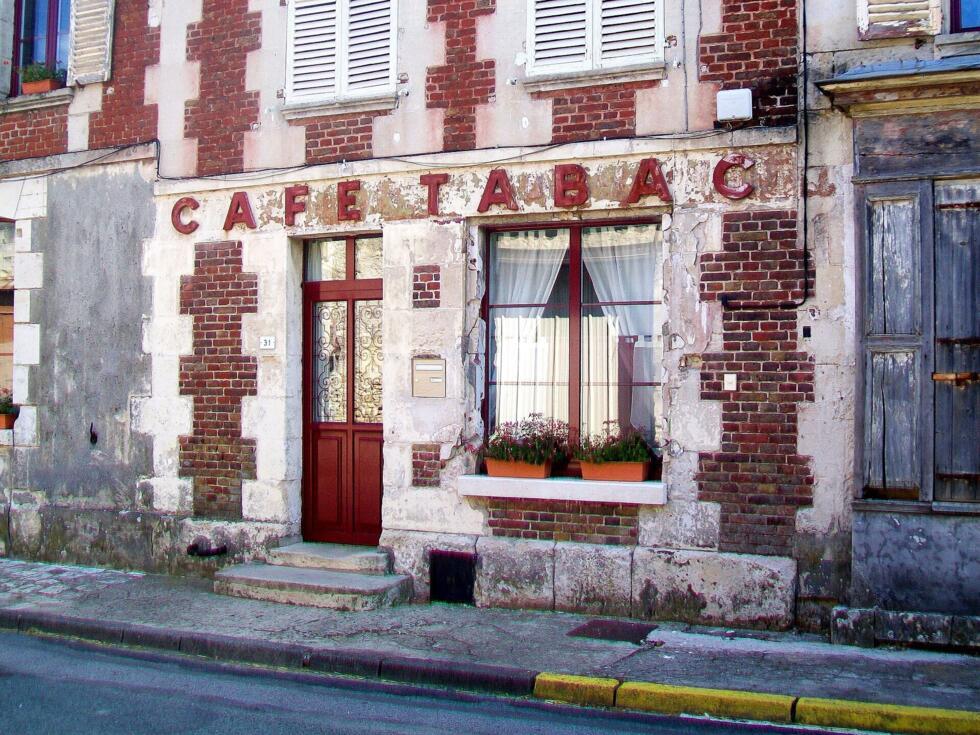 A bar-tabac converted into a home in the village of Néry in the Oise department northwest of Paris. P.poschadel, Wikimedia Creative Commons
Talk of France’s “left behind” is also a staple of Le Pen’s RN party.
Analysing some 2.19 million statements made in the French parliament between 2007 and 2014, Subtil found that RN lawmakers made no greater mention of France’s stricken constituencies than other parties, but that the language they used to frame the debate was markedly different.
Where centrist lawmakers offered technical remedies, the far right spoke of France’s “forgotten” or “abandoned” territories, terms more likely to strike a chord with constituents who feel left behind, the author explains.
The closing chapter to his study stresses the power of public policy in addressing the grievances of constituencies stripped of their bars-tabacs and other services and social venues.
Subtil found that where new bars-tabacs open, the National Rally vote tends to go down – a trend he says underscores the potential to reverse the cycle of social decline and far-right support through public investment.
“The erosion of social ties is not irreversible,” he writes. “Public policies aimed at preserving or recreating places for socialising can have a lasting impact on electoral trends.”







 English (US) ·