
Warning: readers may be disturbed by the content of this article.
The chilling video was posted on Facebook on January 22 by an account based in Germany which has since been shut down. The video is filmed by a man who appears to be part of the majority-Kurdish group the Syrian Democratic Forces (SDF), posing selfie-style in front of a row of bodies on the ground. He’s smiling broadly and has a rifle slung over his arm.
In the video, he claims that one of the fighters with the SDF – who are thought to have committed this massacre – joked that they should blow the bodies up. A second video shows bullets being fired at the bodies, though it is unclear who is shooting.
This footage documents a massacre that took place on January 22 near Kobane in northwestern Syria. A local Facebook group Radar Sarine reported that the SDF had carried out extrajudicial killings of at least 21 young men. The SDF had allegedly just released the victims from Yeddi Qawi Prison near Kobane.
Fifteen bodies recovered
The massacre documented in the video took place against a complicated backdrop. January 2026 saw significant numbers of SDF forces retreating from the Syrian cities of Deir ez-Zor and Raqqa towards Kobane. On January 19, clashes broke out between these fighters and the Syrian Army near the Tishrin Dam south of Kobane.
Sometime after that, in circumstances that are still unclear, doors were opened at Yeddi Qawi, a prison located south of Kobane, resulting in the flight of many of the people who had been imprisoned there. Sometime after that, the massacre documented in the video posted online on January 22 took place.
A Facebook page dedicated to local news reported that members of the Syrian Civil Defence had recovered the bodies of 15 victims of a massacre they said took place near Kobane and handed them over to local authorities. The bodies were then transferred to Manbij National Hospital, where the families could collect them.
Mukhtar (not his real name) says he was incarcerated in the prison in the village of Yeddi Qawi. He shared with us a copy of the documents he received upon leaving the prison which were issued by the Kurdish Autonomous Administration, confirming that he was imprisoned in Yeddi Qawi.
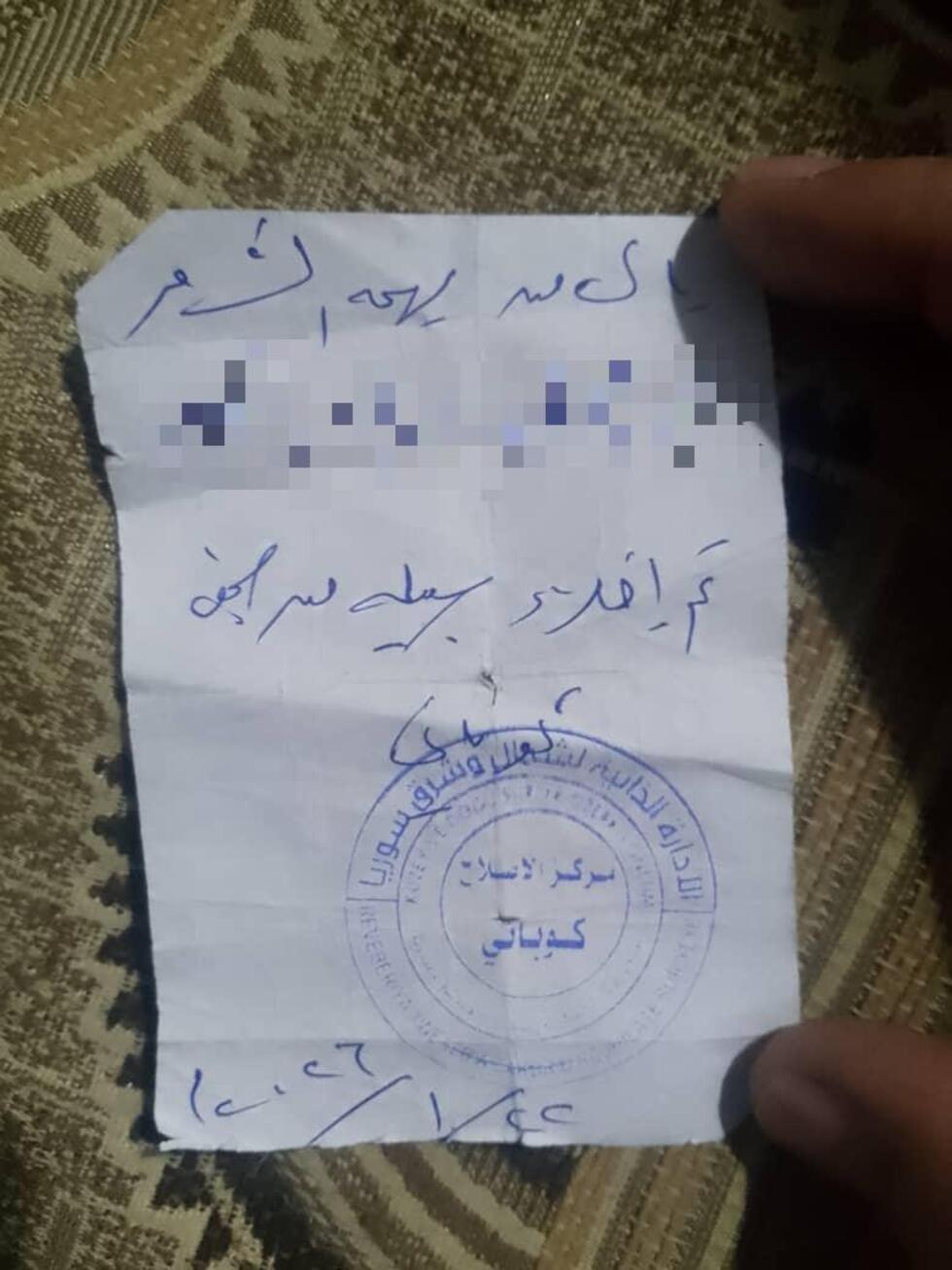 This is a photo of the document issued by the Kurdish autonomous administration to someone leaving prison. We masked the name of the formerly incarcerated person. The document reads, “To whom it may concern. He was released from the Kobane prison.” It is affixed with the seal of the Autonomous Administration of North and East Syria, Kobane reform centre. This photo was given to us by our Observer. © Mukhtar
According to Mukhtar, the massacre and the events leading up to it took place between January 19 and 22, 2026.
He describes the prison where he was being held as overcrowded, with hundreds of men being held. He says a majority of the prisoners there were Arab, with a small Kurdish minority.
"They were speaking to us about a general amnesty. But only the Kurdish detainees were being released. About a hundred of them. Meanwhile, they were telling us Arabs, ‘Your turn will come.’ Many believed it.”
The situation became increasingly tense and, on January 21, prisoners started burning sheets, mattresses and beds. There was smoke everywhere.
"We were choking. People were screaming. At one point, the SDF opened the doors. Not to let us out but to keep everyone inside from dying. I would say that between 300 and 400 prisoners, including me, left the prison and headed into the nearby fields. From there, we separated and dispersed. Some of us headed in the direction of Sarrin, and others – maybe about 30 people – headed towards Kobane."
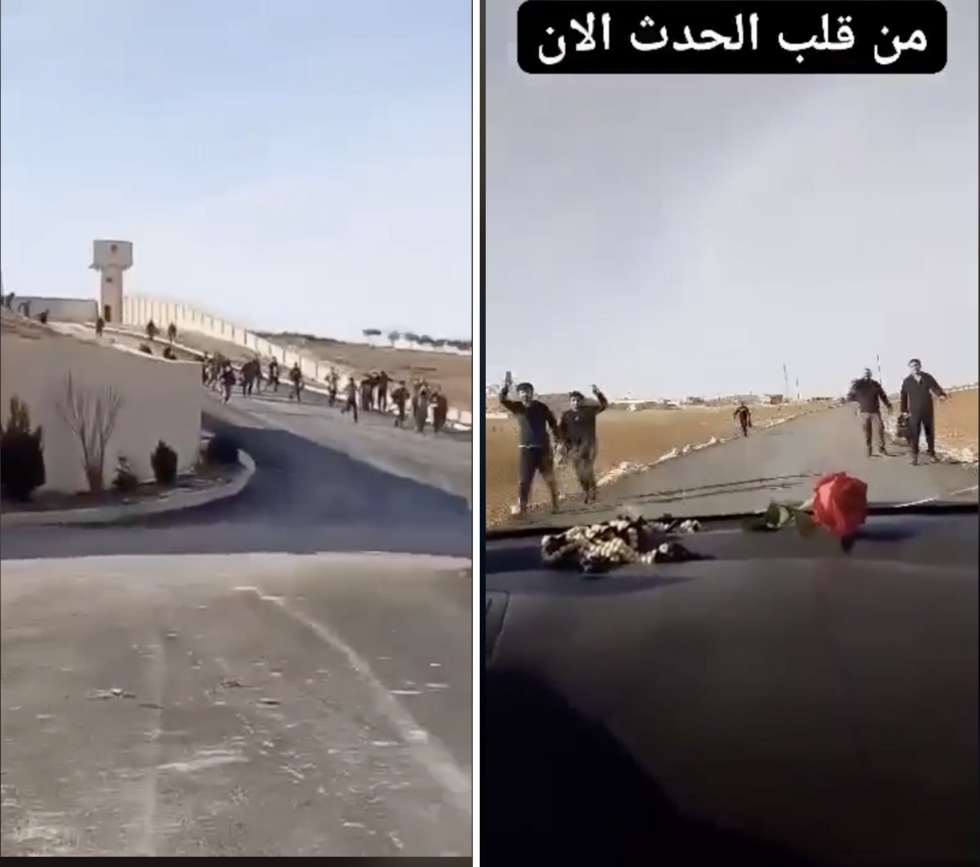 These two screenshots were taken from two videos filmed on January 21. The image on the left shows people leaving the prison, while the image on the right shows people alongside the road. The videos were posted on Facebook on January 22, 2026. © Facebook
‘They fell right in front of me’
Mukhtar says that when the fleeing prisoners had made it about 1.5km from the prison, they were intercepted by several vehicles carrying SDF fighters. Mukhtar then went on to describe extrajudicial killings that occurred before those documented in the video.
"They begin by firing shots in the air. People were running in every direction. Then, they started shooting at us. I saw men fall in front of me. They were carrying nothing – no weapons, not even cell phones.
They fell right in front of me. Four or five people died immediately, while others were injured. Everyone was panicking. I managed to hide in a field, but was later stopped at an SDF roadblock. They tied my hands and made all of us survivors lie face down on the asphalt. Some of the soldiers wanted to execute us then and there."
Mukhtar says that some of the female SDF soldiers intervened on their behalf and dissuaded the men from executing his group. He and his group were taken back to Yaddi Mawa prison. Others seem to have been sent elsewhere.
‘It was revenge and ethnic discrimination’
"I was finally released again on the evening of January 22, 2026. After we were released, I headed towards Ain al-Arab [also known as Kobane] while another group of about 27 people went towards the Sarrin region.
Members of the Autonomous Administration [Editor’s note: the civilian branch of the SDF] had them get into vehicles. They were going to drive them to the last point under Kurdish control before reaching territory under the control of the Syrian regime.
Most of those in the group of 27 people were killed. I was at a checkpoint at the south entrance to Kobane when I heard the news. I saw some of the injured people arrive. I recognised some of the people in the video.
These murders weren’t to prevent people from escaping. It was revenge and ethnic discrimination. The soldiers were insulting the victims and saying to the prisoners, 'In any case, you’ll die.'
I survived along with four other people. We made it to a service station alongside the road, and the owner let us in and gave us shelter. Three days later, he brought us to an area outside of Kurdish control."
Mukhtar thinks that between 40 and 45 people were executed on January 22.
“The number is much higher than the 21 bodies that you can see in the video because there were other executions elsewhere,” he explained.
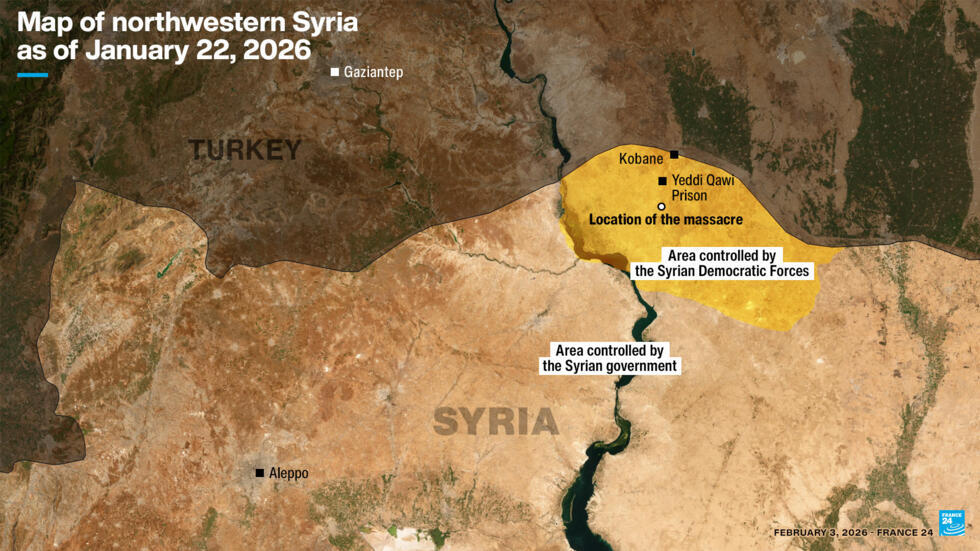 The yellow indicates the area that was still under the control of the Syrian Democratic Forces on January 22, 2026, the date when the video was filmed. The massacre took place in this area. © FMM graphics studio
The Syrian Democratic Forces (SDF) said that the images were authentic, though they claimed that the bodies were those of armed fighters killed during clashes. Our Observer’s account casts doubt on this claim, as do the videos themselves. The bodies are lined up neatly, and there are no weapons to be seen. They are also all wearing civilian clothing.
Adnan Al-Hussein, a journalist based in the region, says that the videos provide evidence.
"Everything in the video indicates that the area has been secured. If there had been fighting, we would see the remnants. Here, you see men who have been gathered here, restrained and killed.”
‘I am telling my story for those who died’
Mukhtar says that speaking out comes with risks.
"I hesitated. But if I remain silent, then they die a second time. I am not asking for international justice. I’m asking for the truth to be spoken. I am telling my story for those who died.”
People in Manbij are still working to identify the bodies. However, the number of casualties remains unknown.
Tributes to two young men thought to have been killed in the massacre were published on the Radar Sarin Facebook page. One man, Ismail Al-Hassani, known as Abu Halab, was from the village of Al-Qubba. The second, Abbas Muhammad Al-Hussein, was from the village of Al-Abdkliya in Sarin district. Our Observer also spoke of the death of these two men.
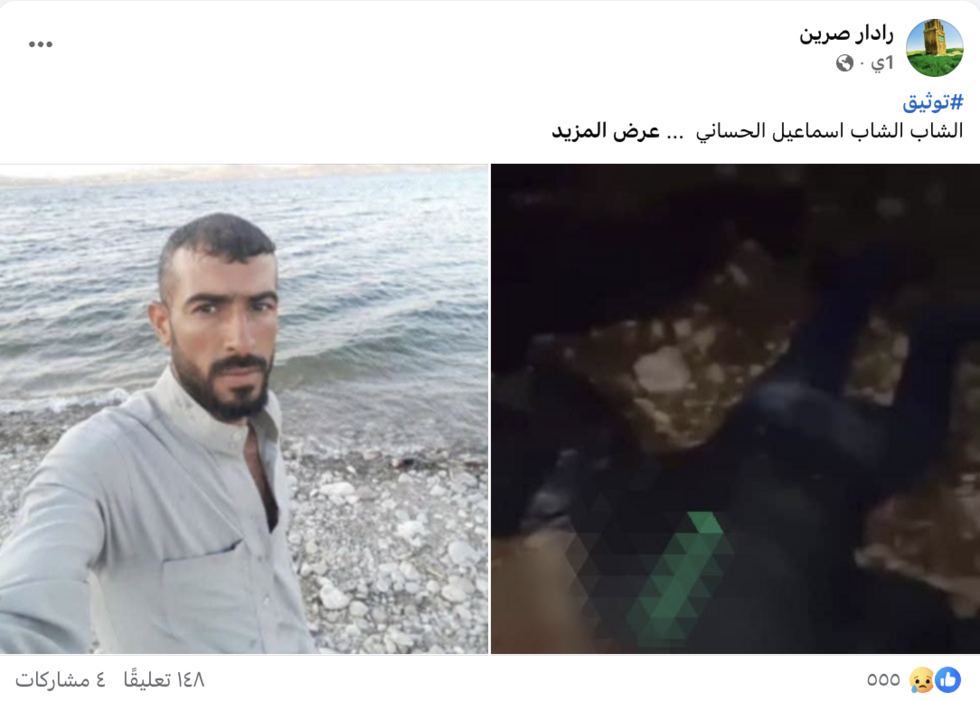 This Facebook post features a photo of Ismail Al-Hassani alive alongside a screengrab of the video believed to show his body. © Facebook
To display this content from Facebook, you must enable advertisement tracking and audience measurement.
This article has been translated from the original in French by Brenna Daldorph.





 English (US) ·