
Raqqa, located on the eastern bank of the Euphrates River in northeast Syria, has experienced every stage of the war in Syria. It was the first large city to join the uprising against former president Bashar al-Assad in 2013. Then, it was taken over by the Islamic State group in 2014, becoming its de facto capital. In October 2017, after a destructive campaign led by an international coalition, the town was taken back by the Kurdish-led Syrian Democratic Forces (SDF).
However, many of its residents now say that they are worried. Images and videos taken since spring 2025 show heavy machinery being used to dig the entrances to tunnels in a number of residential areas. So far, there has been no official explanation given by local authorities, who are affiliated with the SDF.
This construction is taking place as the December 31 expiration date approaches quickly for the deal signed on March 10, 2025, between the SDF and the Syrian government. The agreement was meant to establish the progressive integration of the Kurds’ civil and military institutions into the central government.
Analysts say that there are two possible outcomes. Either the deal will be extended in the hopes that the SDF can be integrated into the national government, or the new Syrian government may launch an offensive to recapture the areas under SDF control.
Several people died when clashes between the SDF and the Syrian government forces broke out on December 22 in Aleppo.
Read moreDeadly clashes in Aleppo as Turkey urges Kurds not to be obstacle to Syria's stability
‘The sound of digging is audible even when you are inside your house’
Salamah (not his real name) lives in Raqqa and has been observing the recent activity with trepidation.
“After the agreement was signed last March between the SDF and the new Syrian government, I noticed that I was seeing more and more tunnel entrances in the city’s streets. Wherever I go, I see workers coming out of these openings.
The sound of digging is audible even when you are inside your house because these tunnels go under civilian residences.
Back in May, there was a collapse on al-Wadi street. Dozens of families have left the al-Firdous neighbourhood because of the construction of tunnels. This neighbourhood is strategic because it sits above the rest of the city.”
To display this content from Facebook, you must enable advertisement tracking and audience measurement.
Salamah says that there are at least 30 visible tunnel entrances in the city. Workers involved in the excavation work come and go from some of the tunnel entrances, in particular those near Raqqa’s National Hospital.
Construction sites with winches and mounds of earth
A video published on April 6 shows excavation work being carried out near the entrance to the National Hospital. You can see three workers gathering around a winch positioned on a metal frame. At a certain point in the video, one of the workers seems to disappear into a hole.
To display this content from Facebook, you must enable advertisement tracking and audience measurement.
The mounds of earth visible in the image look like what is removed when a tunnel is dug out. The metal frame is what is known in Syria as a “raf‘a”: you affix a motor onto it and then use it to lower down a wheelbarrow then lift it back up filled with dug-out earth.
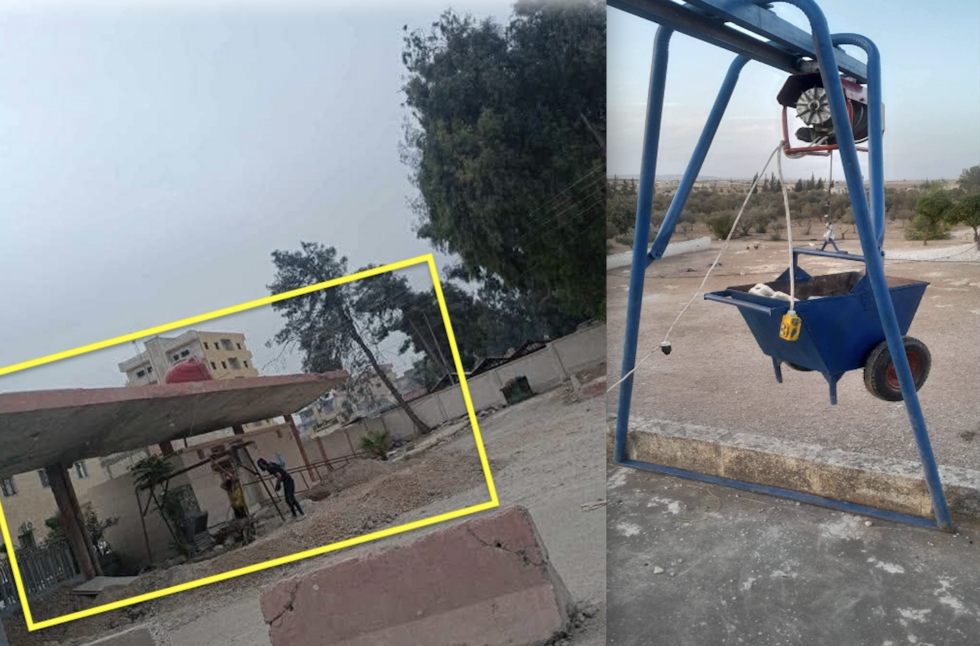 The photo on the left was posted on Facebook on April 24, 2025. It shows a building site near one of the entrances of Raqqa’s National Hospital. The photo at right shows a winch on a metal frame. This tool, called a “raf’a”, is commonly used in construction in Syria. © Observers
Construction sites near hospitals and other civilian sites
Aside from the building site near the National Hospital, people also observed other sites near Al-Mawasi Hospital, near the city’s municipal stadium and in residential neighbourhoods, as shown in the photos posted online. Local people were able to verify the authenticity of the images for us.
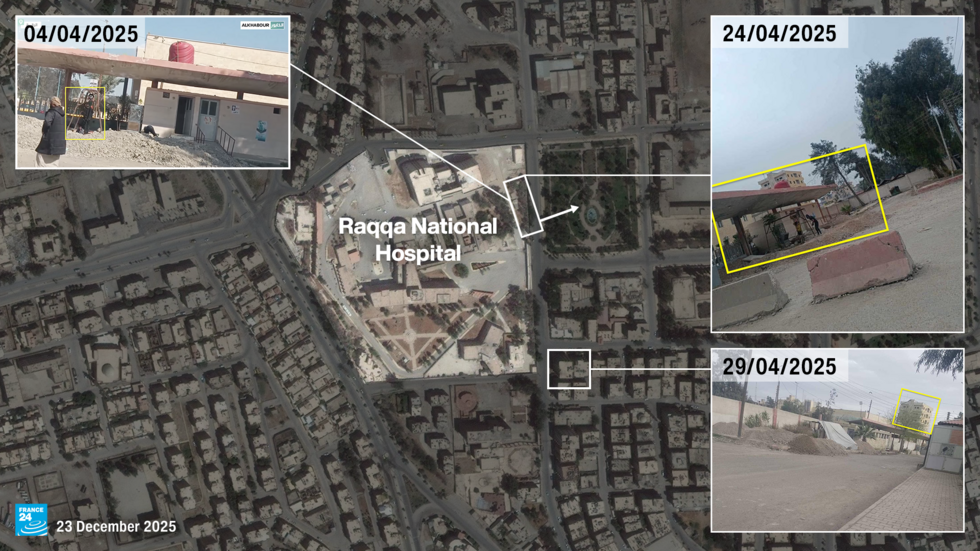 Mapping of the Raqqa National Hospital paired with social media imagery documenting the excavation of tunnels near one of the hospital's entrances. © FMM graphics studio
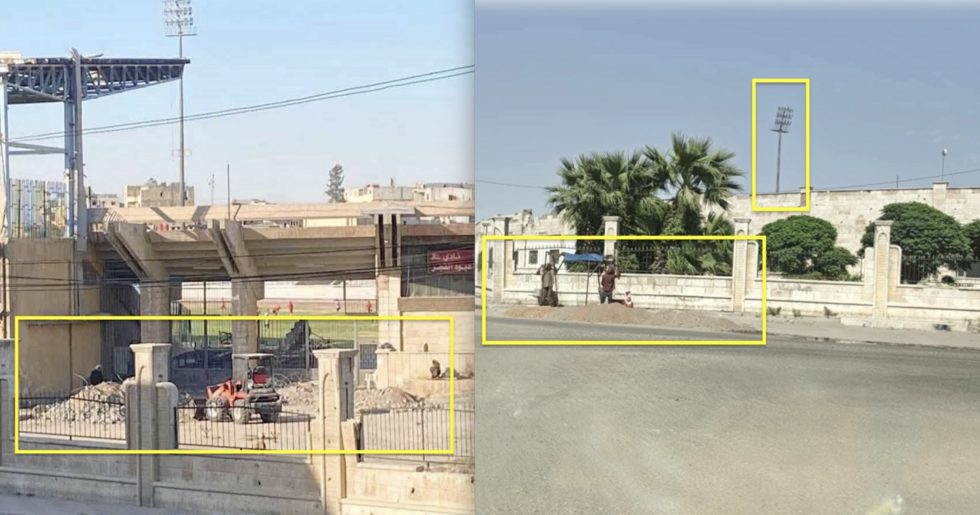 These two images show Raqqa’s municipal stadium, known locally as the Black Stadium. At left is a photo posted on Facebook on October 3, 2025, showing mounds of earth drawn from a tunnel under construction. At right is a photo posted on Facebook on August 9, 202,5 showing another building site near the stadium. © Facebook
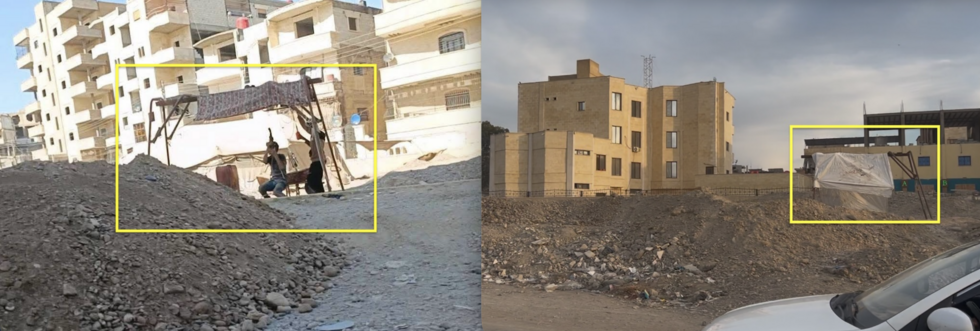 These two images show tunnels under construction in Raqqa. At left is a photo posted on Facebook on August 6, 2025, showing a building site in a residential neighbourhood of the town. At right is a photo taken by a resident in November 2025 showing another building site behind a building that houses several trade unions. © Facebook
Concrete supports being transported throughout the city
A photo published on Facebook on June 11, 2025, shows a truck carrying concrete supports. The caption explains that the blocks will be used to provide reinforcements for Raqqa’s tunnels. Another post, this one from November 9, 2025, shows the SDF opening a centre for making concrete blocks in Al-Aqtan Place, in the north of the city. Residents say that the centre is in constant operation.
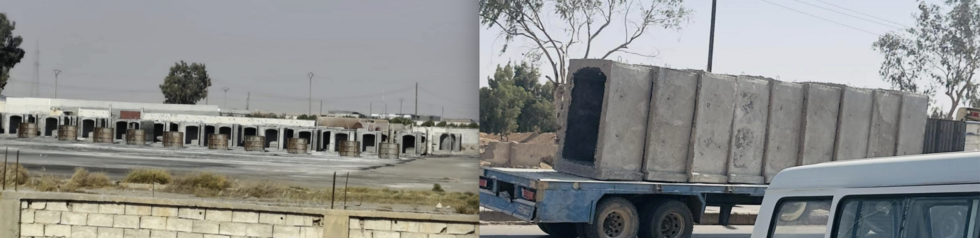 The photo at left, posted on Facebook on November 9, 2025, shows a site in the north of the city where concrete blocks are being manufactured, according to local sources. The photo at right, posted on June 11, 2025, shows concrete supports being transported. The caption explains that the concrete blocks will be used to reinforce tunnels in Raqqa. © Facebook
Our team reached out to the SDF officials to ask them about the existence, the nature and the goals of the tunnels dug in the city of Raqqa. They had not responded to our questions by the time of publication.
‘The tunnels have been dug as preparation for urban fighting’
According to an analyst specialised in the region, these building sites are part of an old strategy often used in zones under the control of the SDF. Back in 2014, it was adopted by the YPG, the Syrian Kurdish militia, whose full name is the People’s Protection Units.
“The People's Protection Units (YPG) started to dig tunnels beginning in mid-2014 in the region of Hassaké when the region was being bombarded with Turkish strikes. Initially, the aim was to protect themselves from the Turkish planes. [After the SDF was created in 2015], digging operations intensified in all the regions under their control, including Manbij, Afrin and Hassaké.”
According to another analyst, based in Raqqa, the building work began to accelerate after March 2025, despite the deal reached with Damascus. He said the building sites are being run by entrepreneurs – most of them Kurdish – who responded to a call for applications. He describes the creation of a giant, regional subterranean network.
“The tunnels have been dug in order to prepare for urban fighting, to fortify positions and to build secret passages that allow for mobility during military clashes. The tunnels are divided into three categories: there are galleries meant for the displacement of personnel, corridors that are large enough to allow vehicles to pass and still other tunnels are meant to be used as shelters and command centres.
Because the tunnels are connected, the collapse of just one could lead to the collapse of dozens of buildings and lead to mass civilian casualties.”
‘The tunnels are everywhere – under mosques, hospitals and public gardens’
Locals say there is a palpable disquiet. Salamah explained this to us.
“I have the sense that the SDF is preparing the city for some kind of resistance. Like many other residents, I fear a new war.”
Another city resident, whom we are calling Qassem, says that he is worried about the structural integrity of the buildings with tunnels under them:
“The situation is frightening. A few months ago, the SDF kicked out a family living near Raqqa’s municipal stadium because they wanted to create a tunnel starting in a room in their house.
It’s catastrophic. The tunnels are everywhere – under mosques, hospitals, public gardens. All of that seems to indicate preparation for a military confrontation with the army.”
Raqqa’s predominantly sandy soil sits close to the groundwater table. It’s also an area prone to seismic activity. All of this frightens residents. Collapses are common.
Photos posted on November 15 show a collapse in a residential neighbourhood near Al-Furusiyah, located to the north of the city. Locals blamed the collapse on tunnels under the ground.
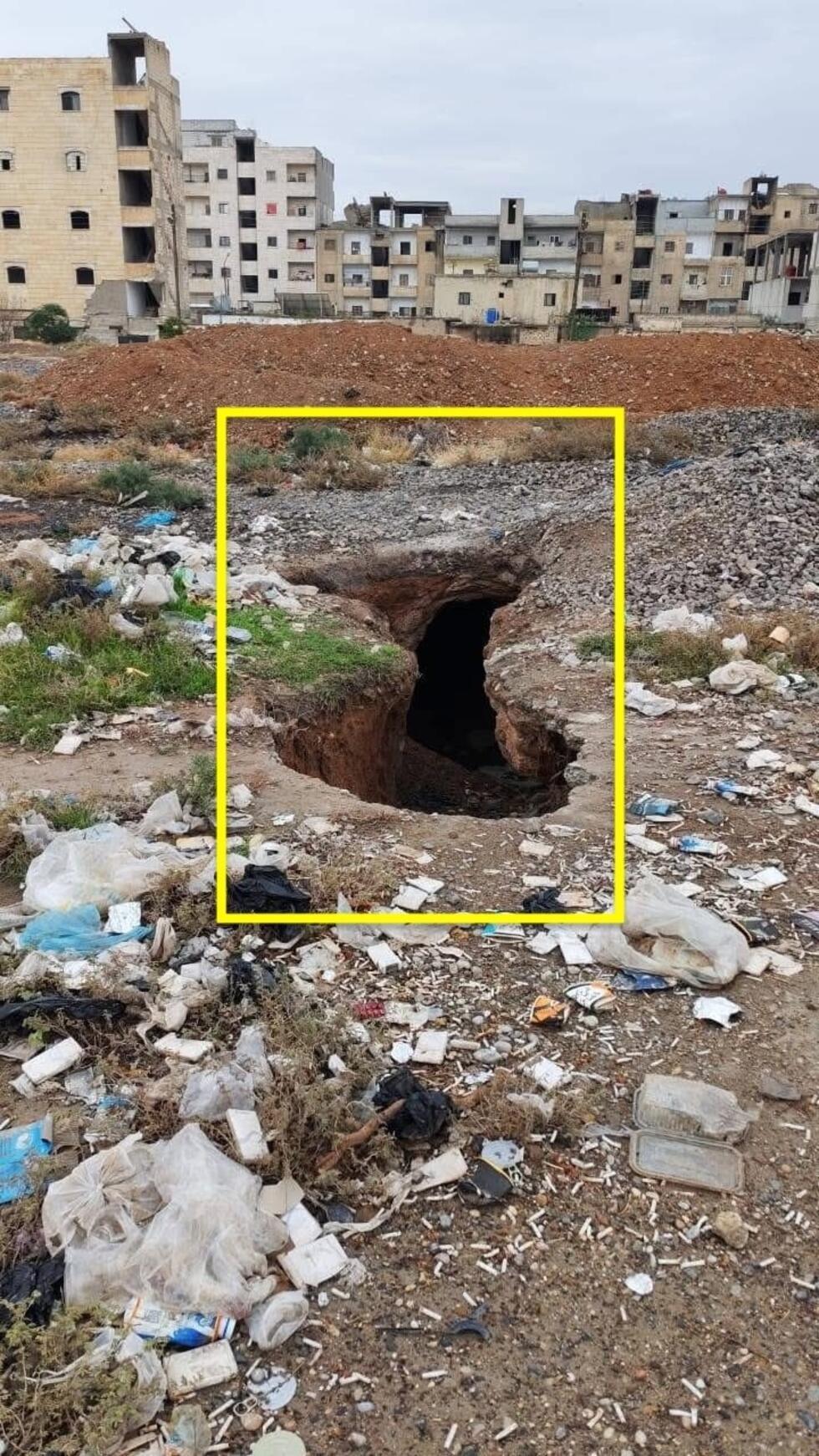 This photo, posted on Facebook on November 15, 2025, shows what was described as the collapse of a tunnel under construction in a neighbourhood in the north of Raqqa. © Facebook
This article has been translated from the original in French by Brenna Daldorph.






 English (US) ·