
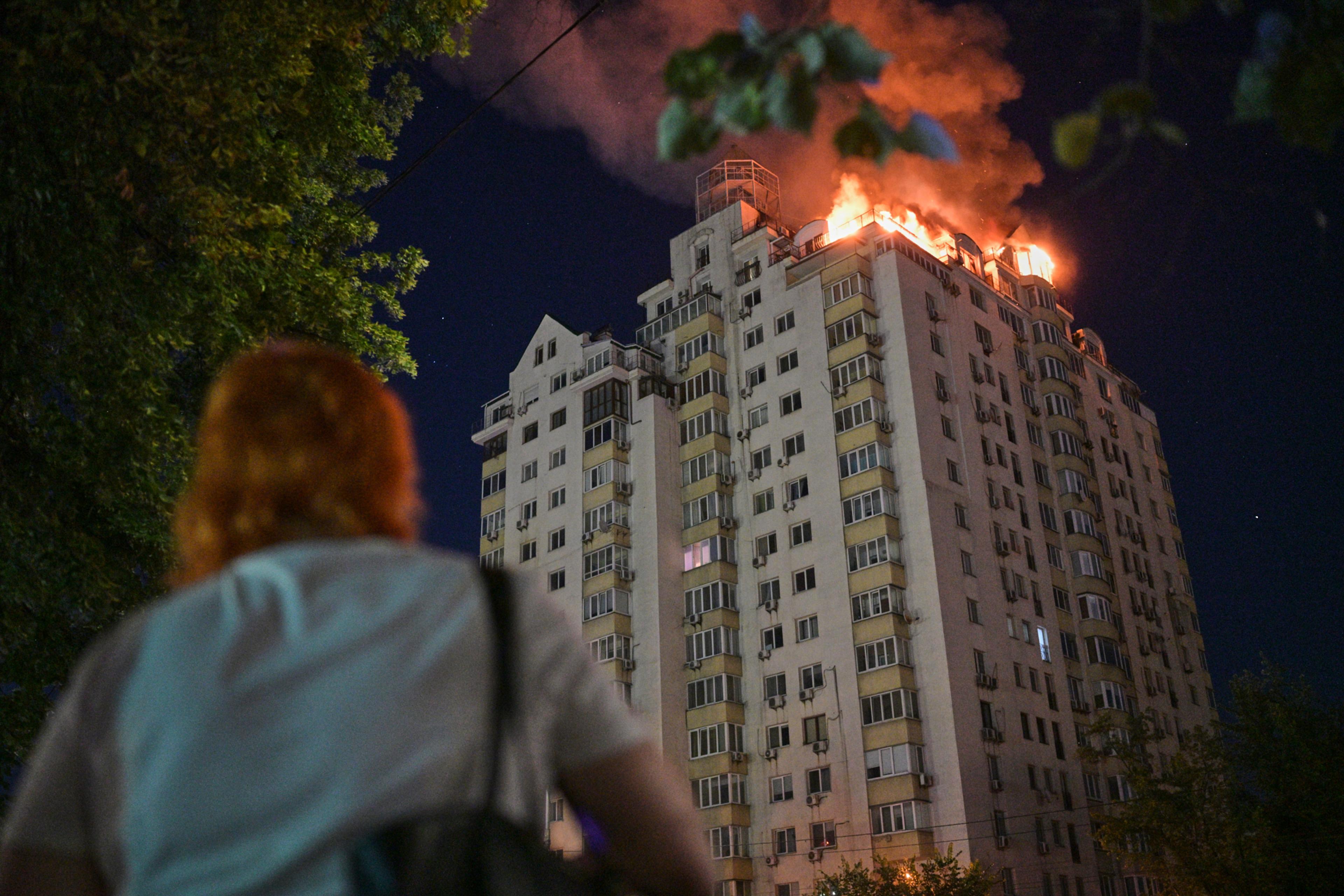
A woman looks at an apartment building burning after a Russian missile attack in Kyiv, Ukraine, on July 2, 2026.
Russia launched a barrage of drones and missiles at Kyiv in what Ukrainian officials described as a “night of horror” for the capital.
At least 20 people have been killed, according to a local official, and more than 80 injured. Search and rescue efforts are still underway.
“Russia launched more than 70 missiles of various types against Ukraine overnight, nearly half of them ballistic missiles, along with almost 500 attack drones, including jet-powered shaheds,” said Ukrainian President Volodymyr Zelensky.
Strikes were reported at more than 30 locations across every district of Kyiv, including residential neighborhoods, driving citizens into bomb shelters and underground metro stations.
Kyiv’s mayor Vitali Klitschko has declared a day of mourning, with flags on municipal buildings set to be flown at half-mast.
The Sumy, Dnipro, Zaporizhzhia, Cherkasy, and Kharkiv areas were also impacted.
Ukraine’s Foreign Minister Andrii Sybiha described the assault as a "night of horror" and referred to Russian President Vladimir Putin as a “war criminal.”
“Putin can only wage a vile and terroristic war against civilians, women, and children. Because in his war against Ukraine’s Defense Forces he cannot achieve a single result,” he argued.
The Russian Defense Ministry declared the “massive attack” was carried out in response to Ukraine’s drone strikes on Russia.
Kremlin spokesperson Dmitry Peskov said the assault had been aimed at "military or military-related facilities" and vowed Russia will "continue increasing pressure" on Ukraine in order to achieve its goals.
Ukraine has stepped up its drone attacks on oil refineries, with reports indicating Russia is now entering a summer fuel crisis.
Last week, Zelensky “approved a 40-day influence operation” for the Security Service of Ukraine “against the aggressor state, aimed at compelling it to end the war.”
The Ukrainian leader was in Dublin, Ireland, on Wednesday, discussing Ukraine’s envisioned future in the E.U. as Ireland assumed the presidency of the European Council this week, but he cut short his visit and returned home, relaying he had received intel about “another massive Russian strike.”
Following the assault, European leaders have repledged their support to Ukraine and its people.
“Russia has again chosen escalation over peace with this deplorable onslaught on Kyiv, including dozens of missiles and hundreds of drones killing and injuring civilians, including children,” said U.K. Foreign Secretary Yvette Cooper. “We will keep increasing the international pressure on Russia, strengthen Ukraine’s air defences—solidarity with Ukraine.”
Irish Minister of State Thomas Byrne described the overnight attacks as showing Russia’s “utter brutality and inhumanity” and said Ireland will stand with Ukraine “for however long it takes.”
Kaja Kallas, the E.U.'s chief diplomat, said “words of condemnation alone will not stop attacks on Kyiv. Only sustained military support for Ukraine and increased pressure on Moscow can do that.”
“Today, I will propose to sanction more entities supporting Russia’s military-industrial complex in response to the strikes. The more Moscow attacks civilians, the more sanctions must be imposed,” she vowed.
On Tuesday, the E.U. disbursed the first installment of its €6 billion defense package to support drone procurement as part of the €90 billion Ukraine Support Loan.
Marta Kos, the European commissioner for enlargement, said “Ukraine needs the means to defend itself and a credible path to E.U. membership.”
Ukraine is a step closer to joining the European Union, after officials opened the first negotiating cluster last month—initiating a crucial phase of the membership negotiation process. But there’s a long road ahead, and Ukraine’s eagerness to have the decision on accession fast-tracked by 2027 has been met with skepticism.






 English (US) ·